The FPE Profession · Careers
How to Become a Fire Protection Engineer: Degrees, Experience and PE Licensure
You become a fire protection engineer by earning an engineering or closely related degree, passing the Fundamentals of Engineering (FE) exam, working under experienced engineers for several years, and then passing the NCEES Professional Engineer (PE) exam in Fire Protection. The state board then issues your license. The whole path usually takes a few years of work after graduation, and the exact rules depend on the state.
This guide walks through each step in order. It also covers the technician route through NICET, what to study, and how to check your own state’s rules.
TL;DR
- Start with a four-year degree. A fire protection engineering program is the most direct route, but mechanical, civil and other engineering degrees also lead into the field.
- Take the FE exam near the end of your degree, then gain supervised experience. SFPE gives a typical four years after an engineering bachelor’s degree and five to eight years after an engineering-technology bachelor’s degree.
- Pass the NCEES PE Fire Protection exam to earn state licensure. States set their own education, experience and supervision rules, so confirm them with your board.
- NICET certification is a separate technician route for designers. It is valuable on its own and does not replace the PE license.
Table of Contents
- What a fire protection engineer does
- Step 1: Choose a degree path
- Step 2: Build the core knowledge
- Step 3: Take the FE exam
- Step 4: Gain qualifying experience
- Step 5: Pass the PE Fire Protection exam
- Step 6: Get licensed in the right state
- The technician route: NICET
- How long does it take?
- What about pay?
- Our perspective
- Work with an engineering team
- FAQ
- Sources
What a fire protection engineer does
A fire protection engineer applies science and engineering to limit the harm fires cause to people, buildings and operations. In practice that means analyzing how fires grow and how smoke moves, designing sprinkler, alarm and smoke control systems, and working out how a building’s occupants get out safely.
We do not repeat the full job description here. If you want to see how the work looks from the client side, our guide on working with a fire protection engineer covers it.
Step 1: Choose a degree path
There is no single door into the profession. SFPE describes three broad routes: fire protection engineering and related programs, engineering-technology programs, and a move into the field from another engineering background. Pick the one that matches where you are now.
Route A: A fire protection engineering degree
This is the most direct path. SFPE describes the academic sequence as starting with calculus, chemistry and physics, then moving into fire hazard analysis, building design, industrial process assessment, and fire detection and suppression systems. You graduate already fluent in the vocabulary of the work.
Look for programs accredited by ABET, the body that accredits US engineering and engineering-technology programs. Accreditation matters later because state boards often look at the type of degree when they review a license application.
Route B: Engineering technology
Some programs sit in engineering technology rather than engineering. ABET’s program database shows, for example, Oklahoma State University’s fire protection and safety engineering technology bachelor’s program accredited by ABET’s engineering technology commission since October 1, 1977, and Eastern Kentucky University’s comparable program since October 1, 2013.
This route is real and well established. The trade-off is time: the experience needed before the PE exam is usually longer, as covered below.
Route C: Another engineering degree, then specialize
Many working fire protection engineers started in mechanical, civil, chemical or electrical engineering. A common approach is to earn that degree, then add fire protection graduate study or take a first job at a firm that trains you on the job. Mechanical coursework in fluid flow and heat transfer carries over directly, because sprinkler hydraulics and fire dynamics rest on both.
| Route | Typical starting point | What to plan for |
|---|---|---|
| Fire protection engineering degree | ABET-accredited program | Most direct fit for the PE path |
| Engineering-technology degree | ABET-accredited technology program | Longer experience period and stricter state rules in some states |
| Other engineering degree plus FPE study | Mechanical, civil, chemical or electrical | Build fire-specific knowledge through graduate courses or on-the-job training |
Step 2: Build the core knowledge
Whatever degree you hold, employers and licensing boards look for the same body of knowledge. NFPA lists these core areas:
- Fire dynamics and smoke behavior
- Human behavior, evacuation, egress and occupant movement
- Selection and design of active protection systems
- Hazard, risk and economic analysis
- Codes, standards, occupancy classifications and fire-test interpretation
SFPE’s core competencies framework groups the same ground into four headings: fire science, human behavior and evacuation, fire protection systems, and fire protection analysis. It also makes the point that education and practice are both necessary. A degree gives you the science. Years of reviewing real drawings give you the judgment.
Practice the science with real numbers
Fire dynamics is easier to learn when you can change an input and watch the result move. Our free fire protection engineering calculators let you do that with topics such as fire growth, detector activation and smoke layer descent. They are useful for students and for PE candidates refreshing their fundamentals.
Step 3: Take the FE exam
The FE exam is the fundamentals examination. SFPE notes that it is normally taken near the end of an engineering degree. Passing it usually earns you the Engineer in Training (EIT) designation, sometimes called Engineer Intern, depending on the state.
Take it while the math, thermodynamics and fluids are still fresh. Candidates who wait years after graduation often find the review much harder.
Step 4: Gain qualifying experience
Experience is where most of the calendar time goes. SFPE gives the typical pattern:
- About four years after an engineering bachelor’s degree
- Five to eight years after an engineering-technology bachelor’s degree
- Usually one year of experience credit for an engineering master’s degree
Those are typical figures, not universal rules. Your state board decides what counts.
What good experience looks like
Boards care about who supervised you and what you did. Seek work where you:
- Review and prepare designs for sprinkler, alarm, standpipe, pump or smoke control systems.
- Apply codes and standards to real buildings, not just exercises.
- Work under a licensed engineer who can later verify your experience.
- Document projects as you go, with dates, scope and your role.
The supervision point deserves emphasis. Hawaii’s licensing board minutes, for instance, show a requirement that acceptable experience be gained in the discipline applied for and under an engineer licensed in that same discipline. Other states differ, but the lesson holds everywhere: find out before you take a job whether it will count.
Step 5: Pass the PE Fire Protection exam
After the education and experience requirements are met, your state board approves you to sit for the discipline-specific PE exam. Passing the PE Fire Protection exam, together with the state’s other requirements, leads to licensure.
NCEES, which writes and scores the exam, says it measures minimum competency in fire protection engineering and is designed for engineers with at least four years of post-college experience in the discipline. It lists the following format:
- 85 questions
- A 9.5-hour appointment, with 8.5 hours of exam time
- A single-day, computer-based event
NCEES posts the current test dates and registration steps on that same page. Check it directly for the schedule, because dates change from year to year.
How to prepare
- Start with the NCEES exam specifications so you study what is tested, not what you find interesting.
- Work through the standards the specifications reference, and practice finding answers quickly in them. A computer-based exam rewards speed in reference material.
- Review fire dynamics, hydraulics and detection fundamentals by working numerical problems by hand.
- Join a study group or SFPE chapter. Colleagues who have passed are your best source of calibration.
Step 6: Get licensed in the right state
The PE exam is national. Licensure is not. SFPE says requirements vary by state: some require an engineering degree, while others accept an engineering-technology or related degree, with experience requirements adjusting to match. SFPE also explains that boards award registration based on education, professional experience and written examinations, and that most states require a license to offer engineering services to the public.
A concrete example comes from Kentucky. Eastern Kentucky University reported that graduates of its ETAC-accredited program must pass the FE and PE exams and complete six years of supervised professional experience for licensure there. That is longer than the typical four years for an engineering degree, which shows why the degree type and the state both matter.
Why a PE license is worth planning for early
SFPE recommends starting the PE path early. It points to the authority to practice publicly, career advancement and promotion opportunities with employers. In consulting, the license is also what lets you seal drawings and reports, which is the work clients pay for.
If you plan to work across state lines, ask each board about comity or licensure by endorsement. Firms that serve several states, as we do across New York, New Jersey, Pennsylvania, Maryland and Delaware, rely on engineers holding licenses in each jurisdiction where they seal documents.
The technician route: NICET
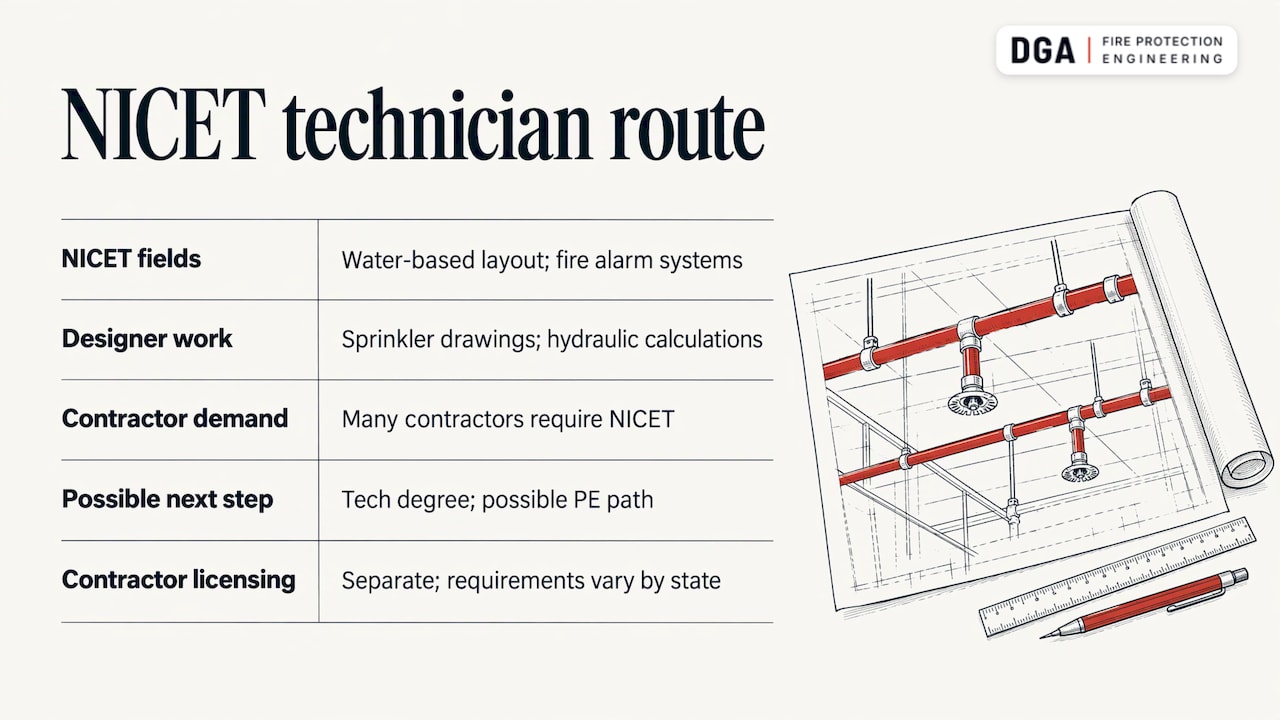
Not every career in fire protection runs through a PE license. The National Institute for Certification in Engineering Technologies (NICET) certifies technicians in fields such as water-based systems layout and fire alarm systems. Designers with NICET certification prepare sprinkler shop drawings and hydraulic calculations, and many contractors require it.
The NICET route suits people who want hands-on design and installation work. It can also be a starting point. Some technicians go on to earn an engineering-technology degree and pursue the PE path, though state rules on that degree type apply, as noted above. Check NICET’s own site for current levels and requirements, since certification programs are revised over time.
A note on contractor licensing: it is separate from engineer licensing. The National Fire Sprinkler Association’s state-by-state table shows that contractor, fitter, managing-employee and inspection requirements vary widely by state. If you plan to install systems rather than design them, that is the table to read.
How long does it take?
A realistic outline for the typical engineering-degree path looks like this:
| Stage | Typical length |
|---|---|
| Bachelor’s degree | Four years |
| FE exam | Near the end of the degree |
| Supervised experience | About four years (engineering degree), five to eight years (engineering-technology degree) |
| PE exam and licensure | After experience is approved by the board |
A master’s degree in engineering usually earns one year of experience credit, so graduate study can shorten the post-degree wait. It also lets career changers from other engineering fields build fire-specific knowledge quickly.
What about starting later in life? Nothing in the licensing path sets an age limit. The requirements are education, experience and exams. People enter fire protection engineering from other engineering careers at all ages.
What about pay?
Salary depends heavily on region, employer type, licensure and experience. Published figures use different methods and years, so we do not quote one number here. NFPA’s career page cites SFPE data on average pay and reports that PE-licensed fire protection engineers earn more on average than those without a license. For a current view in your area, look at public job postings from cities and agencies, which often list pay ranges and separate entry-level positions from those requiring a PE.
Our perspective
Hiring and mentoring engineers has shaped how we think about this career. The strongest early-career engineers did not just know the equations. They understood why a reviewer asks a question, and what a drawing has to show to answer it.
That judgment comes from working next to licensed engineers on real projects. A licensed PE stays on every project we take, from first scope to final stamp, and that is also the right environment for a candidate building experience toward the PE exam.
Our advice to students: learn fire dynamics well, then learn how codes are applied by the people who enforce them. Those two skills together are what turn a degree into a career.
DGA Fire Protection Engineering
Work with an engineering team
If you are on the other side of the table, a developer, owner or architect who needs fire protection design, code consulting or plan review, our engineers handle inquiries directly, with no sales desk. Our fire protection engineering design service covers sprinkler, alarm, smoke control and related systems for projects in New York, New Jersey, Pennsylvania, Maryland and Delaware.

And if you are considering joining the profession, see our fire protection engineering careers page.
FAQ
Do I need a fire protection engineering degree to become a fire protection engineer?
No. A dedicated degree is the most direct route, but SFPE also recognizes engineering-technology programs and entry from other engineering backgrounds. Mechanical and civil engineers often add fire-specific graduate study or learn on the job. Check your state board, since degree type can change the experience you need.
How many years of experience do I need before the PE exam?
SFPE gives a typical four years after an engineering bachelor’s degree and five to eight years after an engineering-technology bachelor’s degree. A master’s degree usually earns about one year of credit. NCEES designs the exam for engineers with at least four years of post-college experience. Your state board makes the final call.
What is on the PE Fire Protection exam?
NCEES lists 85 questions in a single-day, computer-based session, with a 9.5-hour appointment and 8.5 hours of exam time. The content follows the NCEES exam specifications, which you should download and study from. Read the NCEES page for current test dates.
Is a NICET certification the same as a PE license?
No. NICET certifies technicians, including designers who prepare sprinkler and alarm drawings. A PE license is a state credential that lets an engineer offer services to the public and seal engineering documents. Some people hold both over a career.
Do licensing rules differ by state?
Yes. SFPE says education and experience requirements vary, and examples such as Hawaii’s supervision rule and Kentucky’s six-year requirement for graduates of ETAC-accredited programs show how specific they can be. Always confirm with the board in the state where you want to practice.
More in The FPE Profession
Sources
- NFPA: Learn About a Career as a Fire Protection Engineer
- SFPE: Core Competencies
- SFPE: Pathways to a Career in FPE
- SFPE: Credentialing
- SFPE: Licensing & PE Exam
- ABET program name search
- NCEES: Fire Protection PE exam
- Hawaii Board of Professional Engineers, Architects, Surveyors and Landscape Architects minutes
- Eastern Kentucky University: Path Cleared for EKU Fire Protection Engineer Grads
- NFSA: State-by-State Contractor Licensing
Recommended
- Working with a Fire Protection Engineer: Fire Protection Guides and Code Questions
- Fire Protection Engineering Careers
This article is general information from DGA Fire Protection Engineering, not engineering advice for a specific building or project. Code requirements vary by jurisdiction and edition. Confirm with the authority having jurisdiction or a licensed fire protection engineer before acting on it.