Features & Perspectives
BLEVE Explained: How a Boiling Liquid Explosion Happens
A BLEVE (pronounced “blev-ee”) is a boiling liquid expanding vapor explosion. It happens when a closed vessel holding a liquid above its normal boiling point fails suddenly, the pressure drops to atmospheric, and the liquid flashes into vapor almost at once. The result is a pressure wave and flying fragments. If the contents are flammable, a fireball follows. Fire heating the vessel shell is the classic trigger, and cooling water on the shell is the classic defense.
This article explains the physics step by step, the role of the shell, the relief valve and cooling water, and what a fireball means for people nearby. It is written for engineers, students, plan reviewers, operators and owners who want to understand the mechanism. It is not a guide to what a code requires.
TL;DR
- A BLEVE needs a sealed vessel, a liquid held as liquid by pressure above its normal boiling point, and a sudden loss of containment.
- Fire is a common trigger. Flames on the vapor space weaken the steel, and the shell can fail below its design pressure.
- When the shell opens, the liquid flash boils. The harm comes from the pressure wave, flying pieces and, for flammable contents, a fireball.
- Cooling water applied to the shell, and thermal protection, slow the heating that leads to failure. A relief valve limits pressure but cannot restore steel strength.
- You can estimate fireball size with our free fireball calculator.
Table of Contents
- What the code requires today
- What BLEVE means
- The physics, step by step
- Why a flammable BLEVE makes a fireball
- Can a propane tank BLEVE?
- Conditions that must line up
- How cooling water and relief valves reduce the risk
- What this means for different readers
- Where DGA can help
- Our perspective: protect the shell, not just the pressure
- FAQ
- Sources
What the code requires today
OSHA’s Process Safety Management standard, 29 CFR 1910.119, applies to processes with listed highly hazardous chemicals at or above threshold quantities and to certain flammable gases and liquids. For LP-gas and other hazardous materials storage requirements, see our Hazardous Materials hub.
What BLEVE means
The name is a description of the event, word by word.
- Boiling liquid: the contents are a liquid that is hotter than its normal boiling point.
- Expanding vapor: when the vessel opens, that liquid turns to vapor and expands violently.
- Explosion: the expansion is fast enough to produce a blast.
Transport Canada describes a BLEVE as a physical explosion involving a pressure liquefied gas stored as a liquid under pressure. If the container fails with a sudden loss of containment and a sharp pressure drop, the release of vapor and boiling liquid can be explosive. The hazards it lists are blast, flying projectiles and a vapor cloud.
Note the word “physical.” A BLEVE is a failure of a pressurized container and a change of state from liquid to vapor. It is not, by itself, a chemical reaction. The fuel does not have to burn for a BLEVE to occur. Water, for example, can produce one. Burning adds the fireball when the contents are flammable.
The physics, step by step
1. Pressure keeps the liquid a liquid
Many common fuels and refrigerants are gases at room temperature and atmospheric pressure. We store them as liquids by compressing them into a vessel. Transport Canada gives a useful example: at 68°F (20°C), propane is kept liquid by a pressure of 121 psi (834 kPa). Inside the tank, liquid and vapor sit in balance. The vapor pressure depends on temperature.
2. Heat raises the temperature and the pressure together
In a closed container, the liquid can be heated far above its normal boiling point, and the pressure rises with temperature. This is the first piece of the physics. The liquid is now superheated relative to atmospheric conditions. Superheat means the liquid is hotter than the temperature at which it would boil if it were open to the air. It stays liquid only because the vessel holds it under pressure.
Think of the vessel as a lid on stored energy. The hotter the liquid, the more energy is waiting for the lid to come off.
3. The shell weakens
Steel loses strength as it gets hot. In a fire, the part of the tank wall that touches liquid stays relatively cool, because the liquid absorbs heat as it boils. The part of the wall above the liquid level, the vapor space, does not have that benefit. Vapor carries heat away poorly, so the metal there can get very hot.
The NFPA-derived material hosted by Texas A&M describes how fire impingement above the liquid level can weaken the vessel so that internal pressure fails it. AIChE’s Process Safety Beacon makes the same point from the process-safety side: exposing the vapor space to flames heats and weakens the metal, so the vessel can fail below its design pressure. The tank does not need to be over-pressured. It needs to be weak enough.
4. The vessel fails
Fire is not the only route. AIChE lists several causes of a BLEVE: excessive pressure, mechanical impact or corrosion damage, and exposure to external fire. The Texas A&M page adds that mechanical damage such as a derailment or traffic accident can also start a BLEVE.
The definition on that page is specific. The liquid has to be well above its atmospheric boiling point, and the vessel ruptures into two or more pieces. A small leak or a vented relief valve is not a BLEVE.
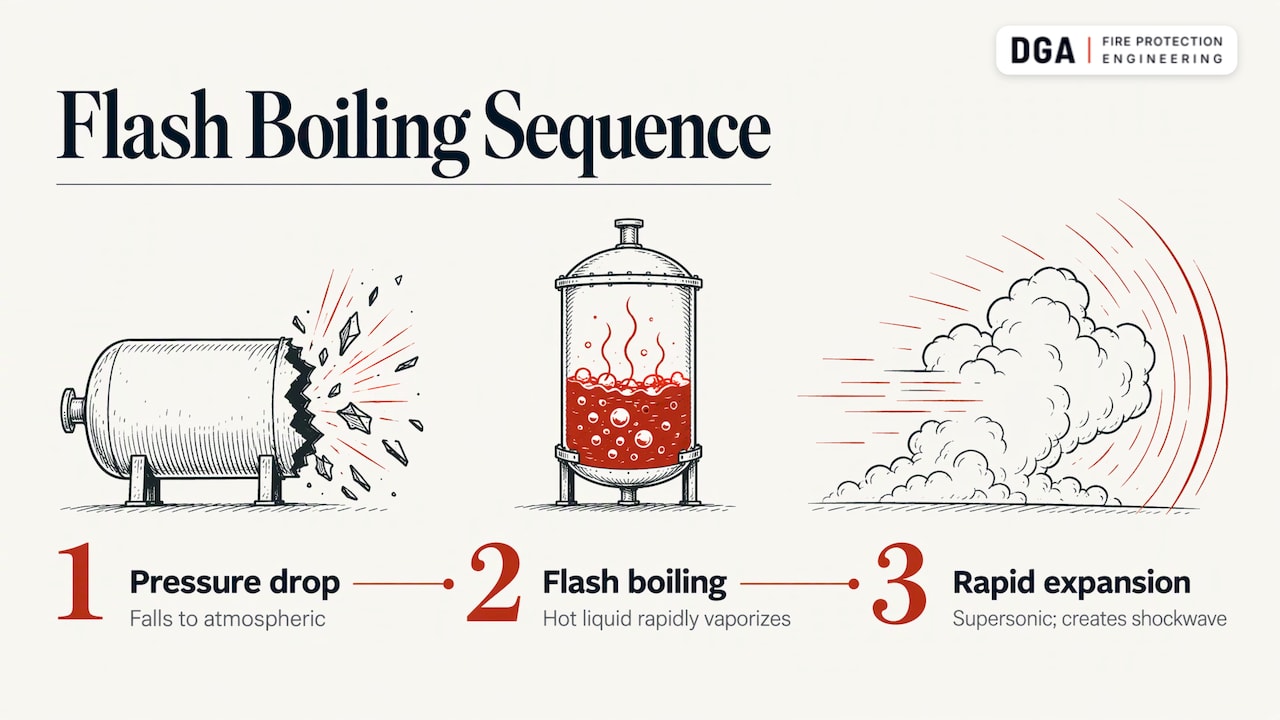
5. The liquid flash boils
The moment the shell opens, the pressure on the liquid surface falls. AIChE says it drops immediately to atmospheric and the hot liquid boils rapidly, generating a large quantity of vapor. Lawrence Berkeley National Laboratory describes the same step: once the pressure on the liquid is not enough to prevent boiling, the liquid flash boils, expanding at supersonic speeds and creating a shockwave. It also notes that the hotter the liquid before failure, the larger the explosion.
This is the heart of the event. Almost all the energy comes from the stored superheated liquid changing state in a fraction of a second.
6. Pressure wave, fragments and fireball
AIChE sums up the damage: it comes from the pressure wave and flying pieces of the vessel and piping. If the material is flammable, it may ignite and form a large fireball.
Fragments deserve special attention. Transport Canada states that a large tank BLEVE can throw fragments, pipes and debris 1,000 meters (about 3,300 ft) and more. The Texas A&M page describes debris traveling hundreds of feet with tremendous force. Tank sections can behave like rockets, because escaping vapor pushes them.
Why a flammable BLEVE makes a fireball
When the contents are fuel, the flash-boiled cloud of vapor and fine liquid droplets mixes with air and ignites. The cloud is rising and expanding as it burns. That gives the rounded, rising shape people recognize from footage.
The main hazard from the fireball is radiant heat. People and combustible materials at a distance can be exposed to intense heat for a short time. The fireball is brief, but it can ignite nearby buildings, vehicles and vegetation. That secondary ignition is one reason a BLEVE at a facility is rarely a single event.
The size of the fireball grows with the mass of fuel released. This is why engineers treat the quantity of liquefied flammable gas in one vessel as a key number when they study a site. Our fireball calculator lets you see how that quantity changes the estimate.
How accurate are fireball distances?
Not very, and the best references say so. The emergency response guidebook data from NOAA’s CAMEO Chemicals states that fireball radius and response distances are based on mathematical equations and are approximate. The equations assume a spherical fireball, which is not always the case. The same page says the risk rises rapidly the closer you are.
It also notes that evacuation distances assume particular launch angles for a tank, and that the distances may be very large and impractical in highly populated areas. For an engineer, the lesson is to treat any single distance as an estimate with a range around it.
Can a propane tank BLEVE?
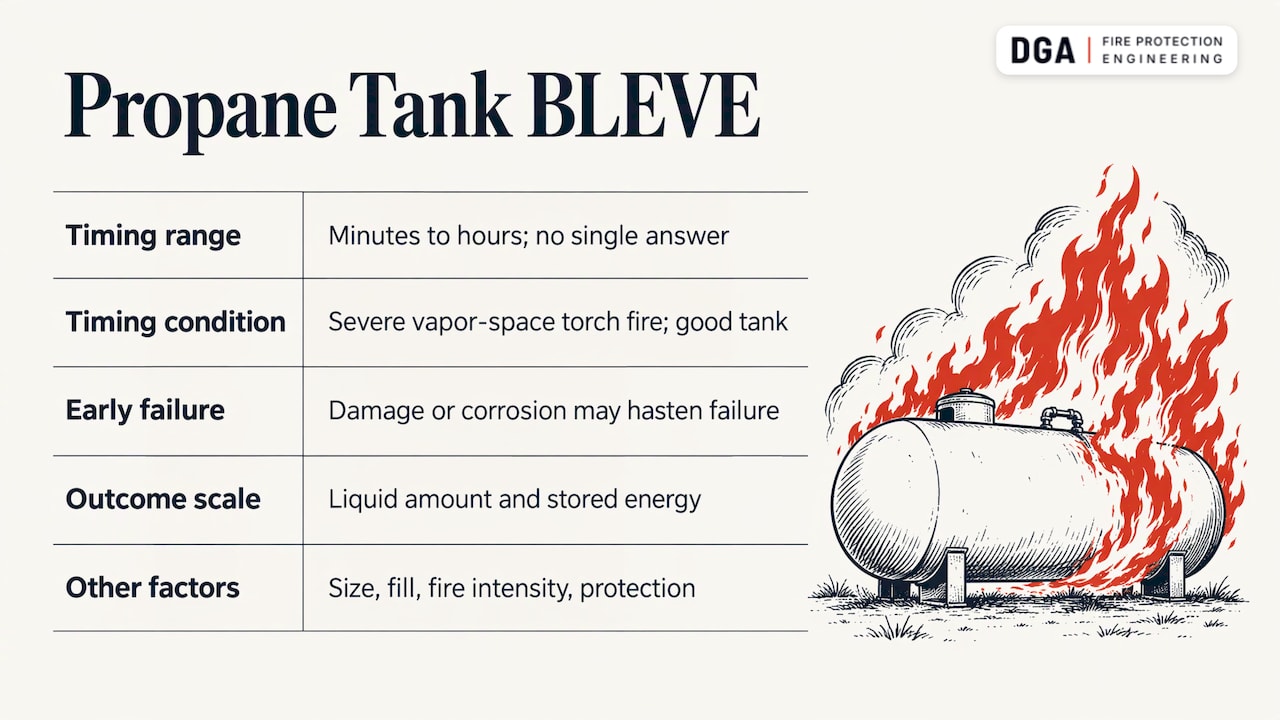
Yes. Propane is a pressure liquefied gas, and a propane tank is the textbook example. Transport Canada explains the sequence for LPG tanks: flames on the side and top of the tank vaporize liquid inside and raise pressure. Fire can also heat the tank above the liquid level and weaken the steel critically.
How long does it take? There is no single answer. The Emergency Response Guidebook material states that minimum time to failure assumes severe torch-fire impingement on the vapor space of a tank in good condition. It adds that tanks can fail sooner if damaged or corroded, and times range from minutes to hours. Tank size, fill level, the fire’s intensity, and any protection on the tank all change the outcome.
Size matters in another way. A small cylinder and a rail tank car both can fail, but the consequences scale with the amount of liquid and the energy it stores.
Conditions that must line up
Putting the sources together, a BLEVE needs these conditions:
| Condition | What it means |
|---|---|
| Closed pressure vessel | A tank, cylinder, tank car or process vessel that holds the contents under pressure |
| Liquid above its normal boiling point | The contents are stored as a liquid only because of the pressure |
| A way to fail | Fire weakening the shell, impact, corrosion or overpressure |
| Sudden loss of containment | The shell opens quickly, so pressure drops to atmospheric in an instant |
If any link is missing, you do not get a BLEVE. This is also why prevention efforts focus on the heating and the shell.
How cooling water and relief valves reduce the risk
Cooling water keeps the steel strong
The aim of cooling water is not to put out the fire. It is to keep the shell cool enough to hold its strength. AIChE says that water-spray systems, such as fixed deluge systems or fire-water monitor nozzles, are effective ways to keep vessels cool enough to maintain mechanical integrity when exposed to fire.
The Texas A&M page says the most effective way to reduce the potential for a BLEVE is applying large quantities of water to the affected tanks. That takes a large supply of water available for a long time. It also favors unattended hose stream or monitor devices, which keep firefighters out of the exposure zone. The page gives a minimum of 500 gpm (about 1,900 L/min) at each point of flame impingement from unmanned master streams.
Two points matter for designers and operators:
- Water has to be applied directly to the vessel exposed to the flame, and it has to be continuous. A dry patch can heat up quickly.
- The water supply is part of the protection. A system with nozzles but no reliable water supply will not do the job. Our guide on sizing a fire protection water storage tank shows how supply volume is approached.
The guidebook also gives a rule of thumb for cooling flow based on tank capacity. Its authors warn that the data are approximate and should be used only with extreme caution, and that they must not be used to risk life. We do not repeat the formula here for that reason. Treat any such figure as a screening number, not a design basis.
Thermal barriers cut the heat input
Cooling water is active protection. Thermal protection is passive. The guidebook states that tanks with thermal barriers or water spray cooling significantly increase the times to failure, and that a thermal barrier reduces heat input by a factor of ten or more. Passive protection works without anyone arriving or any valve opening, which is its advantage in the first minutes of a fire.
What a relief valve does and does not do
A pressure relief valve opens at a set pressure and vents vapor to keep the pressure inside the vessel from exceeding a safe limit. It is a required safeguard on vessels like these, and it handles overpressure from ordinary heating very well.
In a fire, the problem is different. The metal in the vapor space is getting weaker while the valve holds the pressure at its set point. The AIChE point applies here: the vessel can fail below its design pressure when flames weaken the steel. A relief valve cannot restore the strength of hot steel. It buys time and reduces pressure, but it works best together with cooling water and thermal protection, which address the shell itself.
A valve that is venting burning fuel is also a sign of an active fire at the tank, not a sign that the tank is safe.
What this means for different readers
Engineers and students. Treat a BLEVE as three linked calculations: vessel heating and thermal response, release energy, and consequence (blast, fragments, radiant heat). Each has uncertainty. The sources agree on the mechanism and disagree, in the details, on distance and time.
Plan reviewers and fire marshals. The questions to ask at a site with liquefied flammable gas are about exposure and protection: what could put flame on the vessel, how is the vessel protected, and what is the water supply.
Operators, owners and property managers. The practical issues are impact protection, housekeeping near tanks, and keeping combustibles away from vessels. Corrosion and damage matter because, as the guidebook notes, damaged or corroded tanks may fail earlier.
Insurance and loss control. The same factors drive exposure: contents, quantity per vessel, protection, and the response plan.
Developers of energy storage and data centers. These facilities often sit near fuel storage for backup power or have gas-based systems. Check how neighboring pressure vessels could be affected and how your own layout separates people and equipment from them. See our pages on energy storage fire protection and data center fire protection.
Where DGA can help
When a project involves liquefied flammable gas, a hazardous materials area or a question about how fire could expose a pressure vessel, a licensed Professional Engineer stays on the work from first scope to final stamp. Our fire protection engineering design service covers commercial, industrial, warehouse and cold storage buildings. Engineers, not a sales desk, answer inquiries, and code questions get same-day answers.

If you need an independent look at a design, our third-party and peer review service is built for that. To talk to an engineer, contact us.
Our perspective: protect the shell, not just the pressure
The most useful habit we can teach about BLEVEs is to ask which part of the vessel is under attack. Pressure is easy to see on a gauge. Steel temperature is not. A design that only manages pressure can leave a hot, weakened shell holding its contents with nothing to spare.
We look at the whole chain. What can put flame or impact on the vessel? How long can it take for the shell to reach a dangerous temperature? Is the cooling water supply sized and located so it is still working at the minute it matters? And how far does the consequence reach if the protection fails?
This is the kind of question a licensed Professional Engineer should answer at the start of a project, when layout and water supply are still easy to change. The same applies to a code question about a hazardous materials area. Asking early costs less than redrawing late, and it gets the design to the authority having jurisdiction with the reasoning already on paper.
Fire modeling and performance-based design are part of how we approach exposure questions on complex sites. A BLEVE is rare, but the thinking behind it, heat, strength and consequence, applies to every pressure vessel near a fire.
DGA Fire Protection Engineering
FAQ
What does BLEVE stand for?
It stands for boiling liquid expanding vapor explosion. It describes a pressure vessel that fails while holding liquid above its normal boiling point. The liquid flashes to vapor as the pressure drops, which produces a pressure wave and flying fragments. A fireball follows if the contents are flammable.
Can a propane tank BLEVE?
Yes. Propane is stored as a liquid under pressure, so a tank exposed to fire can heat, lose strength in the vapor space and fail. Time to failure ranges from minutes to hours, depending on the fire, the tank’s condition and any protection.
Does a BLEVE always cause a fireball?
No. A fireball needs flammable contents that ignite. A BLEVE of a non-flammable liquid still produces a pressure wave and fragments. The LBL guidance describes the flash boiling and shockwave for any superheated liquid in a failed container.
How far can fragments travel?
For a large LPG tank, Transport Canada says fragments and debris can travel 1,000 meters (about 3,300 ft) and more. Distances depend on tank size, fragment shape and launch angle, so treat any figure as an estimate.
How is a BLEVE prevented?
By keeping the shell from reaching a weakening temperature and by avoiding damage to the vessel. Fixed water spray, monitors and thermal barriers are the main measures named in the sources above. For the storage rules that apply to LP-gas, see the Hazardous Materials hub. To test fireball size, try the fireball calculator.
Sources
- BLEVE – Response and Prevention, Transport Canada
- Process Safety Beacon: BLEVE!, AIChE (November 2009)
- Pressurization and Explosion Hazards, Lawrence Berkeley National Laboratory EHS
- BLEVE, NFPA vapor explosion report content, Texas A&M NCSP
- BLEVE Safety Precautions, ERG 2024, NOAA CAMEO Chemicals
- 29 CFR 1910.119, Process safety management, OSHA
Recommended
- Flashover vs. Backdraft: How Two Different Fire Events Work
- Flammable Liquid Classification (NFPA 30)
- BLEVE Fireball Calculator (CCPS Method)
- Time to Ignition Calculator
This article is general information from DGA Fire Protection Engineering, not engineering advice for a specific building or project. Code requirements vary by jurisdiction and edition. Confirm with the authority having jurisdiction or a licensed fire protection engineer before acting on it.