Features & Perspectives
Number One Cause of House Fires: What the Data Shows
Cooking is the number one cause of house fires in the United States. The U.S. Fire Administration (USFA) estimates that cooking caused 160,300 residential building fires in 2024, far ahead of any other cause. It is the leading cause of fires, though not of deaths. For deaths, the ranking changes, and that gap is the most useful thing an engineer, owner or plan reviewer can take from the data.
This article is current as of November 2026. It uses the most recent national figures published by USFA and the National Fire Protection Association (NFPA), and each number names its source and period.
TL;DR
- Cooking is the leading cause of U.S. home fires. USFA’s 2024 estimates put it at 46.7% of 343,000 residential building fires.
- Heating equipment is the second leading cause in NFPA’s data. Electrical malfunction and unintentional or careless acts follow in USFA’s.
- Smoking materials, not cooking, led home fire deaths in NFPA’s 2019-2023 data. Many of those fires start while people are asleep.
- Unattended cooking is the most common factor in cooking fires. Working smoke alarms and residential sprinklers reduce losses once a fire starts.
- “Number one” depends on what you count: fires, injuries or deaths.
Table of Contents
- What counts as a house fire in the statistics
- The ranking by number of fires
- Why cooking leads
- Number one for deaths is a different answer
- Heating, electrical and the rest of the list
- The season matters
- What reduces losses
- How to read these numbers
- Our perspective
- Fire protection for multifamily and residential occupancies
- FAQ
- Sources
What counts as a house fire in the statistics
The two main sources use slightly different definitions, so their numbers do not match exactly.
NFPA reports on “home structure fires.” That term covers fires in one- and two-family homes, apartments and similar dwellings. It covers fires reported to fire departments. NFPA’s 2019-2023 report found that home structure fires averaged 328,590 a year. They caused an average of 2,600 civilian deaths and 10,770 injuries a year. Home fires were 24 percent of all reported fires, but they caused 70 percent of civilian fire deaths.
USFA reports on “residential building fires.” These are estimates drawn from the National Fire Incident Reporting System (NFIRS), a database of fires that fire departments report. USFA’s 2024 estimate is 343,000 fires, 2,975 deaths and 9,225 injuries.
Both sources count fires that fire departments responded to. Small fires that residents put out themselves are mostly missing. That matters for cooking, because many kitchen fires are small and never reported.
The ranking by number of fires
USFA’s 2024 estimates give this order for residential building fires, drawn from its cause tables:
| Rank | Cause | Estimated fires, 2024 |
|---|---|---|
| 1 | Cooking | 160,300 |
| 2 | Other unintentional or careless | 34,400 |
| 3 | Heating | 27,200 |
| 4 | Electrical malfunction | 26,400 |
As a share of all fires, USFA’s statistics page reports cooking at 46.7%, unintentional or careless acts at 10.0%, heating at 7.9%, electrical malfunction at 7.7% and intentional fires at 4.7%. The same page gives these 2024 percentages.
The pattern is stable. The prior-year data shows 167,800 cooking fires in 2023. It lists cooking as the leading cause across the whole ten-year period from 2014 to 2023.
NFPA’s numbers agree on the leader. Its 2019-2023 report says cooking was the leading cause of reported home structure fires. The average was 159,400 fires a year, with 430 civilian deaths and 3,850 civilian injuries. NFPA lists heating equipment second, at an average of 65,000 fires a year.
The lists differ below the top because the agencies group causes differently. NFPA keeps heating as its second category. USFA has a broad “other unintentional or careless” category that ranks between cooking and heating. The top spot is the same in both.
Why cooking leads
Cooking is the one daily activity in a home that deliberately combines a heat source, fuel and a person who is often doing something else. Three conditions explain most of the pattern.
Ignition sources are always on. A range or cooktop is designed to get food hot enough to cook. If food, oil or grease stays on the heat too long, it can reach ignition. NFPA’s Home Cooking Fires report found that ranges or cooktops were involved in 53 percent of reported home cooking fires. They were involved in 88 percent of cooking fire deaths and 74 percent of cooking fire injuries (2017-2021 data).
Fuel is close by. Cooking oil and grease burn readily once hot enough. Paper towels, pot holders, packaging and loose sleeves sit within arm’s reach of the burner. A small fire in a pan can reach these items quickly.
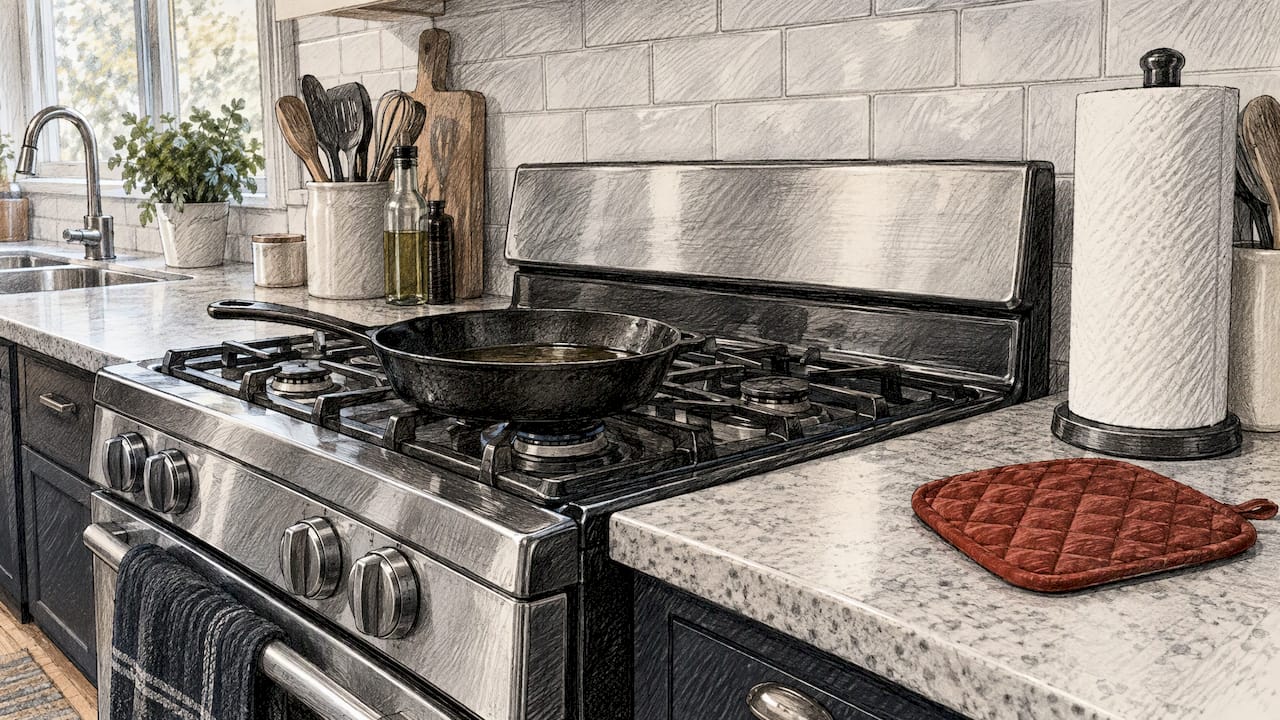
Attention is divided. Unattended cooking is the leading factor. NFPA’s December 2025 press release, covering 2020-2024, reports that unattended equipment was a factor in 25 percent of reported home cooking fires and 43 percent of the associated deaths. Leaving the room to answer a phone, or falling asleep with food on the stove, gives a small fire time to grow.
How a kitchen fire grows
Fire engineers describe early fire growth with a simple idea: heat output rises with the square of time. This is the “t-squared” model. A fire that starts small can double and double again before anyone sees it. The practical lesson is the same one the statistics teach. The first minutes decide the outcome, and someone in the room can change those minutes.
If you want to see how growth rate changes the time available to detect a fire, the free t-squared fire growth calculator lets you compare slow, medium, fast and ultrafast growth.
Number one for deaths is a different answer
The fire with the highest count is not the fire that kills the most people. NFPA’s 2019-2023 data shows that smoking materials were the leading cause of home fire deaths. An average of 15,200 smoking-material fires a year caused 600 deaths and 1,050 injuries.
Cooking was involved in many more fires, but fewer deaths: 430 a year on average. Heating equipment also averaged 430 deaths a year in the same report.
Who dies from which cause also varies by age. NFPA’s report on victims by age and gender found that smoking materials led deaths only for people aged 45 to 84. Cooking was the leading cause of fire death for adults aged 20 through 44 and for those 85 and older. The same report found that 34 percent of smoking fire fatalities occurred while the victim was sleeping.
USFA’s death tables use different categories and tell a related story. Its 2023 data lists 625 deaths from other unintentional or careless fires. That category was the leading cause of residential fire deaths in 9 of the 10 years from 2014 to 2023. Deaths in that category rose 50% over the period.
USFA’s multiple-fatality report (2021-2023) shows the gap clearly. “Other unintentional, careless” action led residential multiple-fatality fires at 24%. By comparison, cooking was the predominant cause of nonfatal residential fires at 48%.
In short:
- Most fires: cooking.
- Most deaths (NFPA, 2019-2023): smoking materials.
- Most multiple-fatality fires (USFA, 2021-2023): other unintentional or careless acts.
The reason is timing. A cooking fire usually starts while someone is awake and nearby, so it is often noticed and put out. A fire that starts while people sleep, or one that involves furniture and bedding, gives occupants less warning. USFA found that residential multiple-fatality fires occurred most often between midnight and 6 a.m. Being asleep was the leading human factor contributing to ignition in those fires.
Heating, electrical and the rest of the list
Heating equipment
Heating is the second leading cause in NFPA’s data and third in USFA’s 2024 estimates. It is also seasonal. NFPA’s December 2025 release reports that 46 percent of home heating fires occur from December through February. Space heaters and heating stoves were involved in 47 percent of home heating equipment fires, 73 percent of deaths and 70 percent of injuries.
The common thread is fuel too close to a heat source. USFA’s Home Fire Safety brochure says to keep anything that can burn at least three feet (0.9 m) away from fireplaces, wood stoves, space heaters and radiators. It also advises having the furnace, chimney and chimney connector inspected by a professional each winter.
Electrical malfunction
Electrical malfunction ranked fourth in USFA’s 2024 estimates, with 26,400 fires. It was also among the leading causes of multiple-fatality fires, at 12% in the 2021-2023 report. These fires start inside walls, cords and equipment, where residents cannot see the problem developing. That makes them harder to spot early.
Smoking and candles
Smoking is the leading cause of home fire deaths in NFPA’s data, even though it causes far fewer fires than cooking. Candles are on the standard top-five list used by public health agencies, which follows the same order as the data: cooking, heating, electrical, smoking, candles.
Furniture and bedding
One more finding explains why deaths have not fallen as fast as fires. NFPA reports that the number of home fires and home fire deaths has been cut in half since 1980, while the death rate per 1,000 home fires has stayed consistent. For fires that began with upholstered furniture, mattresses or bedding, the death rate in 2019-2023 was more than double that of 1980-1984. Fewer fires have not made each fire less deadly.
The season matters
Holiday weeks change the picture. NFPA’s December 2025 release names Thanksgiving as the leading day for home cooking fires. It also points to Christmas trees, decorations with candles or electrical lighting and heating equipment as contributors to higher risk in the holiday period.
The same release says that an estimated 48 percent of home structure fires, 35 percent of home fire injuries and 16 percent of home fire deaths involved kitchen and cooking equipment (2020-2024).
What reduces losses
No single measure prevents every fire. The agencies’ guidance falls into three layers: prevent ignition, detect early, and control or escape the fire.
Prevent ignition
- Stay in the kitchen while frying, grilling or broiling. NFPA’s Steps to Fire Prevention guide gives this advice, and it is consistent with the unattended-cooking data.
- Keep space heaters at least 3 feet (0.9 m) from anything that can burn. The same NFPA guide gives this distance.
- Keep combustibles away from the cooktop. Move towels, packaging and loose items out of the cooking zone.
Detect early
Smoke alarms shorten the time between ignition and response. NFPA’s guide recommends alarms on every level of the home, inside each bedroom and outside each sleeping area. USFA’s multiple-fatality report gives similar guidance and adds that alarms belong in the basement. That matches the midnight-to-6 a.m. pattern in the data.
For fire alarm design and how detection systems connect, see our fire alarm insights hub.
Control and escape
Two measures help once a fire is burning.
- A planned and practiced escape route. NFPA’s guide recommends planning and practicing escape from fire and smoke.
- A closed bedroom door. USFA’s report notes that research has shown a closed door to sleeping rooms could potentially save lives. It references the UL Fire Safety Research Institute’s “Close Before You Doze” program.
Residential sprinklers add automatic control. In general terms, a sprinkler operates at the fire’s location, soon after the heat reaches it. That keeps the fire small and gives people more time to leave. For how sprinkler systems work at a general level, start with our sprinkler systems insights hub.
How to read these numbers
A few cautions help when you use the statistics in a report, a design brief or a risk assessment.
- Name the period. NFPA’s 2019-2023 averages and USFA’s single-year 2024 estimates will not match, and they should not.
- Name the count. Fires, injuries and deaths each have a different leader.
- Do not mix definitions. NFPA’s “home” and USFA’s “residential building” overlap but are not identical.
- Remember what is reported. Both datasets rely on fire department responses.
- Match the cause list to the source. USFA’s “other unintentional or careless” category has no exact equivalent in NFPA’s cause list.
These datasets describe houses and apartments. Commercial, industrial and storage occupancies have different fire causes and different hazards, and they should not be assessed from home fire figures.
Our perspective
Home fire data is a lesson in where time is lost. A cooking fire is common because ignition is routine. A fatal fire is different, because it often starts when no one is watching and the warning arrives late.
We see the same principle in the buildings we design for. A fire protection system works on time: how quickly a fire is detected, how quickly occupants are told, and how quickly the fire is controlled. Each of those can be calculated and designed for. The statistics show what happens when any one of them is missing.
For multifamily and mixed-use projects, the home fire pattern is the starting point for design conversations. A licensed Professional Engineer stays on each of our projects from start to finish. That means the questions about detection, notification and automatic suppression get answered by the same person who stamps the design.
We also publish free calculators built from the SFPE Handbook, so engineers, students and reviewers can test fire growth and detection time themselves.
DGA Fire Protection Engineering
Fire protection for multifamily and residential occupancies
If you own, develop or manage multifamily housing, the home fire pattern applies to your buildings: kitchens in every unit, heating equipment, and residents asleep. Our team designs fire alarm, sprinkler and life safety systems for these projects. See our multifamily fire protection engineering page and our fire alarm system design service.

An engineer answers project inquiries directly, and you can reach us through the contact page at dgaconsulting.net/contact.
FAQ
What is the number one cause of house fires?
Cooking. USFA’s 2024 estimates list cooking as the leading cause of residential building fires, at 160,300 fires. NFPA’s 2019-2023 home structure fire data agrees, with an average of 159,400 cooking fires a year.
What is the number one cause of house fire deaths?
In NFPA’s 2019-2023 data, smoking materials were the leading cause of home fire deaths, averaging 600 deaths a year. USFA’s 2023 death tables rank “other unintentional or careless” first, with 625 deaths. The two agencies group causes differently, so the lists are not identical.
What are the top three causes of house fires?
USFA’s 2024 estimates rank them as cooking, other unintentional or careless acts, and heating. NFPA’s 2019-2023 report ranks cooking first and heating equipment second. Electrical malfunction and smoking appear in both datasets among the leading causes.
Why is unattended cooking so dangerous?
Oil, grease and food can ignite when left on heat, and a small fire grows quickly. NFPA’s 2020-2024 data shows unattended equipment was a factor in 25 percent of reported home cooking fires and 43 percent of the associated deaths. Staying in the kitchen while you fry, grill or broil keeps someone there to respond early.
When are house fires most likely?
For cooking, Thanksgiving is the leading day, according to NFPA. For heating, 46 percent of fires occur from December through February. For the deadliest fires, USFA found multiple-fatality fires happen most often between midnight and 6 a.m.
Sources
- Home Structure Fires, NFPA Research
- Home Structure Fires (oshomes report), NFPA
- Home Cooking Fires, NFPA
- Home fire victims by age and gender, NFPA Research
- December among leading months for U.S. home fires, NFPA press release
- Steps to Fire Prevention, NFPA
- Residential building fire estimate summaries (2015-2024), USFA
- Residential building fire causes (2015-2024), USFA
- Residential building fire causes (2014-2023), USFA
- Residential building fire death causes (2014-2023), USFA
- Statistics, USFA
- Multiple-Fatality Fires in Residential Buildings (2021-2023), USFA
- Home Fire Safety brochure, USFA
Recommended
- What Caused the Triangle Shirtwaist Fire, and Why It Killed 146
- What Fire Protection Does a Change of Occupancy Trigger?
- Flashover vs. Backdraft: How Two Different Fire Events Work
- Notable Fires That Changed the Fire Codes
This article is general information from DGA Fire Protection Engineering, not engineering advice for a specific building or project. Code requirements vary by jurisdiction and edition. Confirm with the authority having jurisdiction or a licensed fire protection engineer before acting on it.