Fire Science · Feature
Flashover vs. Backdraft: How Two Different Fire Events Work
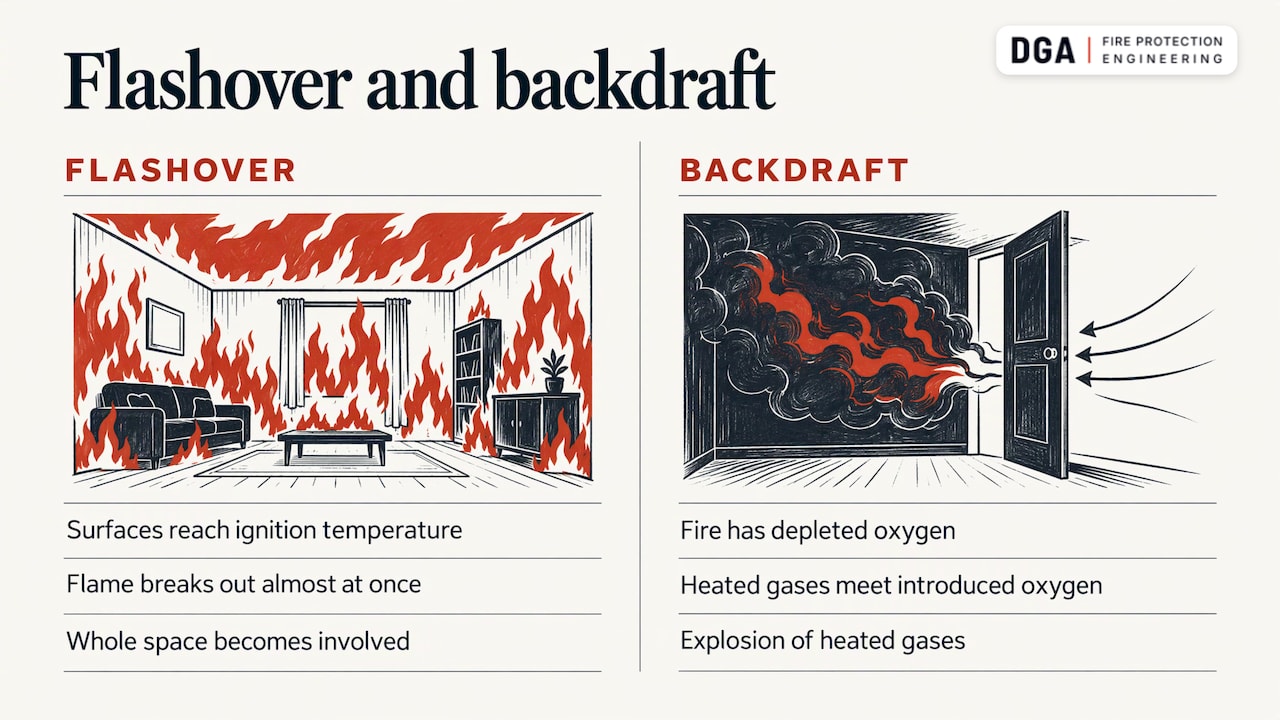
Flashover and backdraft are not the same event. Flashover is a thermal event: radiant heat from the smoke layer brings everything in a room to ignition at nearly the same time. Backdraft is a ventilation event: a fire starved of oxygen has filled a space with hot, unburned fuel gases, and a sudden inflow of air lets them ignite. One is driven by heat. The other is driven by air.
Both happen inside a compartment, which is the engineering term for an enclosed room or space. Both are fast. Both can be survived only by never being there when they happen. This article explains the physics of each, compares them side by side, and shows why fire protection engineers treat them as design inputs. It is an explanation of fire science, not tactical guidance for firefighters.
TL;DR
- Flashover is the near-simultaneous ignition of exposed combustible surfaces in a room once radiant heat from the hot upper layer is high enough. It is a temperature-driven transition to a fully developed fire.
- Backdraft is a rapid deflagration (a fast, explosive burn) of accumulated unburned gases when air reaches an oxygen-depleted, still-hot space. It is a ventilation-driven event.
- Flashover is tied to the growth stage of a fire. Backdraft is tied to the decay stage, after oxygen has been used up.
- Both can happen in the same incident, in different rooms, through different mechanisms.
- Engineers study both with compartment fire models and hand calculations, including the free flashover calculator on our site.
Table of Contents
- The short definitions
- How flashover works
- How backdraft works
- Flashover vs. backdraft side by side
- Related terms: rollover and smoke explosion
- Can both happen in one fire?
- Why ventilation changes everything
- How engineers use this in design
- Common misunderstandings
- Our perspective
- Working with an engineer on compartment fire questions
- FAQ
- Sources
The short definitions
Start with how the standards bodies word it. The National Fire Protection Association (NFPA) glossary describes flashover as the stage when all surfaces and objects in a space are heated to their ignition temperature and flame breaks out almost at once over the entire surface. The same glossary describes backdraft as an explosion of heated gases that occurs when oxygen is introduced into a space where the fire has depleted it.
NFPA 921, the guide for fire and explosion investigations, adds precision on flashover. It treats it as a transitional phase in compartment fire development in which exposed surfaces reach ignition temperature more or less simultaneously, so fire spreads rapidly and the whole space becomes involved. Fire Rescue 1 quotes that NFPA 921 definition in its flashover explainer.
Two words matter in those definitions. Flashover is about surfaces reaching ignition temperature. Backdraft is about gases meeting oxygen. Everything else follows from that difference.
How flashover works
Picture a fire that starts in one item, say a sofa, in a closed room. The flames heat the air above them. That hot air rises as a plume, hits the ceiling and spreads outward. A layer of hot smoke builds up and thickens, working its way down the walls.
That upper layer is the key. It radiates heat downward onto everything in the room: furniture, carpet, curtains, wall finishes. The contents begin to give off flammable vapors as they heat. This is called pyrolysis, the thermal breakdown of a solid into gases. Those vapors feed the fire, which makes more heat, which makes more radiation. Engineers call this a feedback loop.
At some point the loop tips. Objects far from the original fire reach their ignition temperature at nearly the same moment, and the whole room becomes involved. That tipping point is flashover.
The numbers engineers use
Two benchmarks are widely used for ordinary combustibles. Flashover is typically associated with an upper layer temperature of roughly 930 to 1,110 °F (500 to 600 °C) and a radiant heat flux at floor level of about 20 kilowatts per square meter (kW/m², or roughly 1.8 BTU/ft²·s). Heat flux is the rate of heat energy landing on a surface. Different fuels, room shapes and ventilation openings shift these values, which is why they are screening criteria and not exact thresholds. Our flashover calculator lets you test how room size and opening size change the heat release needed to reach that condition.
For scale, the NFPA description of flashover, as reproduced in Fire Engineering, notes that temperatures can climb as high as 1,000 °F (538 °C) near floor level within seconds. It adds that even a firefighter in full protective gear is unlikely to survive. Radiant heat at that level is also how other hazards are rated: Australia’s bushfire attack level ratings in New South Wales classify how much exposure a building site faces, a reminder that radiant exposure is a common language across fire problems.
Timing is not fixed
A popular claim says flashover arrives a set number of minutes after ignition. It does not. As Fire Engineering’s primer on flashover and backdraft puts it, there is no fixed time frame for flashover. The time depends on the fuel, the room geometry, the ceiling height, the ventilation and the ignition source. A room with a lot of fast-burning synthetic furnishings can get there quickly. A room with little fuel may never get there.
The transition itself is quick. Fire Rescue 1 reports that multiple sources put the time for the flashover transition at roughly 7 to 10 seconds. That is why the recognition of conditions beforehand matters more than any reaction during the event.
Where flashover sits in a fire’s life
A compartment fire is usually described in stages: ignition, growth, fully developed burning and decay. Flashover occurs mainly between growth and fully developed burning. The National Institute of Standards and Technology (NIST) notes, as cited in the Fire Engineering review, that it may also be possible during decay, when oxygen has been consumed but hot gases remain. That detail shows how blurred the lines can get in real fires.
How backdraft works
Backdraft starts from the opposite situation. Instead of a fire with plenty of air, imagine a fire in a tightly closed space that has used up most of the available oxygen. It burns low or smolders. Meanwhile it keeps producing hot, unburned pyrolysis products and carbon monoxide, and these collect in the space.
The compartment is now full of fuel, hot, and short on oxygen. Nothing is exploding because the mixture is too rich to burn. Then an opening appears: a window fails, a door is opened, a roof is breached. Air flows in as a gravity current, a dense stream of fresh air that moves along the floor. It mixes with the fuel-rich gases and creates a combustible mixture. Any ignition source, even a glowing ember, can set it off. The result is a rapid deflagration that pushes flame and pressure out through the opening.
That description follows the current definition discussed in a Forensic Fire Institute paper on backdraft knowledge, which draws on the work of Quintiere and of Pagni and Fleischmann.
What laboratory work says about thresholds
Experiments give a sense of how specific the conditions must be. A 2019 study in the journal Fire Technology by Wu, Santamaria and Carvel looked at the critical factors for the onset of backdraft. For the polypropylene fuel they used, the compartment’s highest temperature needed to be above 350 °C (662 °F) for auto-ignition of the gases. With a pilot source, mixtures could ignite down to about 320 °C (608 °F). Below 320 °C, backdraft did not occur.
The same study found that carbon monoxide concentration mattered. At least 0.6% in the compartment before the door opened was needed for backdraft without a pilot spark. Slightly below the critical temperature, a concentration above 2.8% and a pilot source were essential. These are results for one fuel in one test setup, not universal limits. They do show that backdraft needs a particular combination of hot, fuel-rich and oxygen-poor, and that it is not a vague catch-all for any dramatic fire event.
Backdraft is not limited to sealed buildings
Another myth holds that backdraft only occurs in airtight buildings. The Fire Engineering primer says a backdraft can occur in almost any enclosed space given the right conditions. Fire needs to burn in a ventilation-limited space long enough to build up unburned fuel. Tightness helps, but it is not a requirement for the physics.
Oxygen levels
Normal air is about 21 percent oxygen. According to the same primer, visible flame is reduced when oxygen falls below roughly 14 percent, while the room contents may still be at ignition temperature. They can erupt in flame when air is introduced. The explosive force depends on how much superheated gas is present and how much oxygen is let in. It can break windows, knock down walls and injure people nearby.
Flashover vs. backdraft side by side
| Flashover | Backdraft | |
|---|---|---|
| What it is | Transition to full room involvement as exposed surfaces ignite nearly at once | Rapid deflagration of accumulated unburned gases when air arrives |
| Driver | Heat: radiant feedback from the hot upper layer | Air: new oxygen entering a fuel-rich, oxygen-poor space |
| Cause | Growing fire heats the room contents to ignition temperature | Ventilation-limited fire builds up hot unburned fuel; an opening introduces air |
| Typical fire stage | Between growth and fully developed burning (possible in decay) | Decay stage |
| Warning signs | Rollover at the ceiling, intense radiant heat, dense dark smoke pushing out of openings, rapidly darkening smoke | Smoke that pulses or is drawn back in, stained or cracked glass, a small smoldering fire, hissing or whistling air movement |
| Timing | No fixed time; the transition itself takes seconds | Occurs after an opening is made; depends on gas build-up and mixing |
| What follows | A fully developed fire throughout the room, with heat flows into adjacent spaces | A pressure wave and fireball out of the opening, and often a fire that then burns freely with new air |
| Needs new air? | No; it can happen in a closed or partly ventilated room | Yes; it is triggered by the introduction of air |
The warning signs come from the NFPA descriptions in Fire Engineering’s review of fireground phenomena, which also notes that flashover is heat-driven while backdraft follows the introduction of air into a smoldering fire.
Related terms: rollover and smoke explosion
Two other terms often show up beside these. They are different events.
Rollover is flame traveling through the hot gas layer at the ceiling. NFPA describes it in its All About Fire guide as ignited fire gases or incompletely burned fuels that rise to the ceiling and spread horizontally. If nothing ventilates the room or cools the air, the guide says this condition leads to flashover. Rollover is therefore a flashover precursor, not a separate outcome.
Smoke explosion is the ignition of a mixture of smoke and air that has already formed in a space, such as a void or an adjacent room that the fire has filled with gas. It resembles backdraft in that unburned gases ignite, but it does not depend on an oxygen-starved fire receiving a fresh air supply. Investigators separate the two because the conditions that set them up are different.
Can both happen in one fire?
Yes. They are separate mechanisms, and a single incident can produce both. One room may flash over during its growth stage. A different part of the same structure, closed off and short of air, may later build up fuel-rich gases and produce a backdraft when it is opened. Fire investigator Randy Elmore makes this point in a comparison of the two events. Treating them as a single “flash fire” hides the cause, and the cause is what engineers and investigators need.
Why ventilation changes everything
Ventilation is the thread that ties the two events together. It controls how much oxygen a fire gets, how fast heat builds up and where hot gases go.
The UL Fire Safety Research Institute (FSRI) examined this in a 2010 study sponsored by the Department of Homeland Security. Its report says that ventilation, if used properly, improves visibility and reduces the chance of flashover or backdraft. It also says poorly placed or timed ventilation can increase a fire’s air supply and make it grow and spread rapidly. The point for building design is that the airflow paths in a building are part of the fire problem. Doors, windows, shafts, and the way smoke is managed all affect which of these events is possible.
Newer fuels add another wrinkle. In a 2025 safety advisory summarizing UL FSRI testing, the International Association of Fire Fighters notes that unburned battery gas in a ventilation-limited fire increases smoke flammability and can contribute to backdraft risk. It also says that venting a garage fire with a significant quantity of lithium-ion batteries in thermal runaway can produce very fast fire growth or a backdraft. That is one reason energy storage and electric vehicle spaces get close attention from engineers.
How engineers use this in design
We do not design to a flashover or a backdraft as an event to survive. We design so occupants have left, or the fire has been controlled, well before the conditions develop. Compartment fire physics shapes that work in a few concrete ways:
- Fire growth. How fast a fire grows determines how soon the upper layer becomes hot enough to matter. The t-squared fire growth calculator models that growth.
- Upper layer temperature. The compartment fire temperature calculator estimates the hot gas layer temperature in a room with given openings.
- Fuel loading. The fire load density calculator helps compare how much combustible material a space holds, which affects how long and how hot a fire can burn.
- Smoke management. Controlling where smoke goes changes both the hot layer and the airflow around a fire. Our Smoke Control hub covers the engineering of those systems.
When a project falls outside prescriptive rules, fire modeling and performance-based design lets an engineer test these dynamics directly for a specific building.
Common misunderstandings
“Backdraft is what happens after flashover.” Some summaries describe flashover as the ignition and backdraft as the explosion that follows. The physics does not work like that. They have different drivers and usually occur in different stages of a fire.
“Flashover happens at four minutes.” No fixed time exists. Fuel, geometry and ventilation set the pace.
“Backdraft needs a sealed building.” It needs a ventilation-limited space with accumulated fuel gas. Perfect tightness is not required.
“Full protective gear solves flashover.” Fire Rescue 1’s discussion of flashover notes that flashover temperatures often exceed the limits of protective equipment. Recognizing conditions early is the safeguard.
Our perspective
Most confusion about flashover and backdraft comes from treating them as two names for one dramatic moment. We find it more useful to ask what is driving the fire. If heat is feeding back on fuel, you are looking at the flashover pathway. If fuel gases have built up without air, you are looking at the backdraft pathway.
That distinction matters in design. It changes which questions we ask about a space: how fast could a fire grow here, how much hot gas could collect, where would air come from if an opening appeared, and how will smoke move. A licensed Professional Engineer stays on each of our projects from first scope to final stamp, so those questions are answered by the person who signs the work.
We publish free calculators built on published fire dynamics methods so that engineers, students and building owners can see how room size, fuel and openings shift these outcomes. When a building needs more than a hand calculation, our fire modeling work is built for that purpose.
DGA Fire Protection Engineering
Working with an engineer on compartment fire questions
If your project involves large open volumes, unusual fuel loads, energy storage, or spaces where smoke movement is a concern, a fire protection engineer can analyze the compartment fire behavior directly. We are licensed in New York, New Jersey, Pennsylvania, Maryland and Delaware, and our fire modeling and performance-based design service covers this kind of analysis.

For broader design work, see our fire protection engineering design page, or talk to an engineer at our contact page.
FAQ
What is the main difference between flashover and backdraft?
Flashover is caused by heat. Radiant energy from the hot upper layer brings exposed surfaces to ignition so the whole room becomes involved. Backdraft is caused by air. Fuel-rich gases in an oxygen-starved space ignite explosively when new air arrives. The first is a thermal transition, the second a ventilation event.
Can a backdraft happen without a flashover?
Yes. They have separate mechanisms. A backdraft needs a ventilation-limited fire that has accumulated unburned gases, then an opening that introduces air. A room that never reached flashover can still meet those conditions. The reverse is also true: flashover does not need an air inflow event.
Does flashover always happen within a few minutes?
No. There is no fixed time frame, according to Fire Engineering’s primer on the subject. Fuel type, room size, ceiling height and ventilation all affect how fast a fire grows. Some fires never flash over. The transition itself, once it begins, is very fast.
What is rollover, and is it the same as flashover?
No. Rollover is flame traveling through the hot gas layer along the ceiling. NFPA describes it as a condition that leads to flashover if the room is not ventilated or cooled. It is a warning stage, not the full-room ignition itself.
Where can I test these ideas with real numbers?
Try our free flashover calculator. It lets you change room dimensions and openings to see how they affect the heat release associated with flashover conditions. For how smoke is managed in buildings, our Smoke Control hub is the next stop.
Sources
- NFPA Glossary, Reporter’s Guide to Fire
- NFPA, All About Fire: A Guide for Reporters
- Fire Rescue 1, Flashover facts
- Fire Engineering, Differentiating the Fireground Phenomena
- Fire Engineering, Flashover and Backdraft: A Primer
- Wu, Santamaria and Carvel, Fire Technology (2019), critical factors for backdraft onset
- Forensic Fire Institute, current knowledge and training regarding backdraft
- UL Fire Safety Research Institute, 2010 DHS ventilation study report
- IAFF Safety Advisory (2025)
- Backdraft vs Flashover: Key Differences Explained
- Bushfire BAL ratings in NSW
Recommended
- Flashover Calculator (NFPA 555)
- Fire Plume Temperature Calculator (NFPA 92)
- Performance-Based Design & Fire Modeling
- t-Squared Fire Growth Calculator (NFPA 72 / NFPA 92)
This article is general information from DGA Fire Protection Engineering, not engineering advice for a specific building or project. Code requirements vary by jurisdiction and edition. Confirm with the authority having jurisdiction or a licensed fire protection engineer before acting on it.