Features & Perspectives
NICET Certification: Levels, Subfields and How It Works
NICET certification is a nationally recognized credential for engineering technicians. It shows that a person has passed exams, documented real work experience and earned recommendations at a defined career level. In fire protection, it is the credential most often tied to sprinkler layout, fire alarm work and the inspection and testing of installed systems. It is not a course certificate and it is not a PE license. This article explains how each piece works, from an engineer’s point of view.
TL;DR
- NICET is the National Institute for Certification in Engineering Technologies, a division of the National Society of Professional Engineers (NSPE). Its certification rests on exams, documented experience and, at higher levels, recommendations.
- Fire protection programs run from Level I (entry) to Level IV (senior). Not every program has four levels.
- Certification is not gained by attending a class. It is a career level that you earn and then maintain.
- Recertification is every three years, with 90 continuing professional development (CPD) points.
- NICET certifies technicians. A Professional Engineer (PE) license is a state license that lets an engineer seal engineering documents. The two do different jobs.
Table of Contents
- What the code requires today
- What NICET certification is
- The fire protection and building systems programs
- The four levels, explained
- Exams: what to expect
- NICET subfields and the work they point to
- Recertification
- Where NICET is required
- NICET vs. the PE license
- What NICET means for your career
- Our perspective
- When a project needs both
- FAQ
- Sources
What the code requires today
Some states and local authorities having jurisdiction (AHJs) require NICET certification for sprinkler layout or for inspection and testing work, and the requirement differs by place. For how inspection and testing is handled in practice, see our Inspection and Testing hub.
What NICET certification is
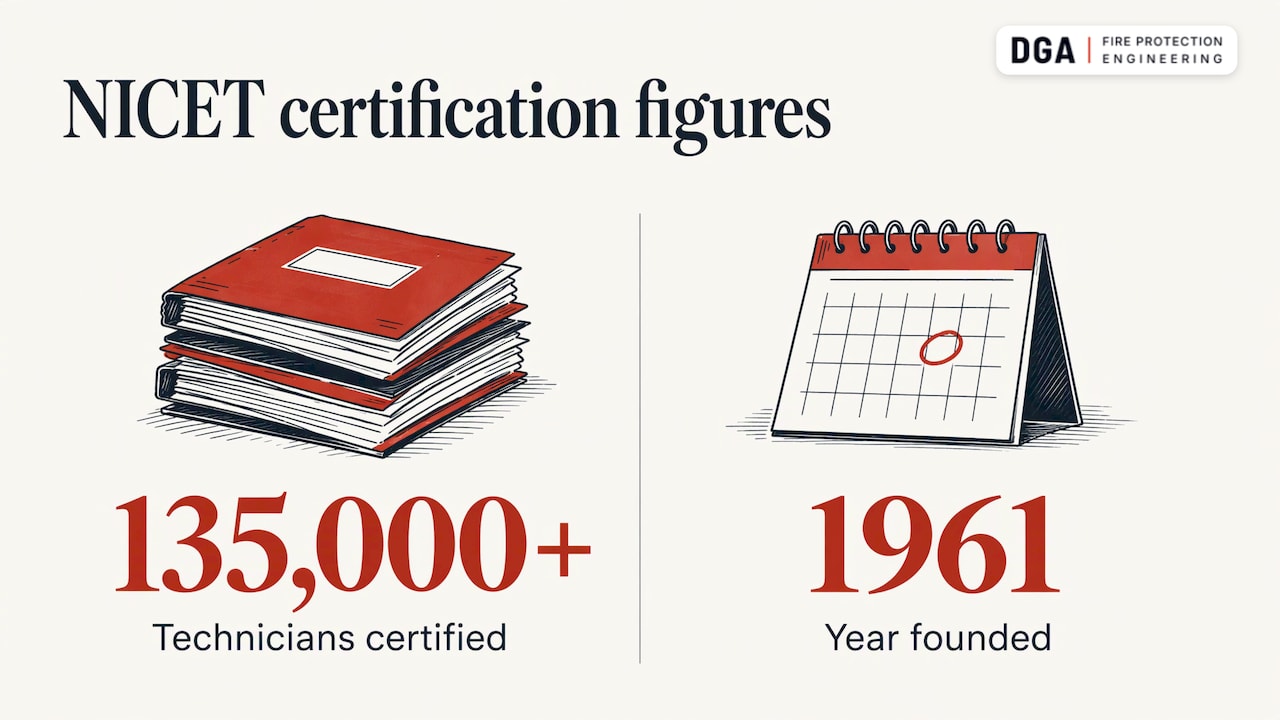
NICET has certified more than 135,000 engineering technicians and technologists since it was founded in 1961, according to NSPE. Employers and government agencies across the country recognize it, and many require it, as assurance that a person has mastered the critical elements of a specific discipline.
Three features set it apart from a training certificate.
It tests job knowledge. The exams are written and multiple choice. They cover what a technician needs to do the work, not what a single course taught.
It verifies experience. Candidates submit a work history that documents specific industry experience. For most programs, a supervisor verifies it.
It marks a career level. NICET describes its programs as a career path from entry to senior-level responsibilities, designed by industry experts to build a qualified workforce.
That is also the difference between a certificate and a certification. A certificate says you attended or completed something. A certification says an independent body tested you and verified your record. Prep courses can help you study, but they do not give you a level.
NICET also has a technologist track. Per NSPE, technologist certification is based on a four-year engineering technology degree, with documentation of work history and endorsements at the advanced level, and it does not use an exam. Most fire protection candidates take the technician route, which is the focus here.
The fire protection and building systems programs
As of late 2026, NICET’s Fire Protection and Building Systems group lists six programs relevant to our field. Each has its own number of levels.
| Program | Abbreviation | Levels | What it covers |
|---|---|---|---|
| Fire Alarm Systems | FAS | I to IV | Layout, equipment selection, installation, acceptance testing, troubleshooting, servicing |
| Inspection and Testing of Fire Alarm Systems | ITFAS | I to II | Inspection and testing of installed alarm systems |
| Water-Based Systems Layout | WBSL | I to IV | Layout and detailing of sprinkler and other water-based systems |
| Inspection and Testing of Water-Based Systems | ITWBS | I to III | Inspection and testing of existing water-based systems |
| Special Hazards Systems | SHS | I to IV | Special hazard suppression systems |
| In-Building Public Safety Communications | IBPSC | Three installation levels plus one design level | Public safety radio and communications in buildings |
The program details are on NICET’s pages for Fire Alarm Systems, Water-Based Systems Layout and Inspection and Testing of Water-Based Systems.
Two points often cause confusion.
First, the water-based subfield is split by function. Water-Based Systems Layout is the design-side path. It covers plan and submittal preparation, equipment selection, hydraulics, water supply requirements and technical management of layout projects. Inspection and Testing of Water-Based Systems is the field path for existing systems. It centers on NFPA 25 (the standard for inspection, testing and maintenance of water-based systems), along with documentation, impairment procedures and working safely.
Second, NICET has no program for sprinkler fitters. If you install pipe, you will not find an installer track in NICET’s water-based programs. They cover layout and inspection.
The four levels, explained
The level names are consistent across programs, though the requirements are not identical. NICET describes Level I as designed for trainees and entry-level technicians who perform limited tasks under supervision. Level IV is for senior technicians whose work includes complex or specialized systems and the supervision of others. Levels II and III sit between them, with growing independence and, at Level III, responsibility for leading others.
Fire Alarm Systems is a useful example, because NICET publishes its certification requirements in detail. All time requirements are full-time equivalent.
| Level | Minimum experience | Other requirements |
|---|---|---|
| I | 6 months with fire detection and signaling systems | Exam |
| II | 2 years, with at least 12 months of direct fire alarm experience and up to 12 months of related experience | Exam, work history |
| III | 5 years, with at least 45 months of fire alarm experience and up to 15 months of related experience | Field experience, team leadership, at least one year in a technical management role, personal recommendation |
| IV | 10 years, with at least 105 months of fire alarm experience and up to 15 months of related experience | At least two years overseeing project management, personal recommendation, description of a major project showing senior responsibility for a complex system |
The pattern matters more than the numbers. Each step up asks for more time, more responsibility and more proof that you have led work, not just done it. Other programs set their own requirements, so read the page for your subfield before you plan a timeline.
Exams: what to expect
NICET exams are written and multiple choice. Using Fire Alarm Systems as the model, NICET’s program page lists these exam formats:
- Level I: 85 questions in 110 minutes.
- Level II: 110 questions in 155 minutes.
- Level III: 115 questions in 170 minutes.
- Level IV: 120 questions in 290 minutes, including a 30-minute break.
The technical areas for this program include applicable codes and standards, types of detectors and signaling systems, supervision and power requirements, building and occupancy considerations, and basic electricity and electronics.
The exams are delivered through a testing vendor, and the exact references change when NICET updates its exams. Check the candidate handbook for your program before you study, since the editions of codes the exam is based on are updated on a schedule that NICET sets. NICET has also updated its water-based inspection exams in recent years, which is a good reminder that the current handbook is the only reliable guide.
How the process runs
- Create an account on nicet.org and choose the program and level.
- Complete the application, including the affidavit, your work history and any required recommendations.
- Confirm payment and schedule the exam with the testing vendor, within the testing window you choose.
- Pass the exam and have your documentation approved. Both are needed for the level to be issued.
A passing score alone does not make you certified. Work history and recommendations are part of the decision, which is why people who study hard sometimes find the paperwork is the slower part.
NICET subfields and the work they point to
Choose the subfield by the work you want to do, not by the level you hope to reach.
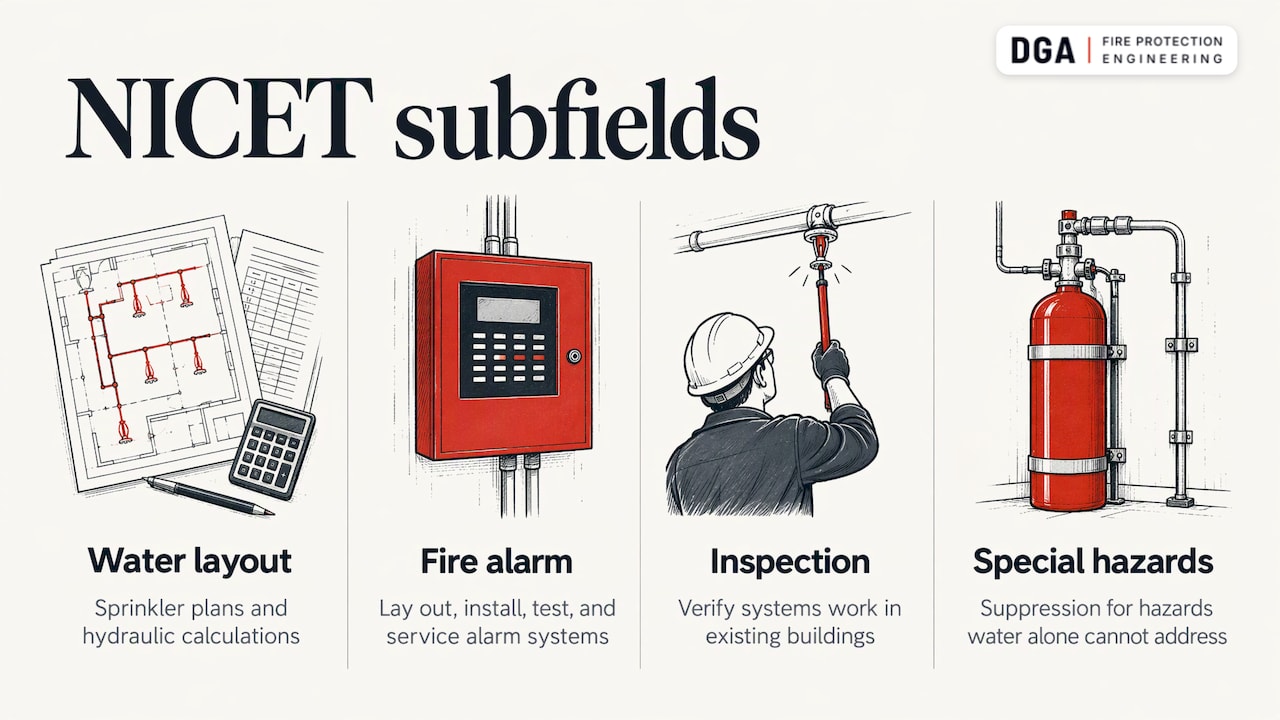
Water-based layout suits people who prepare sprinkler plans and hydraulic calculations. If you draw systems and run the numbers, WBSL matches your daily work. It also lines up with the skills behind sprinkler shop drawings, which are the detailed installation drawings a contractor submits for approval. Our page on what is included in a sealed set of sprinkler shop drawings shows what that work product contains.
Fire alarm suits people who lay out, install, test and service alarm systems. Our overview of how fire alarm systems integrate with other building systems gives context for what a Level III technician is expected to understand.
Inspection and testing suits people who visit existing buildings and verify that systems work. It is a different skill set from design. It rewards methodical field work and clean documentation.
Special hazards suits people working on suppression systems for hazards that water alone does not address.
Many careers cross subfields. A designer who understands inspection findings writes better drawings, and an inspector who can read a hydraulic calculation finds problems faster.
Recertification
NICET certification is not permanent. It must be maintained through continuing professional development and recertified every three years. Per NICET’s Recertify page, each certification needs 90 CPD points in the three-year cycle, drawn from at least two of five categories:
- Active Practitioner (maximum 72 points)
- Additional Education (maximum 72 points)
- Advance Profession (maximum 45 points)
- Certification Activity (maximum 90 points)
- Special Exam (maximum 45 points)
Because of the two-category rule, one activity type cannot cover the entire requirement. Keep records as you go. Rebuilding three years of training and work records at the deadline is the most common avoidable stress in the process.
Where NICET is required
NICET describes certification as increasingly a condition of employment, a jurisdictional requirement or a qualifier for work in its subfields, as explained in its certificate and verification article. Some states and local authorities require NICET for layout or inspection work. The rule differs from one jurisdiction to the next, so confirm it with the state licensing body or the AHJ where you work. This article does not list specific state requirements.
For the sprinkler side of that picture, our Sprinkler Systems hub is the place to start.
Verifying a credential
Employers, owners and plan reviewers can verify a NICET credential through NICET’s online Certification Directory. It works best with the Certification ID. Last name and first initial also work. NICET issues a downloadable certificate, and a wallet card on request. The original certificate carries a blue metallic foil treatment that is hard to copy on office equipment, and it shows the holder’s name, level, field, subfield and certification number.
NICET vs. the PE license
People often ask which one they need. They are different credentials for different roles.
| NICET certification | PE license | |
|---|---|---|
| Issued by | A national certifying body | A state licensing board |
| Covers | Engineering technicians in defined subfields | Professional engineers |
| Based on | Exams, documented experience, recommendations | Education, experience and examination under state rules |
| Maintained by | CPD and recertification every three years | State renewal rules |
| Typical work | Layout, detailing, installation, testing, inspection | Engineering design, sealing documents, responsible charge |
In practice they work together. A NICET-certified designer prepares layouts and shop drawings. A licensed PE is the person who takes engineering responsibility for design decisions and seals the documents where the law requires it. Many fire protection engineers begin on the technician track and later pursue the PE.
What NICET means for your career
Certification is tied to hiring and advancement. NICET states that employers and government agencies recognize it, and in some jurisdictions it gates the work you can do on your own. Level II is commonly where technicians gain independence on most projects, and Levels III and IV open lead and management roles.
We will not quote salary figures here. The pay data we found for this topic comes from commercial prep sites and not from official sources, so it is better to ask employers and check current job postings in your region.
A few habits help at every level:
- Log projects as they happen, with dates, system types and your role.
- Pick a mentor who holds the level above yours and can later write your recommendation.
- Read the standards your exam references, not only summaries of them.
- Use free engineering tools to check your intuition against the numbers.
On that last point, our sprinkler design calculators let you work through hydraulic relationships and see how changes in design area or density affect demand. They are built to teach the underlying engineering, not to replace a sealed design.
Our perspective
We work with NICET-certified designers every week, and we value what the credential shows: a person who has been tested and whose experience has been checked. A sprinkler layout is only as good as the person who details it, and certification gives owners, contractors and reviewers a common reference point.
The credential does a specific job, though. It certifies technical competence for layout, installation and inspection. It does not replace engineering judgment on a complex building. That is why a licensed Professional Engineer stays on each of our projects from first scope to final stamp, and why our sprinkler shop drawings are prepared by NICET-certified designers.
If you are starting out, our advice is simple. Choose the subfield that matches the work you do now, document everything, and plan to grow into the engineering side if design is where you want to end up. Technicians who understand the engineering behind the code write drawings that get through review without rework.
DGA Fire Protection Engineering
When a project needs both
NICET-certified designers and licensed engineers are part of the same workflow on our projects. We prepare sprinkler shop drawings and hydraulic calculations through NICET-certified designers, with a licensed PE involved from start to finish. If your building also needs broader engineering, our fire protection engineering design service covers sprinklers, alarms, pumps and more across New York, New Jersey, Pennsylvania, Maryland and Delaware.

For project questions, engineers answer inquiries directly. There is no sales desk.
FAQ
How do I get a NICET certification?
Pick the program that matches your work, such as Water-Based Systems Layout or Fire Alarm Systems. Create an account on nicet.org, complete the application and work history, and schedule your exam. Higher levels also need personal recommendations. Read the handbook for your program first, since requirements differ by subfield.
What is the difference between a certificate and a certification?
A certificate usually shows that you completed a course or training. A NICET certification is awarded at a career level after you pass exams and NICET verifies your work experience. It cannot be earned by attendance alone, and it has to be recertified every three years.
Does NICET certification expire?
Yes. It must be maintained through continuing professional development and recertified every three years. NICET asks for 90 CPD points per certification, drawn from at least two of five categories. Keep records of training and work activity throughout the cycle.
Is NICET the same as a PE license?
No. NICET certifies engineering technicians in defined subfields. A PE license comes from a state board and allows an engineer to seal engineering documents. Many projects use both: certified designers prepare layouts, and a licensed engineer takes responsibility for the engineering.
Is NICET certification required to do sprinkler or inspection work?
Some states and AHJs require it for layout or inspection work, and others do not. Check with your state licensing body or the AHJ for the exact rule where you work. Our Inspection and Testing hub covers how that work is handled.
Sources
- NSPE: National Institute for Certification in Engineering Technologies
- NICET: Certification Programs
- NICET: Fire Alarm Systems
- NICET: Fire Alarm Systems Certification Requirements
- NICET: Water-Based Systems Layout
- NICET: Inspection and Testing of Water-Based Systems
- NICET: Recertify
- NICET: The Certificate, Wallet Card, and Certification Verification
Recommended
- How to Become a Fire Protection Engineer: Degrees, Experience and PE Licensure
- Fire Alarm & Sprinkler PE Inspection Certification Letters
- Fire Protection Engineer New Jersey | NJ UCC & Sprinklers
This article is general information from DGA Fire Protection Engineering, not engineering advice for a specific building or project. Code requirements vary by jurisdiction and edition. Confirm with the authority having jurisdiction or a licensed fire protection engineer before acting on it.