Features & Perspectives
The Station Nightclub Fire: What Happened and What Changed
On February 20, 2003, a fire at The Station nightclub in West Warwick, Rhode Island, killed 100 people. The official investigation by the National Institute of Standards and Technology (NIST) found that three things combined: flammable foam on the walls and ceiling, no sprinklers to stop the fire early, and exits that could not clear the room in time. Each of those findings changed how engineers, code officials and building owners treat nightclubs and other assembly spaces. This article, current as of November 2026, explains what NIST found and what changed afterward. It is written with respect for those who died and for the people who survived.
TL;DR
- Pyrotechnics used during a band’s performance ignited polyurethane foam lining the walls and ceiling of the stage platform, according to NIST. The fire spread along the ceiling over the dance floor.
- NIST named three direct factors: a hazardous mix of building contents, inadequate ability to suppress the fire early, and exits that could not handle the occupants in the time available.
- The club had no sprinklers. NIST’s simulation with sprinklers showed tenable conditions throughout the 300 seconds modeled.
- NFPA adopted interim amendments in July 2003. They became permanent in the 2006 editions of NFPA 101, NFPA 5000 and NFPA 1.
- The main lesson for designers: fire growth and evacuation have to be analyzed together, not as two separate checks.
Table of Contents
- What the code requires today
- What happened on February 20, 2003
- Why the fire grew so fast
- The exits: a single main entrance under pressure
- What sprinklers would have changed
- NIST’s three direct factors
- What changed afterward
- Lessons for engineers today
- Perspective
- Egress and code review for assembly spaces
- How The Station compares with other nightclub fires
- FAQ
- Sources
What the code requires today
What the code requires today: NFPA 101 now calls for sprinklers in all new nightclub-type assembly occupancies, and in existing ones with an occupant load over 100, as NFPA’s case study describes. For how these rules apply to a project, see our Life Safety and Egress hub.
What happened on February 20, 2003
The Station was a nightclub at 211 Cowesett Avenue in West Warwick. During a band’s performance, pyrotechnics ignited polyurethane foam insulation that lined the walls and ceiling of the stage platform. NIST’s investigation page gives this as the official account of how the fire began. It is also as far as this article goes on cause. The official finding is where the facts stop, and we do not add to it.
The fire did not stay on the stage. It spread quickly across the ceiling above the dance floor. Smoke and heat filled the main room, and the people inside had very little time.
NIST reports that 100 people died. Of those deaths, 95 were due to occupants being unable to get out before they were overcome by untenable conditions along the egress path. “Untenable” is an engineering term for conditions in which a person can no longer survive or act effectively, because of heat, toxic gases or lack of visibility.
Why the fire grew so fast
Fire growth depends on what burns and how quickly it releases heat. NIST tested the materials found in the club. In its materials testing and small-scale experiments, polyurethane foam typically ignited in 3 to 14 seconds and reached its peak heat release in less than 45 seconds. Wood paneling and carpet took up to 41 seconds and 54 seconds to ignite.
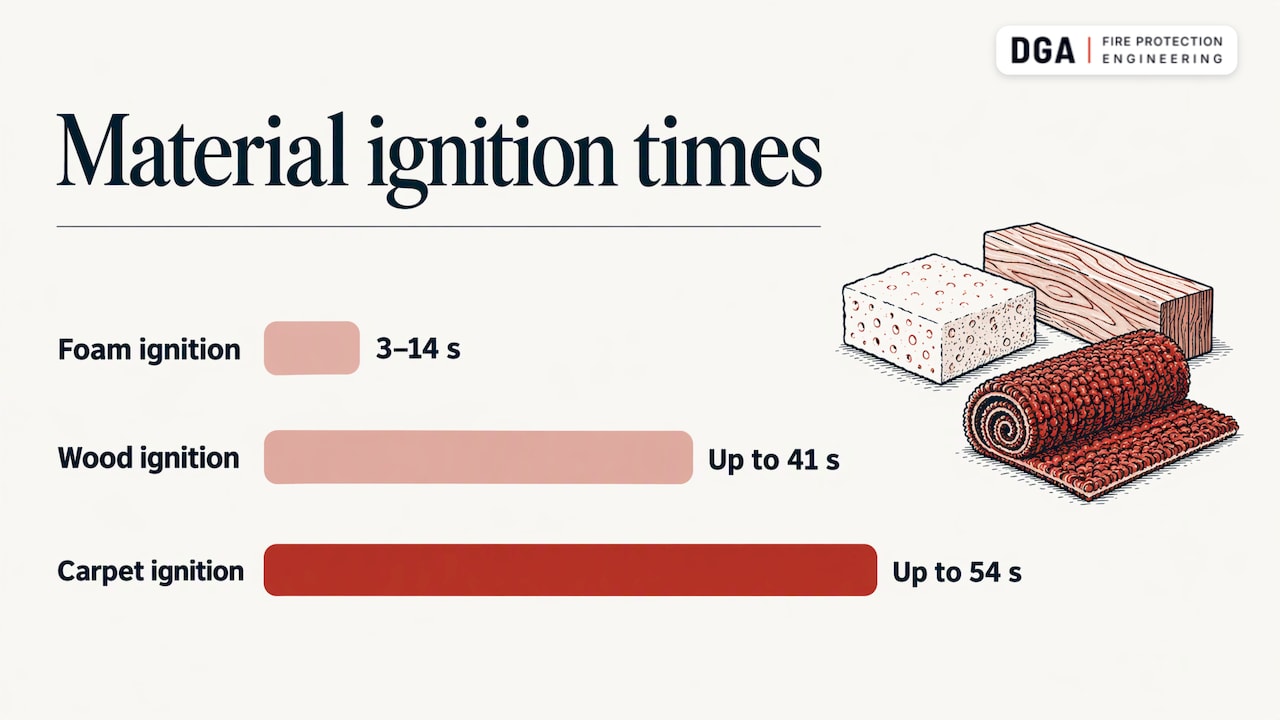
In a separate check, a non-fire-retarded foam sample purchased by NIST ignited within 10 seconds when exposed to a pyrotechnic device, as the NIST investigation summary notes.
Those numbers explain why the room turned dangerous so quickly. Engineers describe fire growth with a t-squared curve, in which the heat release rate climbs with the square of time. A fast-growing fire in a lined ceiling leaves little margin. If you want to see how growth rate changes the timeline, our free t-squared fire growth calculator lets you test it.
Interior finish matters
Interior finish means the material on the exposed surfaces of walls, ceilings and floors. It matters because a burning surface above people spreads flame to more surface and sends heat and smoke down onto them. The Station fire is one of the clearest examples of why codes regulate it. The foam in this case was not a decoration in a corner. It lined surfaces at the stage and spread the fire where the crowd was standing.
The exits: a single main entrance under pressure
NIST found that about two-thirds of the occupants tried to leave through the main entrance. Many did not make it. Before 90 seconds into the fire, a crowd crush occurred at the main entrance and almost entirely disrupted the flow of the evacuation through the front exit.
NIST’s finding on why it happened is specific. The event was likely related to the arrangement of a single interior door where merging streams of traffic met, and to the pressure to escape rapidly worsening conditions in the main area. In plain terms, people came together from several directions at one narrow point, and the pressure from behind built faster than the doorway could pass them.
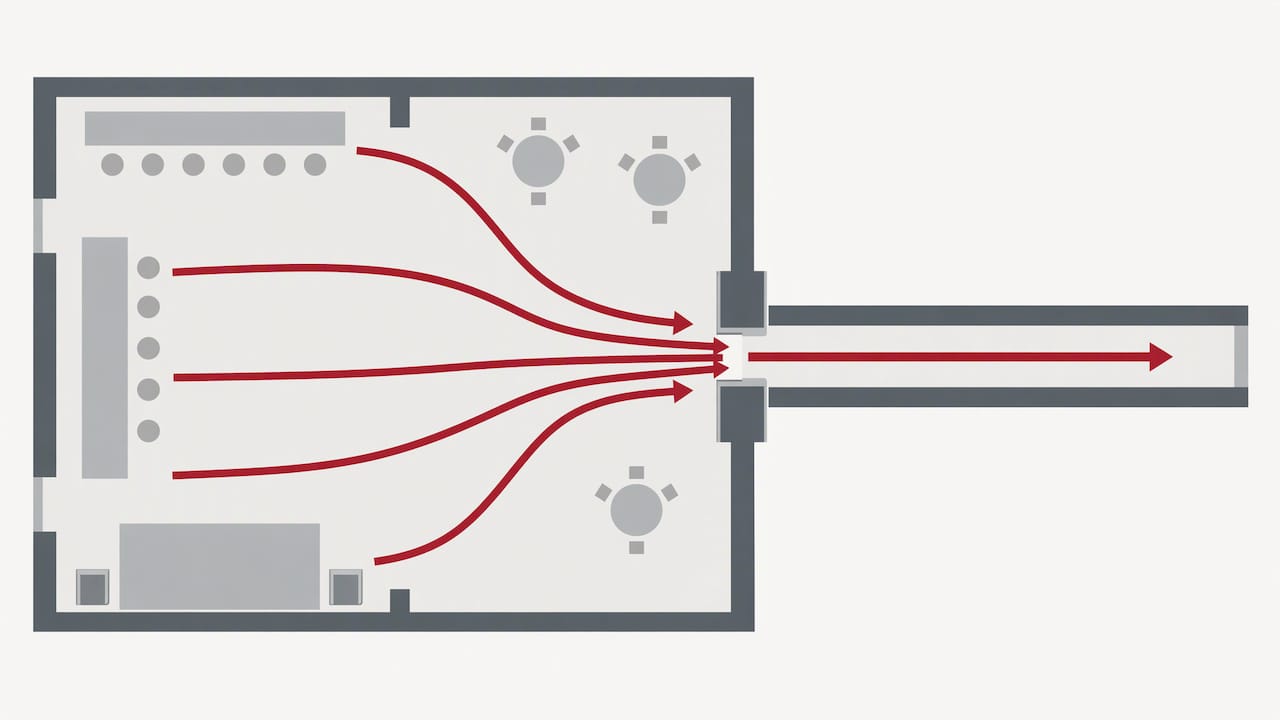
This is the part of the story that engineers who work on egress return to most. Exit capacity on paper is not the same as exit capacity under pressure. Width, door arrangement, where streams of people merge, and how familiar people are with other exits all affect how a crowd actually moves. You can estimate movement time for your own layout with our egress time calculator.
What sprinklers would have changed
The nightclub did not have sprinklers. NIST ran computer simulations of the fire in the building as it was, and again with sprinklers. In the simulation of the full nightclub equipped with sprinklers, tenable conditions existed throughout the 300-second simulation. The fire was fully extinguished approximately 114 seconds after ignition.
That result is the center of the engineering argument. A sprinkler does not wait for people to find the exit. It acts on the fire while it is still small, which keeps the room survivable and gives the crowd time. This is why the later code changes put sprinklers first.
Sprinkler design and hydraulic analysis are the subject of our Sprinkler Systems hub. The Station fire is a reminder of what that engineering protects.
NIST’s three direct factors
NIST’s report identifies three factors that directly contributed to the rapid spread of the fire, the building failure and the large loss of life:
- The hazardous mix of building contents.
- An inadequate capability to suppress the fire early.
- The inability of exits to handle the egress of all of the occupants in the short time available with such a fast-growing fire.
The three are linked. Take away any one and the outcome could have been different. Better materials slow the fire. Sprinklers suppress it. More exit capacity moves people out. Safety comes from layers, and The Station had too few of them.
What changed afterward
The NFPA codes
The NFPA Standards Council approved Tentative Interim Amendments in July 2003 as interim requirements. A Tentative Interim Amendment is a fast-track change that lets NFPA issue a rule between normal code cycles. These became permanent in the 2006 editions of NFPA 101 (the Life Safety Code), NFPA 5000 and NFPA 1 (the Fire Code). The changes included sprinklers in existing nightclub-type assembly occupancies with occupant loads over 100, and in all new ones, as the NFPA case study on nightclub fires records. The same body of changes also addressed crowd managers and interior finish in these occupancies.
NIST’s recommendations
NIST released its final report on June 29, 2005. It made 10 recommendations to increase occupant safety in nightclubs. By the time the final report came out, seven of the 10 had already been acted on by the state of Rhode Island and by national model code development organizations. That speed is unusual in code development, and it reflects how clear the findings were.
Enforcement
NIST also looked past the text of the codes. Its report urged state and local jurisdictions to adopt a building and fire code covering nightclubs based on a national model code, to run aggressive and effective inspection and enforcement programs, and to make sure enough fire inspectors and plan examiners are on staff.
A code only protects people when it is applied. For owners and property managers, that means keeping a clear record of inspections, findings and corrections. Teams that manage many properties often use property compliance tracking software to keep those records in one place and to see what is still open.
Lessons for engineers today
Analyze fire and evacuation together
A research team led by Galea ran a coupled fire and evacuation simulation of The Station. In the published paper, a building population of 460 produced 180 fatalities in the base case. With a 15-second delay in the fire timeline, the evacuation simulation gave 84 fatalities, in good agreement with the actual number. The authors noted that traditional ASET/RSET calculations, which do not couple the fire and the evacuation, can be considerably over-optimistic about the level of safety a design achieves.
ASET is the available safe egress time: how long conditions stay tenable. RSET is the required safe egress time: how long people need to get out. A design passes when ASET exceeds RSET with margin. The lesson is that both numbers depend on the same fire and the same crowd, so treating them as independent can hide a problem. This is a core reason performance-based design uses fire modeling and evacuation analysis side by side.
Treat crowd behavior as a design input
The crush at the main entrance was not an exotic event. It is what happens when many people head for the way they came in. Egress analysis should look at where streams merge, how doors are arranged, and how people will really choose exits.
Check the finishes, not just the systems
A code-compliant sprinkler system and a compliant alarm do not make up for hazardous contents in the room. The review should cover what is on the walls and ceilings, and what is brought in for events.
Where the lessons apply
These lessons are not limited to nightclubs. They apply to any assembly space with a crowd, a fast fuel and a limited exit path: event venues, restaurants, houses of worship, and adaptive reuse of older buildings. Our page on historic and adaptive reuse buildings covers a related setting where older construction meets current life safety expectations.
Perspective
We read The Station fire as a lesson in how layers of protection work together. The NIST findings show that no one measure would have been enough on its own, and that any one of them could have changed the outcome.
For us, the most important point is how early the decisions are made. Interior finish, sprinkler coverage and exit arrangement are all set in design, long before an event. A licensed Professional Engineer who stays involved from first scope to final stamp can keep those decisions connected, so that egress analysis, sprinkler design and code review are not handled as separate tasks.
We also believe that code questions should get answers quickly, so that a design team does not move forward on an assumption. Our code consulting and life safety work is built around that idea, tailored to the local reviewer and authority having jurisdiction in New York, New Jersey, Pennsylvania, Maryland and Delaware.
DGA Fire Protection Engineering
Egress and code review for assembly spaces
If you are planning or reviewing a venue, our Life Safety & Egress Consulting service looks at exit capacity, door arrangements and occupant movement, and our Fire Modeling & Performance-Based Design service analyzes fire growth and tenability. Both are led by a licensed Professional Engineer, and code questions get same-day answers.

How The Station compares with other nightclub fires
The Cocoanut Grove fire in Boston on November 28, 1942, killed 492 people, according to USA Today’s review of the deadliest U.S. nightclub fires. The Providence Journal describes The Station fire as the nation’s fourth deadliest nightclub fire. Each of these fires led to code changes. For more fires and what they changed, see our collection of notable fires that changed the fire codes.
FAQ
How many people died in the Station nightclub fire?
NIST reports that 100 people died. Of those, 95 deaths were due to the inability of occupants to evacuate before they were overcome by untenable conditions along the egress path.
Did the Station nightclub have sprinklers?
No. NIST states the nightclub was not equipped with sprinklers. In its simulation of the full club with sprinklers, tenable conditions would have existed throughout the 300-second run, and the fire would have been extinguished about 114 seconds after ignition.
What changed in the codes after the fire?
NFPA approved interim amendments in July 2003. They became permanent in the 2006 editions of NFPA 101, NFPA 5000 and NFPA 1. They include sprinklers in new nightclub-type assembly occupancies and in existing ones with occupant loads over 100.
What did NIST recommend?
NIST’s final report, released June 29, 2005, made 10 recommendations for occupant safety in nightclubs. It also urged jurisdictions to adopt a model code, enforce it through inspections, and keep enough inspectors and plan examiners on staff.
What was the deadliest nightclub fire in U.S. history?
The Cocoanut Grove fire in Boston on November 28, 1942, killed 492 people. The Station fire is considered the fourth deadliest nightclub fire in the country.
Sources
- The Station Nightclub Fire 2003, NIST
- Reconstructing the Station Nightclub Fire: Materials Testing and Small-Scale Experiments, NIST
- Reconstructing the Station Nightclub Fire: Computer Simulation, NIST
- NIST Rhode Island Nightclub Fire Investigation Team Calls for Improvements
- NIST Building Safety Efforts Mark Fifth Anniversary of R.I. Nightclub Fire
- Final NIST Rhode Island Nightclub Fire Report Urges Strict Adherence
- NFPA Case Study: Nightclub Fires
- Coupled Fire/Evacuation Analysis of the Station Nightclub, IAFSS
- Deadliest nightclub fires in U.S. history, USA Today
- Property Compliance Tracking Software
Recommended
- One Meridian Plaza Fire: What Happened and What Changed
- What Caused the Triangle Shirtwaist Fire, and Why It Killed 146
- Notable Fires That Changed the Fire Codes
- Hospitality Fire Protection Engineering
This article is general information from DGA Fire Protection Engineering, not engineering advice for a specific building or project. Code requirements vary by jurisdiction and edition. Confirm with the authority having jurisdiction or a licensed fire protection engineer before acting on it.