Features & Perspectives
Thermal Runaway: How a Lithium-Ion Cell Fails and Why It Is Hard to Stop
Thermal runaway is uncontrolled self-heating. A lithium-ion cell makes heat faster than it can shed it, and the extra heat drives chemical reactions that make still more heat. Once that loop is established, removing the original cause does not stop it. This article explains the physics and chemistry in plain terms, what the failing cell releases, why one cell can take its neighbors with it, and why water cools a failing battery but does not end the reaction quickly.
Table of Contents
- TL;DR
- What thermal runaway actually is
- The sequence inside a cell
- What starts it
- Can a battery start a fire when it is not plugged in?
- How it spreads from cell to cell
- What comes out of a failing cell
- Why water cools but does not stop it quickly
- If a lithium-ion battery fails near you
- Our perspective
- Where this meets a real building
- FAQ
- Sources
TL;DR
- Thermal runaway is a feedback loop: heat triggers reactions inside the cell, and those reactions release more heat.
- The usual tipping point is an internal short circuit, often after the separator between the electrodes is damaged, melted or defective.
- The cell vents flammable and toxic gas. Hydrogen, carbon monoxide and hydrocarbons are among the components, so a failing cell is a gas source as well as a heat source.
- Heat from one failing cell can push neighboring cells into runaway. This is called propagation.
- Water removes heat from the outside but does not stop the reactions inside. Re-ignition can follow after the visible fire is out.
What the code requires today
Requirements for lithium-ion battery storage and use exist in the model fire codes and vary by occupancy and quantity. We cover them in our Hazardous Materials hub, and this article stays with the science.
What thermal runaway actually is
A lithium-ion cell stores energy in chemical form. In normal use that energy comes out slowly as electricity, and a small amount of heat leaves with it. The cell stays stable because the heat it makes is carried away to its surroundings.
Thermal runaway begins when that balance breaks. The UL Fire Safety Research Institute’s guide to lithium-ion hazards describes it as uncontrolled self-heating, often starting when heat generated inside the cell exceeds the heat lost to the surroundings. The added heat causes chemical reactions that release thermal energy of their own.
Two points matter for engineers and for anyone who has to respond to one of these events.
- It is not ordinary burning. The reactions inside the cell supply their own heat. Taking away the outside heat source does not stop them.
- It is not the same as ignition. Runaway is the failure of the cell. Fire is one possible consequence, and we return to that distinction below.
The sequence inside a cell
A cell has four main parts: a negative electrode (anode), a positive electrode (cathode), a liquid electrolyte that carries lithium ions between them, and a thin plastic separator that keeps the electrodes from touching. The failure sequence runs through these parts in a rough order.
Stage 1: Heat builds
Something raises the temperature of the cell. It might be overcharging, an external heat source, or heat from a short circuit. In the early stage the temperature climbs slowly, and the cell can still look and behave normally from the outside.
Stage 2: Protective layers break down
As the cell warms, the thin protective film on the anode and then the electrolyte begin to decompose. These reactions release heat. Individually they are small. Together they push the temperature up faster, which speeds the next reaction.
Stage 3: The separator fails
The separator is a polymer film. Per the FSRI guide, high enough temperatures can distort or melt it, and that allows an internal short circuit. Rapid heat generation during an internal short is typically the tipping point after which thermal runaway occurs, with rising temperature accelerating the reactions in a feedback loop.
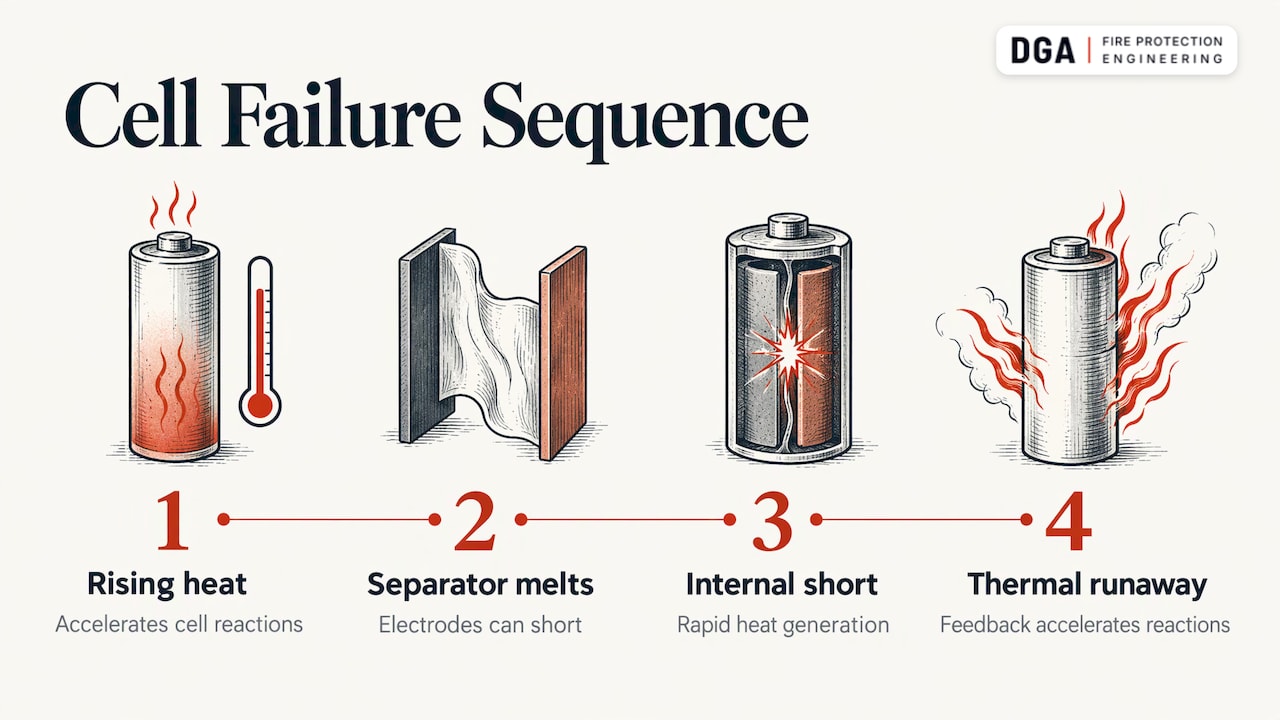
Think of a pot sitting on a hot burner that also gets hotter each time you stir it. The separator is the last thing keeping the electrodes apart. When it goes, a large amount of stored energy is released inside a very small volume.
Stage 4: The cathode releases oxygen and gas
At higher temperatures the cathode material itself breaks down, and in many chemistries that releases oxygen. The cell pressure rises, the vent opens or the case ruptures, and hot gas and vapor leave the cell. The EPA’s response guide for lithium-ion batteries notes that a cell in thermal runaway will typically be over 550°F (about 288°C).
Because the cell contains its own fuel and, in many designs, its own oxidizer source, this stage does not depend on air reaching the cell. That is one reason the usual picture of fire (fuel, oxygen, heat) fits poorly here.
What starts it
The OSHA lithium-ion battery safety publication lists the common initiators: internal short circuits from manufacturing defects, mechanical damage, exposure to excessive heat or cold, and improper charging.
UL’s research arm groups the causes into two families in its explanation of what causes thermal runaway:
- Internal failure, such as an internal short circuit from separator defects.
- External off-nominal conditions, including overcharge, multiple overdischarges followed by charge, an external short circuit, and high or low temperature environments.
An academic review of battery thermal management, Wang et al. (2025), sorts abuse into three types:
| Abuse type | What happens to the cell |
|---|---|
| Mechanical | Compression, puncture or collision damages the cell structure and can rupture the separator. |
| Thermal | Exposure to high temperature can melt the separator. |
| Electrical | Excessive current or improper charge control can drive lithium dendrites (needle-like metal growths) through the separator. |
The review notes that all three routes end in the same place: an internal short circuit, more side reactions, and a positive feedback loop of sudden energy release.
Can a battery start a fire when it is not plugged in?
Yes. Thermal runaway does not need a charger. A cell holds stored energy whether or not it is connected to anything. If its separator is defective, damaged or heated, the cell can short internally and enter runaway on its own.
The EPA’s response guide says damaged lithium-ion batteries may go into thermal runaway instantly or after a delay, and that damage and defects may not be visible. The FIRESCOPE emergency guideline for lithium-ion batteries states that runaway can happen at any time without warning.
In practice, a dropped, crushed or overheated battery deserves the same caution as one that is charging, even if it looks fine and has sat idle for hours.
How it spreads from cell to cell
One failing cell is a small event. A pack, rack or pallet of cells is where it becomes large.
The EPA response guide explains that heat from a failing cell may transfer to surrounding cells and damage them until they fail as well. This cell-to-cell heat transfer is called propagation. Heat travels by conduction through contact, by hot vent gas washing over neighbors, and by ejected particles.
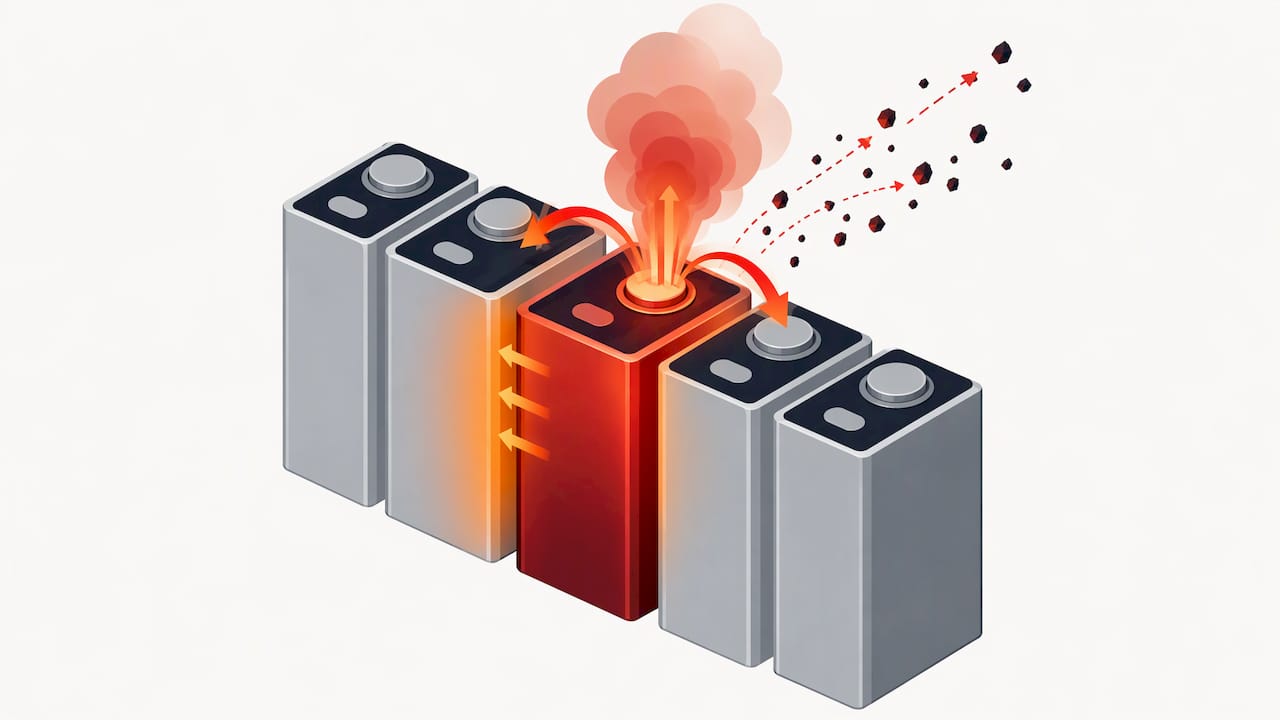
Modeling work published in the COMSOL battery documentation shows a typical shape for the event. There is a quiet period, a steep temperature rise when the first cell fails, then an incubation period of several minutes while heat reaches a neighbor. After the second cell fails, the gaps between successive failures shrink. A slow start is no guarantee of a slow finish.
This timing pattern is why spacing, barriers and venting are central to how battery packs are designed. It is also why the surrounding building, not only the cell, matters to an engineer.
What comes out of a failing cell
A failing cell is a source of gas. The OSHA publication lists hydrogen fluoride, hydrogen chloride, hydrogen cyanide, phosphoryl fluoride, carbon monoxide, carbon dioxide, black carbon and other hazardous chemicals and particulates among the products of fires caused by thermal runaway.
The EPA’s guide for damaged lithium-ion batteries puts hydrogen at 30 to 50 percent of the vapor produced, along with carbon monoxide, hydrocarbons such as methane and ethane, and organic solvent droplets. Those fractions depend on the chemistry and the conditions.
Two hazards follow.
- Flammability. Hydrogen and hydrocarbons burn easily and have wide flammable ranges.
- Toxicity. Several of the listed gases are harmful to breathe at low concentrations, which affects anyone in or near a space where cells are failing.
FIRESCOPE adds that a rupture or “pop” sound and a white vapor cloud may come moments to seconds before ignition.
Gas first, flame later
The Electric Power Research Institute states in its report on thermal runaway and ignition that thermal runaway is not ignition. It describes runaway as the irreversible failure of a cell that produces flammable gases. Ignition of the unmixed gas can give a fire. Ignition of gas mixed with air, often in a confined space, can give an explosion.
The report describes the 2019 failure at a battery site in Surprise, Arizona as an example of runaway without immediate ignition. A rack had failed and filled its container with flammable gas that was initially too rich to burn. When responders opened the doors, air entered and the heat inside ignited the gas.
The lesson for fire science is about mixtures. A gas cloud burns only between a lower flammable limit (LFL) and an upper flammable limit (UFL). Below the LFL it is too lean. Above the UFL it is too rich. Venting gas can pass through that whole range as air mixes in. Our free gas mixture LFL calculator shows how a blend of gases such as hydrogen, carbon monoxide and methane combines into a single lower flammable limit.
Why water cools but does not stop it quickly
Water is very good at absorbing heat, and that helps. Cooling the outside of a pack can slow heat moving to neighboring cells. The FIRESCOPE guideline notes that CO2 can aid cooling of batteries and electrical components with some propagation control, and that dry chemical extinguishers are ineffective on lithium-ion extinguishment.
The limit is where the heat comes from. The reactions are inside the cell, shielded by its case and by the heat already stored in the materials. Water on the outside does not reach the reactants. The EPA response guide goes so far as to say that once a battery goes into thermal runaway there is no way to stop the reaction. In other words, the realistic aims are to carry heat away, limit spread to other cells, and wait for the cell to exhaust its energy.
This also explains re-ignition. The EPA’s guide says re-ignition from propagation or thermal insult to other cells within a battery is common and can occur 30 to 90 days after an initial event. FIRESCOPE says to expect re-ignition at any time after the first fire is out. The FDNY has warned the same, that batteries can re-ignite without warning, minutes, hours or days later.
Where the building has sprinklers, the question of what the water is meant to do is an engineering question. We address how storage of these batteries interacts with sprinkler design in our article on lithium-ion storage and sprinkler design.
If a lithium-ion battery fails near you
The state guidance is consistent and short. The New York State Division of Homeland Security and Emergency Services advises that these fires spread quickly, can become explosive or reignite, and that extinguishers do not work on them. The safest decision is to leave the area immediately and call 9-1-1.
If you see smoke, hear a pop or notice a hiss from a device, move away, close the door behind you where you can do so safely, and call. Do not return for the device.
Our perspective
Thermal runaway is a good example of why fire protection engineering is more than selecting equipment. The event starts inside a cell, but its consequences are set by the building: how heat can move between cells, where gas goes, how fast it mixes with air, and who is in the space when it does.
We look at it as a chain. Heat, gas, flame, spread and re-ignition each have their own physics, and a design has to say which link it is addressing and why. A sprinkler system, a ventilation strategy and a separation distance do different jobs. Treating them as interchangeable is where designs go wrong.
A licensed Professional Engineer stays on each of our projects from first scope to final stamp, and our engineers answer code questions directly. For installations that involve lithium-ion storage, that means the conversation begins with how the hazard behaves, then moves to the system that suits it and the reviewer who will look at it.
DGA Fire Protection Engineering
Where this meets a real building
Understanding the science is the first step. The second is turning it into a design that an authority having jurisdiction will approve. We design and review fire protection for commercial, industrial, warehouse, cold storage and energy storage buildings in New York, New Jersey, Pennsylvania, Maryland and Delaware. You can see how we approach BESS fire protection or read about our fire protection engineering design services.

If a project of yours involves lithium-ion batteries, an engineer can talk through the hazard with you at dgaconsulting.net.
FAQ
What causes thermal runaway?
The common causes are internal short circuits from defects, mechanical damage, excessive heat or cold, and improper charging, according to OSHA. UL groups them as internal failures and external off-nominal conditions such as overcharge and external short circuit. Each route usually ends with the separator failing and the cell heating itself.
Can thermal runaway be stopped once it starts?
Not inside the cell. The EPA response guide states there is no way to stop the reaction once a battery enters runaway. Cooling can limit heat reaching neighboring cells, and responders plan for the cell to burn out its energy. They also plan for re-ignition.
Is thermal runaway the same as a battery fire?
No. EPRI describes runaway as the failure that produces flammable gas, and fire or explosion are possible outcomes. A cell can vent gas without igniting, and the gas can ignite later when it mixes with air.
Can a lithium-ion battery catch fire when it is not charging?
Yes. Stored energy is present at all times. A damaged or defective cell can short internally and fail with no charger connected, and the EPA notes the failure can be delayed and the damage may not be visible.
What gases does a failing lithium-ion cell release?
OSHA lists hydrogen fluoride, hydrogen chloride, hydrogen cyanide, phosphoryl fluoride, carbon monoxide and carbon dioxide among others. The EPA puts hydrogen at 30 to 50 percent of the vapor. The mix is both flammable and toxic.
Sources
- Hazards from Lithium-Ion Batteries, UL Fire Safety Research Institute
- Lithium-ion Battery Safety, OSHA
- What Causes Thermal Runaway?, UL Research Institutes
- Advances in Thermal Management of Lithium-Ion Batteries, Processes 2025
- EPA On-Scene Coordinator Lithium-Ion Battery Response Guide
- FIRESCOPE ICS 1150 Lithium-Ion Battery Emergencies
- Thermal Runaway Propagation in a Battery Pack, COMSOL 6.4 documentation
- EPA Maui Wildfires Damaged Lithium-Ion Battery Management Guide, 2023
- The Difference Between Thermal Runaway and Ignition, EPRI
- What To Do if Lithium-Ion Battery Catches Fire, New York State DHSES
Recommended
This article is general information from DGA Fire Protection Engineering, not engineering advice for a specific building or project. Code requirements vary by jurisdiction and edition. Confirm with the authority having jurisdiction or a licensed fire protection engineer before acting on it.