Insights topic · 39 articles
Water Supply
Running and reading hydrant flow tests, sizing fire pumps, and checking storage tanks and standpipes against sprinkler demand.
Every water-based fire protection system depends on its water supply. A hydrant flow test shows what the city main can deliver, and the system demand shows what the sprinklers and standpipes need. When the supply falls short, the answer is usually a fire pump, a storage tank or both. The guides below cover flow tests, fire pumps, standpipes and acceptance testing.
Start here
Do You Need a Fire Pump? How Engineers Decide (NFPA 20)
A building needs a fire pump when a hydrant flow test less than 12 months old cannot meet the sprinkler or standpipe demand plus a 10 percent or 10 psi…
Questions this topic answers
Overview
| Question | Code basis | Last reviewed |
|---|---|---|
| Water Supply for Fire Protection: The Complete Guide | NFPA 13 (2022; 2019 PA/MD; 2025 DE), NFPA 291 (2022), NFPA 20 (2022; 2019 PA/MD; 2025 DE), NFPA 22 (2023), NFPA 24 (2022), NFPA 14 (2019/2024), NFPA 25 (2023), IFC App. B and C (2021/2024) | Nov 2026 |
What it is
| Question | Code basis | Last reviewed |
|---|---|---|
| What Is a Fire Pump Controller and Transfer Switch? | NFPA 20 Ch 3, 4, 9, 10, 11, 12 in the edition referenced by the adopted code; NFPA 20 (2016) as modified by 2022 NYC BC Appendix Q (Q106); NFPA 20 (2025) in DE; NFPA 70 (NEC) Art 430 and 695, 695.4(B)(2)(b); UL 218; UL 1008; 2021 IBC 913; NFPA 25 (2023) Ch 8, 8.3.3; 2022 NYC BC Appendix Q modifications to NFPA 13 (2016); NYC DOB stationary fire pump requirements | Nov 2026 |
| What Is Backflow Preventer Pressure Loss in Sprinkler Calcs? | NFPA 13 (2022) Ch 16, 28, 29, 30; NFPA 13 (2016) with NYC BC Appendix Q; NFPA 13 (2019) PA and MD; NFPA 13 (2025) DE; NFPA 25 (2023) Ch 13 and 4.3.4; 10 NYCRR 5-1.31; N.J.A.C. 7:10-10; 25 Pa. Code 109.709; COMAR 26.04.01.32; DE Public Drinking Water Regulations 21.0 | Nov 2026 |
| What Is a Combined Sprinkler and Standpipe System? | NFPA 14 (2016 and 2019; edition referenced by the adopted IBC) Ch 3, 6, 7, 9; NFPA 13 (2019 PA and MD, 2022 NYS and NJ, 2025 DE) Ch 5, 16; NFPA 13 (2016, NYC) Ch 8, 24 as modified by Appendix Q; 2021 IBC 403.3, 903.4, 905, 912; 2022 NYC BC Appendix Q (Q102, Q105); NFPA 25 (2023) Ch 5, 6, 15 | Nov 2026 |
| What Is a Water Supply Safety Margin and How Much Is Enough? | NFPA 13 (2022) Ch 5, Ch 19, Ch 20, Ch 28, Sec 4.5.1.1; NFPA 13 (2019) Ch 5, Ch 27; NFPA 13 (2016) with NYC BC Appendix Q; 2021 and 2024 IBC 903.3.5; NFPA 291 (2022) Ch 4; NFPA 20 Ch 4, Ch 6; NFPA 25 (2023) 4.1.6, 4.1.7.1 | Nov 2026 |
| What Should a Hydrant Flow Test Report Contain? | NFPA 291 (2022) Ch 4; NFPA 13 (2022) Ch 4 (water supply information; Section 4.5.1.1 test age), Ch 28 (plans and calculations) and Section 29.4 (hydraulic design information sign); NFPA 13 (2016) Ch 23 (NYC, Appendix Q), NFPA 13 (2019) Ch 27 (PA, MD) and NFPA 13 (2025) Ch 28 (DE) plans chapters; NFPA 25 (2023) Ch 13; 2021 and 2024 IBC Section 903.3.5; AWWA Manual M17 | Nov 2026 |
| How Current Must a Flow Test Be, and Who Can Perform One? | NFPA 13 (2022) 4.5.1.1; NFPA 13 (2019) Ch 4; NFPA 13 (2025) Ch 4; NFPA 13 (2016) Ch 23 via NYC 2022 Building Code Appendix Q; NFPA 291 (2022) Ch 4; NFPA 25 (2023) Ch 13 | Nov 2026 |
| What Is a Fire Pump Room and What Does NFPA 20 Require? | NFPA 20 (2016 as modified by NYC Appendix Q; 2025 in Delaware; edition referenced by the adopted IBC elsewhere) Chapters 4, 6, 7, 9, 10, 11 and 12; 2021 and 2024 IBC Sections 913.2 and 913.2.1; 2022 NYC Building Code Section 913 and Appendix Q Section Q106; NFPA 25 (2023) Chapter 8 | Nov 2026 |
| What Is a Standpipe System (NFPA 14 Class I, II, III)? | NFPA 14 (2016 in NYC via 2022 BC Appendix Q; editions referenced by the 2021 IBC in PA and MD and by the 2024 I-Codes in NJ and NYS; NFPA 1 (2024) in DE); 2021 IBC Section 905; NFPA 25 (2023) Chapter 6 | Nov 2026 |
| What Is a Private Fire Service Main (NFPA 24)? | NFPA 24 (2022); NFPA 13 (2022); 2021 IFC Section 507; NYS 2025 Uniform Code; NYC 2022 Construction Codes; NJ UCC 2024 I-Codes; PA UCC 2021 I-Codes; MD 2021 IBC and NFPA 1 (2024); DE Regulation 701 (2026) | Nov 2026 |
When it is required
| Question | Code basis | Last reviewed |
|---|---|---|
| Do You Need a Fire Pump? How Engineers Decide (NFPA 20) | NFPA 13 (2022) Ch. 28 and 4.5.1.1; NFPA 291 (2022); NFPA 20 (2022); NFPA 25 (2023); NFPA 22 | Oct 2026 |
| When Can a Well or Private Source Supply Fire Protection? | NFPA 13 (2022) Ch 5 and 19; NFPA 20 Ch 4 and 7; NFPA 22 Ch 4; NFPA 13D Ch 6; NFPA 13R; NFPA 25 (2023) Ch 8, 9 and 14; N.J.A.C. 7:9D and 7:19; 25 Pa. Code Ch 110; COMAR 26.04.04 and 26.17.06; 7 Del. Admin. Code 7301 and 7303 | Nov 2026 |
| When Does a Fire Pump Need a Generator or Alternate Power? | NFPA 20 Ch 9 and 10 in the edition referenced by the adopted IBC; NFPA 20 (2016) via 2022 NYC BC Appendix Q; NFPA 20 (2025) in DE; 2021 IBC 403.4.8, 913 and 202; 2022 NYC BC 403.4.8.4; NFPA 70 Articles 695 and 700 (2020 NYC Electrical Code basis, 2023 NJ and DE) | Nov 2026 |
| When Do Standpipes Need Pressure-Reducing Valves? | NFPA 14 Ch. 3, 4, 7 and 11 (edition referenced by the adopted building code); NFPA 14 (2016) as modified by 2022 NYC Building Code Appendix Q; NFPA 25 (2023) Ch. 4 and 13; NFPA 20 Ch. 10 | Nov 2026 |
| When Is a Jockey Pump, Bypass or Test Header Required? | NFPA 20 Ch 4 and Ch 14 (2016 as modified by 2022 NYC BC Appendix Q Q106; 2025 in DE; IBC-referenced edition elsewhere); NFPA 25 (2023) Ch 8 | Nov 2026 |
| When Does a Standpipe Need a Fire Pump or a Second Zone? | NFPA 14 Chapters 5, 7 and 9 as numbered in the 2016 edition (edition referenced by the adopted IBC; system pressure limit 350 psi in NFPA 14 (2016), higher in later editions); NFPA 14 (2016) as modified by 2022 NYC Building Code Appendix Q (Q105.1; 5.4.1.2, 7.2.1, 7.2.3.2 reserved, 7.2.4, 7.7.2, 7.8.1, 7.9.1, 7.9.2, 7.9.3, 7.9.3.1); NFPA 20 Chapter 4 (2025 in DE); NFPA 25 (2023) Chapters 6 and 13; 2021 and 2024 IBC Section 202; 2021 IBC Sections 403 and 403.4.8 | Nov 2026 |
| Can a Fire Pump Take Suction From a City Main? | NFPA 20 Chapter 4; NFPA 13 (2022) 4.5.1.1; NFPA 291 (2022) Chapter 4; NFPA 14 9.1.4(2) as modified by 2022 NYC Building Code Appendix Q; NFPA 20 (2025) in Delaware | Nov 2026 |
| Do You Need a Standpipe During Construction (IFC 3314)? | 2021 IFC Sections 104 and 3314.1 to 3314.3 (3313 in the 2018 IFC; 3307.5 in the 2024 IFC); 2021 IBC Sections 905.3.1 and 3311.1 to 3311.3; 2022 NYC Building Code Sections 3303.8, 3303.8.1 and 3303.8.2; 2022 NYC Fire Code Section 3313; NFPA 14 (buildings under construction chapter); NFPA 241 (2022) Chapter 4 | Nov 2026 |
| How Many Fire Hydrants Does a Site Need (IFC Appendix C)? | 2021 IFC Section 507.5.1; 2021 IFC Appendix C (C102, Table C102.1, C103, C104); NFPA 24 Chapter 7; NFPA 25 (2023) Chapter 7; NFPA 1 (2024) Chapter 18; 1 Del. Admin. Code 702 Chapter 6; N.J.A.C. 5:21 and 5:70-3.2; 2022 NYC Fire Code | Nov 2026 |
| When Is a Fire Protection Water Tank Required? | NFPA 13 (2022) Ch 4 (4.5.1.1), Ch 5 and Ch 19; NFPA 20 Ch 4; NFPA 22; NFPA 25 (2023); 2021 and 2024 IBC 903.3.5 and 403.3.3; NYC 2022 BC Appendix Q (NFPA 14 (2016) 9.1.4, NFPA 20 (2016)); purveyor rules | Nov 2026 |
| When Does a Building Need a Standpipe (IBC 905.3)? | 2021 IBC Sections 905.3 and 905.4; 2024 IBC Section 905.3 (NYS, NJ); 2022 NYC Building Code Section 905.3.1; 2021 IFC Section 3314; NFPA 14 (edition per adopted code); NFPA 25 (2023) Chapter 6; NFPA 101 (2024) | Nov 2026 |
How the process works
| Question | Code basis | Last reviewed |
|---|---|---|
| How Are Underground Fire Mains Flushed and Tested (NFPA 24)? | NFPA 24 (2022) Ch 10; NFPA 13 (2022) Ch 29, (2019) Ch 28, (2016) Ch 10 as modified by NYC 2022 BC Appendix Q; NFPA 14 (2016) 11.4.1 as modified (NYC); NFPA 25 (2023) 4.3.4, Ch 7, 14.3; 15 RCNY 20-01 | Nov 2026 |
| How Does an Electric Fire Pump Acceptance Test Differ? | NFPA 20 Chapters 9, 10 and 14 (edition referenced by the adopted code: 2016 via 2022 NYC BC Appendix Q, 2025 in Delaware); NFPA 25 (2023) Chapter 8, Section 8.3.3; NYC DOB Construction Advisory 2025-001; UL 218; UL 1008; NFPA 110 | Nov 2026 |
| How Is a Dry Hydrant or Drafting Site Approved? | NFPA 1142 (2022; the 2021 IFC references an earlier edition); IFC Appendix B Section B103.3 (2021 and 2024, where adopted); NFPA 1 (2024) Chapter 18 (MD); 1 Del. Admin. Code 702 Chapter 6 Sections 2 and 7, Regulation 703 Chapter 1 (DE); N.J.A.C. 5:70-3.2; 25 Pa. Code Chapter 105 (GP-4); MDSPGP-7; USDA NRCS Conservation Practice Standard 432 (2021) | Nov 2026 |
| How Is a Hydrant Flow Test Run and Read (NFPA 291)? | NFPA 291 (2022) Ch. 4; NFPA 13 (2022) Ch. 4, 5 and 28; AWWA M17; NYS 2025 Uniform Code; NYC 2022 Building Code; NJ UCC 2024 I-Codes; PA UCC 2021 I-Codes; MD 2021 IBC, NFPA 1 and 101 (2024); DE Reg. 701 (2026), NFPA 13 (2025) | Nov 2026 |
| What Happens at a Diesel Fire Pump Acceptance Test? | NFPA 20 (2022); NFPA 22; NFPA 25 for the annual test that follows | Oct 2026 |
How the options compare
| Question | Code basis | Last reviewed |
|---|---|---|
| Split-Case vs In-Line vs Vertical Turbine: Which Fire Pump? | NFPA 20 Chapters 4, 6, 7, 9, 11 and 14 (2016 as modified by NYC Appendix Q, 2025 in Delaware, edition referenced by the 2021 or 2024 IBC elsewhere); NFPA 25 (2023) Chapter 8; 2022 NYC Building Code Appendix Q, Section BC Q106 | Nov 2026 |
| Wet vs Dry vs Manual Standpipes: Which Does the Code Allow? | NFPA 14 Chapters 3 and 5 (2016, 2019); 2021 IBC Sections 202, 905.2, 905.3.1, 905.3.2, 905.3.5, 905.8, 912; 2024 IBC Section 905 (NJ, NYS); NYC 2022 Building Code Section 905 and Appendix Q; NFPA 25 (2023) Chapters 6 and 8 | Nov 2026 |
| Electric vs Diesel Fire Pump: How Do Engineers Choose? | NFPA 20 (2016 NYC via 2022 BC Appendix Q; 2025 DE; edition referenced by the 2021 or 2024 IBC elsewhere) Chapters 9 to 12 and 14; NFPA 25 (2023) Chapter 8; 2021 IBC Section 403.4.8; NYC Fire Code and Mechanical Code (fuel storage); FM Global DS 3-7 | Nov 2026 |
Calculations
| Question | Code basis | Last reviewed |
|---|---|---|
| How Do You Calculate Standpipe Demand and Pressure? | NFPA 14 Chapter 7 and Chapter 9 (edition referenced by the adopted building code); NFPA 13 (2022) Chapter 28; 2022 NYC Building Code Appendix Q (NFPA 14 (2016) as modified); IBC Section 905 | Nov 2026 |
| How Do You Size a Fire Protection Water Storage Tank? | NFPA 13 (2022) Ch. 19 and 20 to 25; NFPA 14 Ch. 7 and 9; NFPA 20 Ch. 4; NFPA 22 (2023) Ch. 4; NFPA 72; FM Global DS 3-2; 2021 and 2024 IBC; NFPA 1 (2024) | Nov 2026 |
| How Do You Read a Fire Pump Test Curve (Speed Corrected)? | NFPA 20 Chapter 14 and Chapter 6 (DE: 2025 edition; elsewhere the edition referenced by the adopted building code); NFPA 25 (2023) Chapter 8, Section 8.3.3; SFPE Handbook, 5th ed. | Nov 2026 |
| How Do You Calculate Available Fire Flow at 20 psi? | NFPA 291 (2022) Ch 4; NFPA 13 (2022) Ch 28; AWWA Manual M17 | Nov 2026 |
| How Do You Calculate Required Fire Flow (IFC Appendix B)? | 2021 IFC Appendix B (B102, B103, B104, B105, Tables B105.1(1), B105.1(2), B105.2); 2021 IBC Section 602; NFPA 1 (2024) Chapter 18; 1 Del. Admin. Code 702 Chapter 6; N.J.A.C. 5:70-3; 19 NYCRR Part 1225; 2022 NYC Fire Code and Building Code | Nov 2026 |
| How Do You Size a Fire Pump (Rated Flow and Pressure)? | NFPA 20 Ch 4, 6 and 7 (2016 NYC via 2022 BC Appendix Q; 2025 DE; editions referenced by the 2024 I-Codes for NYS and NJ and by the 2021 IBC for PA and MD); NFPA 13 (2022) Ch 4, 19 and 28; NFPA 14 Ch 7 | Nov 2026 |
| How Do You Plot Sprinkler Demand Against the Supply Curve? | NFPA 13 (2022) Ch 28, Ch 5, 4.5.1.1 and Ch 19; NFPA 13 (2019) Ch 27 (PA, MD); NFPA 13 (2016) Ch 23 (NYC, Appendix Q); NFPA 13 (2025) Ch 28 (DE); NFPA 291 (2022) Ch 4 | Nov 2026 |
By state and city
| Question | Code basis | Last reviewed |
|---|---|---|
| What Are NYC’s Standpipe Requirements (BC 905, FC 912)? | 2022 NYC Building Code 905, 912, Chapter 17, Appendix Q (NFPA 14, 2016, as modified); 2022 NYC Fire Code 901, 905, 912; 3 RCNY 912-01; 2021 IBC 905.3.1 | Nov 2026 |
Problems and how to fix them
| Question | Code basis | Last reviewed |
|---|---|---|
| Why Did the AHJ Reject the Hydrant Flow Test? | NFPA 13 (2022) Ch 4 (Sec 4.5.1.1), Ch 28, Sec 29.4; NFPA 13 (2016, NYC Appendix Q), (2019), (2025); NFPA 291 (2022) Ch 4; AWWA Manual M17; IBC (2021, 2024) Sec 903.3.5, 105.3.2, 105.5 | Nov 2026 |
| Why Is the Water Supply Weaker Than the Old Flow Test Said? | NFPA 291 (2022) Ch. 4; NFPA 13 (2022) 4.5.1.1, 29.4, Ch. 30; NFPA 25 (2023) 4.1.6, 4.1.7.1, 4.3.4, Ch. 8, 13, 14; 2021 IBC 903.3.5 | Nov 2026 |
A fire protection water supply is the source, piping and equipment that deliver water to a building's sprinklers, standpipes and hydrants at the flow, pressure and duration the design needs. Every sprinkler system in the region is designed to a demand point, a number of gallons per minute (gpm) at a pressure in pounds per square inch (psi) that must be sustained for a set time, and the supply has to meet that point with a margin. When the public main cannot, the project adds a fire pump, a storage tank or a larger service, and each of those carries its own standard, its own acceptance test and its own place in the permit sequence.
This guide is written for owners, developers, architects and construction managers who need to understand how a water supply is measured, how engineers decide whether it is enough, and what happens when it is not. It covers New York State, New York City, New Jersey, Pennsylvania, Maryland and Delaware. It stays at the level of the whole topic and points to the article that owns each individual question.
At a Glance: Water Supply for Fire Protection
- What this topic covers: hydrant flow tests, the supply versus demand comparison, fire pumps, water storage tanks, private fire service mains, standpipes and the fire flow and hydrant rules in the fire code.
- Governing codes and editions: National Fire Protection Association (NFPA) 13 (2022 edition; 2019 under the 2021 International Building Code in Pennsylvania and Maryland; 2025 in Delaware) Chapter 5 for water supplies and Chapter 28 for plans and calculations (Chapter 27 in the 2019 edition); NFPA 291 (2022) for flow testing; NFPA 20 (2022; 2019 under the 2021 IBC; 2025 in Delaware) for fire pumps; NFPA 22 (2023) for tanks; NFPA 24 (2022) for private fire service mains; NFPA 14 (2019 under the 2021 IBC; 2024 under the 2024 I-Codes) for standpipes; International Fire Code (IFC) Appendix B and Appendix C (2021 or 2024, adopted locally) for fire flow and hydrants; NFPA 25 (2023) Chapter 8 for pump testing after acceptance.
- Who it applies to: every sprinklered or standpipe-equipped building, every new building that needs a fire flow determination at site plan, and every owner who inherits a fire pump or tank that must be tested each year.
- The 3 decisions that drive cost: whether the city main can carry the sprinkler demand without a pump; whether a storage tank is needed because the main cannot supply the duration or the water purveyor limits the draw; and whether the building height or standpipe class pushes the pump pressure high enough to require pressure-reducing valves and a second power source.
- Where to start: a current hydrant flow test on the main that will serve the site, read against the sprinkler and standpipe demand before the design is set.
- Related services and tools: DGA's fire pump design and standpipe design services, the Hydrant Flow Test Calculator, the Sprinkler Water Supply Analysis tool, the Fire Pump Test Curve Plotter and the IFC Appendix B Fire Flow Calculator, all linked below.
What a Water Supply Has to Deliver: Flow, Pressure and Duration
A fire protection water supply is judged on three numbers at once. Flow is the volume per minute the system discharges, in gpm. Pressure is what pushes that flow through the pipe network and out of the most remote sprinkler, in psi. Duration is how long the supply must hold that flow, in minutes, and NFPA 13 (2022) Chapter 19 sets the duration and the hose stream allowance by hazard class.
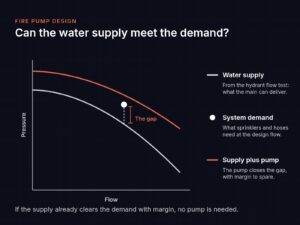
The sprinkler demand is a single point: for example, 720 gpm at 58 psi at the base of the riser for 90 minutes, including 250 gpm of hose stream for the fire department. NFPA 13 (2022) Chapter 5 lists the acceptable sources (a public waterworks, a tank, a pump drawing from a reliable source, or a combination) and Chapter 28 sets what the hydraulic calculation has to show about them. A supply is adequate when the available pressure at the demand flow is above the required pressure, and NFPA 13 (2022) Chapter 28 requires the calculation to show the supply curve, the demand point and the margin between them.
Standpipes add a second demand that is usually larger than the sprinkler demand. Under NFPA 14 (2019) a Class I or Class III standpipe must deliver 100 psi residual at the most remote hose outlet, with 500 gpm for the first standpipe and 250 gpm for each additional standpipe, capped at 1,000 gpm where the building is sprinklered throughout and 1,250 gpm otherwise (Chapter 7). In a high-rise the pressure to reach the roof outlet, plus friction, is the number that decides whether a fire pump is required and how large it is.
| Demand | What sets it | Typical range | Standard |
|---|---|---|---|
| Light and ordinary hazard sprinklers | Density over a remote area, plus hose stream, for the listed duration | About 250 to 1,000 gpm at 40 to 80 psi for 30 to 90 minutes | NFPA 13 (2022) Chapters 19 and 28 |
| Storage sprinklers (early suppression fast response (ESFR), control mode specific application (CMSA) and in-rack) | Number of operating sprinklers at a minimum pressure, plus hose stream, for 60 to 120 minutes | About 1,200 to 3,000 gpm at 50 to 100 psi | NFPA 13 (2022) Chapters 20 to 25 and 28 |
| Class I or III standpipe | 100 psi residual at the most remote outlet, 500 gpm first standpipe plus 250 gpm each additional | 500 to 1,250 gpm; pressure set by building height | NFPA 14 (2019) Chapter 7 |
| Site fire flow for hydrants | Building area and construction type, reduced for sprinklers | 1,000 to 4,000 gpm for 2 to 4 hours (varies by jurisdiction) | IFC Appendix B, where adopted, or NFPA 1 Chapter 18 |
The fire flow in the last row is a different question from the sprinkler demand. Fire flow is the water the fire department needs from hydrants to fight a fire in the building from outside, and the fire code sets it by floor area and construction type in IFC Appendix B, reduced where the building is sprinklered. New York City does not use Appendix B; its water supply and hydrant rules sit in the NYC Fire Code and in the Department of Environmental Protection's standards. This guide only places that arithmetic in the sequence.
The Water Supply Train: Main to Hose Outlet
How the Supply Is Measured and Plotted
The supply side of the comparison comes from a hydrant flow test. A gauge on one hydrant records the static pressure with nothing flowing and the residual pressure while a second hydrant on the same main flows water through a pitot gauge. NFPA 291 (2022) Chapter 4 sets the procedure, and the 2022 edition recommends enough hydrants be flowed to drop the residual pressure by at least 10 percent from static; the 2019 edition asked for 25 percent. The same chapter sets 20 psi as the residual pressure that the available flow is projected to.
Two readings define a curve. Water flow through a pipe network follows a 1.85-power relationship between flow and pressure loss, so when static and residual pressures are plotted on paper whose horizontal axis is scaled to the 1.85 power, the supply becomes a straight line. The engineer then plots the sprinkler demand point on the same graph and reads the distance between the two. The Process article on how a hydrant flow test is run and read covers the field procedure.
A supply that barely clears the demand is not a safe design. Public mains lose pressure as the system ages and as new customers connect, and a test taken on a cool morning reads higher than the same main on a summer afternoon. Most engineers in the region design to a margin of about 10 percent or 10 psi at the demand flow, and some AHJs (authorities having jurisdiction) write a minimum margin into their review standards.
Supply Curve Against the Sprinkler Demand Point
Three Formulas Behind Every Water Supply Analysis
Pitot flow (NFPA 291, 2022, Chapter 4): Q = 29.84 × c × d² × √p, where Q is flow in gpm, c is the outlet coefficient (0.90 for a smooth rounded hydrant outlet, 0.80 for a square outlet, 0.70 for an outlet projecting into the barrel), d is the outlet diameter in inches and p is the pitot pressure in psi.
Projection to 20 psi (NFPA 291, 2022, Chapter 4): QR = QF × ((PS − PR) / (PS − PF))0.54, where QF is the flow measured, PS is static pressure, PF is the residual pressure at the test flow and PR is the residual pressure of interest, normally 20 psi.
Fire pump curve (NFPA 20, 2022, Chapter 4): the pump must deliver at least 150 percent of rated flow at not less than 65 percent of rated pressure, and its no-flow (churn) pressure may not exceed 140 percent of rated pressure (Chapter 4, Fire Pump Unit Performance).
When the City Main Is Not Enough: Pumps, Tanks and Mains
When the supply line falls below the demand point, the engineer works through a fixed order of fixes, cheapest first. The first move is to redesign the system to lower the demand: smaller remote area through a quick-response sprinkler reduction, larger pipe, a gridded layout or a different sprinkler. The second is a larger or second service from the main, which the water purveyor must approve and which NFPA 24 (2022) governs once it leaves the public right of way. Only when those fail does the project add a pump, and only when the main cannot supply the flow at all, or the purveyor caps the draw, does it add a tank.
A fire pump adds pressure, not water. NFPA 20 (2022) requires the suction source to deliver the pump's full 150 percent flow, and the pressure at the suction flange may not drop below 0 psi gauge, with 20 psi the common purveyor and AHJ limit for a pump drawing from a public main (Chapter 4). The live Trigger article on whether a building needs a fire pump covers the decision in detail, and the live Process article on the diesel fire pump acceptance test covers how NFPA 20 Chapter 14 proves the installed pump; both are linked in the questions table below.
A tank adds water, and sometimes pressure. NFPA 22 (2023) covers the tank itself: gravity tanks, suction tanks, pressure tanks and break tanks, their capacity, their heating and their fill. A break tank is the usual answer when the main has enough pressure for domestic use but the purveyor will not allow a direct pump draw; it holds a fraction of the duration and refills from the main while the pump runs. A suction tank holds the full demand for the full duration when the site has no reliable main, which is common in Pennsylvania and Maryland industrial parks served by small systems.
The private fire service main is the piping that ties all of this together outside the building. NFPA 24 (2022) sets its materials, depth of cover, thrust restraint, flushing rate and the 2-hour hydrostatic test at 200 psi or 50 psi above working pressure (Chapter 10). The Definition article on the private fire service main, linked in the table below, defines it and separates it from the public main and the domestic service.
Supply Short? The Fix Order Engineers Follow
Standpipes and High-Rise Pressure
A standpipe is a vertical pipe with hose outlets on each floor that lets firefighters connect hose inside the building instead of dragging it up the stairs. The IBC (2021) Section 905.3.1 requires a Class III standpipe where the floor level of the highest story is more than 30 ft above the lowest level of fire department vehicle access, and allows a Class I standpipe instead where the building is fully sprinklered; other triggers in Section 905.3 cover assembly, covered malls, stages and buildings under construction. NFPA 14 (2019) sets the design: Class I for fire department use with 2 1/2 in. outlets, Class II for occupant use with 1 1/2 in. hose, and Class III with both.
Pressure is the whole problem in a standpipe design. The 100 psi required at the roof outlet, plus about 0.433 psi for every foot of elevation, plus friction in the riser, sets the pressure the pump must produce at grade. In a 20-story building that number often lands near 250 psi, and NFPA 14 (2019) caps the pressure at any hose outlet at 175 psi and requires pressure-reducing valves where the static pressure would exceed it (Chapter 7). Above a certain height the system is split into zones with separate pumps or a transfer pump.
Most standpipe systems in the region are combined systems that also feed the floor sprinklers from the same riser. NFPA 14 (2019) Chapter 7 sets the combined demand, and NFPA 13 (2022) Chapter 28 requires the sprinkler calculation to account for it. Under NFPA 14 (2019) Chapter 7 the combined standpipe demand is capped at 1,000 gpm where the building is sprinklered throughout and 1,250 gpm otherwise, and the pump is sized to the larger of that figure and the sprinkler demand; DGA's standpipe design work and the commercial high-rise sector page below describe the projects where this governs.
What the AHJ and the Water Purveyor Each Control
Two different authorities decide a water supply, and they do not always agree. The water purveyor (a municipal water department or a private utility such as New Jersey American Water, Aqua Pennsylvania or the Philadelphia Water Department) owns the public main, runs or witnesses the hydrant flow test, approves the size of the tap and the service, and often limits how far a fire pump may draw the main down. The AHJ for the building code (the building department, fire marshal or fire department) reviews the hydraulic calculation, the pump room and the standpipe design, and witnesses the acceptance tests under NFPA 20 Chapter 14 and NFPA 24.
The purveyor's rules frequently govern. Many utilities in the region will not release a flow test older than 6 or 12 months, require their own crew to run it, and require a reduced-pressure backflow preventer on the fire service that costs 10 to 15 psi of the available pressure before the water reaches the riser.
The AHJ controls the sequence after the design is set. In New York City, sprinkler and standpipe work is filed with the Department of Buildings (DOB) and the Fire Department (FDNY) witnesses the standpipe and fire pump tests; outside the city, the local code enforcement official or fire marshal does both. The approvals hub linked at the end covers each jurisdiction's filing path; the table below gives the editions and the names.
From Flow Test to Acceptance: The Water Supply Sequence
Code Editions by State
Water supply requirements come from three places in every jurisdiction: the building code that adopts NFPA 13, 14 and 20 by reference, the fire code that sets fire flow and hydrant rules, and the water purveyor's own standards. The table lists the adopted editions as of October 2026, the AHJ that reviews the design and the name of the filing. Local amendments are not shown.
Water Supply Codes, Reviewers and Filings by Jurisdiction
| Jurisdiction | Adopted code and edition (as of October 2026) | Fire flow and hydrants | AHJ | Filing |
|---|---|---|---|---|
| New York State (outside NYC) | 2025 Uniform Code (2024 I-Codes): NFPA 13 (2022), NFPA 14 (2024), NFPA 20 (2022), NFPA 24 (2022) | 2024 IFC Appendix B and C where the municipality adopts them; purveyor flow test | Local code enforcement official; local fire department for hydrants | Building permit with sprinkler and standpipe drawings and hydraulic calculations |
| New York City | 2022 NYC Building Code and 2022 NYC Fire Code: NFPA 13 (2016), NFPA 14 and NFPA 20, as amended in Appendix Q | No IFC Appendix B; hydrant flow tests through the Department of Environmental Protection; NYC Fire Code Chapter 5 | Department of Buildings for design; FDNY witnesses standpipe and pump tests | DOB NOW sprinkler (SP) and standpipe (SD) work types; FDNY test witnessing |
| New Jersey | Uniform Construction Code (UCC) 2024 I-Codes (effective August 17, 2026): NFPA 13 (2022), NFPA 14 (2024), NFPA 20 (2022); Uniform Fire Code on a 2018 IFC basis | Fire flow per 2018 IFC Section 507 as modified by the UFC; local fire official and purveyor | Municipal fire protection subcode official; local fire official for hydrants | UCC construction permit, fire protection subcode technical section |
| Pennsylvania | UCC 2021 I-Codes (January 1, 2026): NFPA 13 (2019), NFPA 14 (2019), NFPA 20 (2019); no statewide fire code | IFC Appendix B and C only where a municipality adopts a fire code; Philadelphia Fire Code | Municipal or third-party code official; Philadelphia Department of Licenses and Inspections (L&I) | UCC building permit; Philadelphia fire suppression permit |
| Maryland | 2021 IBC: NFPA 13 (2019), NFPA 14 (2019), NFPA 20 (2019); NFPA 1 (2024) for fire prevention | NFPA 1 (2024) Chapter 18 water supply and hydrant provisions; county fire marshal standards | County building official and county or State Fire Marshal | County building permit plus fire marshal plan review |
| Delaware | Regulation 701 (2026): NFPA 1 (2024), NFPA 13 (2025), NFPA 20 (2025), NFPA 25 (2023); IBC by county (2021 in New Castle and Sussex, 2018 in Kent and Wilmington) | NFPA 1 (2024) Chapter 18 water supply provisions; State Fire Marshal review | Office of the State Fire Marshal (Wilmington Fire Marshal inside the city) | State Fire Marshal plan review before the county building permit |
Editions as listed in DGA's Fire Code Cheat Sheet for NY, NJ, PA, MD and DE.
Key Concepts
These are the terms the Water Supply articles use. Each is defined once here so the spokes can use the term without re-explaining it.
- Static pressure: the pressure in the main with no water flowing, read on the gauge hydrant at the start of a flow test.
- Residual pressure: the pressure remaining in the main while the test flow is discharging, read on the same gauge hydrant.
- Pitot pressure: the velocity pressure measured in the stream leaving a flowing hydrant outlet, converted to gpm with the pitot equation.
- Demand point: the flow and pressure the sprinkler or standpipe system requires at the point where the supply is compared, usually the base of the riser.
- Supply curve: the line through the static and residual readings on 1.85-power graph paper, showing the pressure the main can hold at any flow.
- Safety margin: the pressure difference between the supply curve and the demand point at the demand flow, held in reserve against main deterioration and seasonal change.
- Hose stream allowance: the extra flow, typically 100 to 500 gpm, added to the sprinkler demand for fire department hose use under NFPA 13.
- Rated point: the flow and pressure stamped on a fire pump nameplate, the 100 percent point on its curve.
- Churn: the pump running with no water flowing, whose pressure NFPA 20 limits to 140 percent of rated pressure.
- Break tank: a tank that receives water from the public main and holds part of the demand so a pump can draw from it without pulling the main below the purveyor's limit.
- Private fire service main: the owner-owned underground piping from the public main or private source to the risers, private hydrants and fire department connections, built under NFPA 24.
- Fire flow: the water the fire code requires to be available from hydrants for exterior firefighting, set by building area and construction type in IFC Appendix B or NFPA 1 Chapter 18.
Working With DGA on Water Supply
DGA's engineers request and witness hydrant flow tests, plot the supply against sprinkler and standpipe demands before a design is committed, size fire pumps and tanks, prepare the sealed hydraulic calculations and pump room drawings for permit, and witness NFPA 20 Chapter 14 acceptance tests for owners. The scope of work and the fee drivers are described on the fire pump design service page and the standpipe design service page, and the kinds of buildings where standpipe pressure governs are described on the commercial high-rise sector page.
DGA designs fire pumps, standpipes and water supply improvements and witnesses their acceptance tests across New York, New Jersey, Pennsylvania, Maryland and Delaware. Project briefs get confirmation and preliminary code feedback within one business day. See where DGA works →
Four tools support the first conversation. The Hydrant Flow Test Calculator turns pitot readings into gpm and projects the available flow to 20 psi. The Sprinkler Water Supply Analysis tool plots that test against a sprinkler demand and reports the margin.
The Fire Pump Test Curve Plotter checks an acceptance or annual test against the NFPA 20 churn, rated and 150 percent points. The IFC Appendix B Fire Flow Calculator estimates the site fire flow from building area and construction type where a jurisdiction adopts the appendix.
Key Takeaway: A fire protection water supply is proven, not assumed. A current NFPA 291 flow test defines what the main can deliver; the NFPA 13 Chapter 28 calculation shows whether that clears the sprinkler and standpipe demand with margin; and when it does not, the fix order is redesign, larger service, fire pump and then tank, each under its own standard and each proven by an acceptance test the AHJ witnesses. Settling the supply before the permit is filed is the single largest schedule and cost protection a project has.
Frequently Asked Questions
Does every sprinklered building need a fire pump?
No. A fire pump is required only when the public main, after a current flow test, cannot deliver the sprinkler or standpipe demand at the required pressure with margin, and redesign or a larger service cannot close the gap. Most low-rise buildings on a strong municipal main are designed without a pump; most high-rises need one for the standpipe pressure.
How old can a hydrant flow test be for a sprinkler design?
Conditional: most AHJs and water purveyors in the region accept a test no older than 6 to 12 months at permit, and some require a new test if the main has been worked on since. NFPA 13 (2022) Section 4.5.1.1 limits the test to 12 months before working plan submittal unless the AHJ approves otherwise.
What is the 20 psi residual in a flow test?
The 20 psi residual is the pressure NFPA 291 (2022) uses as the floor when projecting available flow, because fire pumps drawing from a main and hydrants in use are generally kept from pulling the main below that point. The flow available at 20 psi is the standard way to state a main's capacity, and the sprinkler demand is then compared against the full curve.
Is a fire pump the same as a booster pump on the domestic water?
No. A fire pump is a listed pump installed under NFPA 20 with its own controller, power source, test header and acceptance test, dedicated to the fire protection system. A domestic booster pump is a plumbing pump that cannot serve sprinklers or standpipes, and the two are kept on separate services with a backflow preventer on the fire side.
Who pays for and runs the hydrant flow test?
Conditional: the water purveyor runs or witnesses the test in most of New York City, New Jersey and Philadelphia and charges a fee, while in much of Pennsylvania, Maryland and Delaware the sprinkler contractor or engineer runs it with the purveyor's permission. The owner or developer pays in either case, and the test report becomes part of the permit submission.
This guide is general information, not a substitute for a project-specific water supply analysis. Code editions, local amendments, purveyor standards and reviewer practice change; confirm the adopted code and the authority having jurisdiction for each project.
Not Sure the Main Can Carry the Design?
Send the site address, the intended occupancy and any flow test on file. DGA plots the supply against the demand, states whether a pump or tank is needed, and prepares the sealed design and the acceptance test plan. Project briefs get confirmation and preliminary code feedback within one business day.
From the project portfolio
ESFR sprinkler design for a 600,000 SF distribution center
- 600,000 SF
- 40 ft clear height
- K-25.2 ESFR
Result: Design approved on the first submission, with no changes to the steel package.
Read the project story Warehouse & Distribution · Cranbury area, NJRack storage sprinkler design and fire pump analysis for a fulfillment center
- 3-level pick modules
- In-rack sprinklers
- Diesel fire pump
Result: The pump and tank were sized right the first time, and the system passed acceptance testing on day one.
Read the project story High-Rise · Philadelphia, PAStandpipe and fire pump analysis for a high-rise condominium
- 30 stories
- Failing fire pump
- Pressure-reducing valves
Result: The new pump passed acceptance, and lower-floor pressures came into range.
Read the project storyOther topics
All Insights- Sprinkler Systems3 articles
- Storage and Commodities42 articles
- Fire Alarm1 article
- Life Safety and Egress1 article
- Inspection and Testing2 articles
- Approvals by Jurisdiction62 articles
- Code Strategy2 articles
- Working with a Fire Protection Engineer1 article
Need an engineer on this?
DGA Fire Protection Engineering works on these questions every week for owners, architects and contractors in New York, New Jersey, Pennsylvania, Maryland and Delaware.