Insights topic · 42 articles
Storage and Commodities
When a high-piled storage permit applies, how commodities are classified, and when ESFR or in-rack sprinklers are needed under IFC Chapter 32.
Storage changes sprinkler design more than almost anything else in a building. Once combustible storage goes above 12 feet (6 feet for high-hazard commodities), IFC Chapter 32 and the storage chapters of NFPA 13 apply, and what is stored, how it is packaged and how high it is stacked set the protection. The guides below cover commodity classification, ESFR and in-rack sprinklers, permits and the problems that show up when a warehouse changes what it stores.
Start here
When Does IFC Chapter 32 Apply to High-Piled Storage?
IFC Chapter 32 applies when combustible storage tops 12 ft, or 6 ft for certain high-hazard commodities where the fire code official requires it. What triggers it, how Table 3206.2…
Questions this topic answers
What it is
| Question | Code basis | Last reviewed |
|---|---|---|
| What Is Encapsulation in Storage Sprinkler Design? | NFPA 13 (2016 NYC Appendix Q, 2019, 2022, 2025) Ch. 3, 20, 21, 22, 23; 2021 IFC 3201.3; 2024 IFC (NYS) Ch. 32; 2018 IFC (NJ UFC) Ch. 32; 2021 IBC 413.1; NFPA 1 (2024) Ch. 34 | Nov 2026 |
| What Is a Freezer Preaction Sprinkler System? | NFPA 13 Ch. 8, 21 to 23 (2022; 2019 PA and MD; 2016 NYC App. Q; 2025 DE); NFPA 72 (2022); NFPA 25 Ch. 13 (2023) | Nov 2026 |
| What Are Flue Spaces and Why Do They Matter? | NFPA 13 Ch. 3, 20, 25 (2022; 2019 PA and MD; 2016 NYC App. Q; 2025 DE); IFC 3208 (2021) | Nov 2026 |
| What Is a High-Piled Storage Plan? | 2021 IFC Ch. 32 (Sec. 3201.3, 3203, Table 3206.2); 2024 IFC; 2022 NYC Fire Code Ch. 32; NJ UFC N.J.A.C. 5:70 (2018 IFC); NFPA 1 (2024) Ch. 34; NFPA 13 (2022) Ch. 20 | Nov 2026 |
| What Is Commodity Classification Under NFPA 13? | NFPA 13 Ch. 20 (2022/2025); IFC 3203; FM Global DS 8-1 (insurer) | Oct 2026 |
When it is required
| Question | Code basis | Last reviewed |
|---|---|---|
| When Does IFC Chapter 32 Apply to High-Piled Storage? | IFC Ch. 32 (2021 PA; 2018 basis NJ UFC; 2022 NYC FC; 2024 basis NYS); NFPA 13 Ch. 20; NFPA 1 Ch. 34 (2024) MD and DE | Oct 2026 |
| What Fire Protection Does a Warehouse Need? | 2021 IBC 903.2.9 (2024 IBC in NYS and NJ); 2022 NYC Building Code 903.2.9; IFC Chapter 32 (2021 and 2024; 2018 basis in NJ UFC and Philadelphia); NFPA 1 (2024) Chapter 34 in MD and DE; NFPA 13 Chapters 20 to 25 (2016 via NYC Appendix Q, 2019 PA and MD, 2022 NYS and NJ, 2025 DE); NFPA 20 | Nov 2026 |
| What Fire Protection Do Cold Storage and Food Plants Need? | IBC 2021/2024 Sec. 903.2.4, 903.2.9, 311.3, Ch. 26; NFPA 13 Ch. 4, 8, 16, 20 (2022 NYS/NJ; 2019 PA/MD; 2016 NYC App. Q; 2025 DE); IFC Ch. 22, Ch. 32, Sec. 608 (2021); NFPA 1 (2024) Ch. 34, 53; NFPA 25 Ch. 14 (2023); IIAR 2; NFPA 660 (2025) | Nov 2026 |
| What Rules Apply to Carpet, Mattress and Furniture Storage? | 2021 IBC 903.2.4.3, 903.2.7.2, 903.2.9.4; 2024 IBC 903.2 (NYS, NJ); 2018 IBC 903.2 (Kent, Wilmington DE); 2022 NYC BC 903.2.4, 903.2.7, 903.2.9; 2021 IFC Ch. 32, Table 3203.8; NFPA 13 (2016 NYC App. Q, 2019, 2022, 2025) Ch. 20 to 25 | Nov 2026 |
| What Fire Protection Does a Retail Store Need? | 2021 IBC 903.2.7 (2024 IBC in NYS and NJ); 2021 IFC Ch. 32 (2024 IFC in NYS, 2018 IFC in NJ UFC and Philadelphia); 2022 NYC Building and Fire Codes; NFPA 13 (2016 NYC App. Q, 2019 PA and MD, 2022 NYS and NJ, 2025 DE); NFPA 1 and 101 (2024) in MD and DE | Nov 2026 |
| What Fire Code Rules Apply to Outdoor Storage? | IFC 2024 (2025 Fire Code of New York State); 2022 NYC Fire Code; IFC 2018 (NJ Uniform Fire Code, Philadelphia Fire Code); IFC 2021 (PA local adoption); NFPA 1 (2024) in MD and DE | Nov 2026 |
| What Storage Rules Apply to Tires, Rolled Paper and Cotton? | NFPA 13 (2016 NYC App. Q, 2019, 2022, 2025); IFC 2018, 2021, 2024 Ch. 32, 34 and 37; IBC 2021 Sec. 903.2.9.2; NFPA 1 (2024) Ch. 33 and 34 | Nov 2026 |
| What Are the Fire Code Rules for Idle Pallet Storage? | NFPA 13 (2016 per NYC Appendix Q, 2019, 2022, 2025) Ch. 20 (Sec. 20.14 in 2019; Sec. 20.17 in 2022 and 2025); IFC (2018, 2021, 2024) Ch. 32, Table 3203.8, Sec. 315.7; 2022 NYC Fire Code Ch. 32; NFPA 1 (2024) Ch. 34, Sec. 34.11.3; 2021 IBC Sec. 413 | Nov 2026 |
| When Does a Warehouse Mezzanine Become a Story? | 2021 IBC Sections 505, 506, 903.2, 907.2, Ch. 10 and 22 (2024 IBC basis NYS and NJ; 2022 NYC BC Section 505; 2021 IBC PA, MD, DE New Castle and Sussex; 2018 IBC DE Kent and Wilmington); NFPA 101 (2024) Ch. 8 MD and DE; IFC Ch. 32 | Nov 2026 |
| When Does a Self-Storage Facility Need Special Protection? | 2021 IBC Sections 903.2.9, 903.2.9.4, 907.2.10 and Ch. 10 (PA, MD, DE New Castle and Sussex); 2024 IBC and IFC (NYS 2025 Uniform Code, NJ UCC); 2018 IBC (DE Kent and Wilmington); 2022 NYC Building Code; 2021 IFC Sections 503 and 506 and Ch. 32; NFPA 13 (2016 NYC Appendix Q, 2019 PA and MD, 2022 NYS and NJ, 2025 DE); NFPA 1 and NFPA 101 (2024) MD and DE | Nov 2026 |
| What Does the Fire Code Require for Records Storage? | NFPA 13 (2016 NYC App. Q; 2019 PA, MD; 2022 NYS, NJ; 2025 DE) Ch. 4, 9, 20, 21, 24, 26; IFC Ch. 2 and 32 (2021; 2024 NYS; 2018 NJ UFC; 2022 NYC FC); IBC 311.2 and 903.2.9 (2021; 2024 NYS, NJ); NFPA 1 (2024) Ch. 34 (MD, DE); NFPA 232 (2022); 36 CFR 1234.12 | Nov 2026 |
| When Does a Warehouse Need Draft Curtains? | NFPA 13 (2016 as modified by NYC Appendix Q, 2019, 2022, 2025); NFPA 204 (2021); IFC and IBC Section 910 (2018, 2021, 2024); IFC Table 3206.2 (2018, 2021, 2024); NFPA 1 (2024) | Nov 2026 |
| When Does a Warehouse Need Fire Department Access Doors? | 2021 IFC Ch. 32 (Table 3206.2, Sections 3206.6 and 3206.7), Sections 503, 504.1, 506.1; 2024 IFC (2025 Fire Code of NYS); 2022 NYC Fire Code Ch. 32; NJ UFC (2018 IFC); Philadelphia Fire Code (2018 IFC); PA UCC 2021 IBC 413; NFPA 1 (2024) Ch. 18 and 34 (MD, DE) | Nov 2026 |
| Does Mezzanine Storage Count as High-Piled Storage? | 2021 IFC Ch. 2 and 32 (2024 IFC basis NYS; 2018 IFC basis NJ UFC; 2022 NYC Fire Code Ch. 32); 2021 IBC Section 505; NFPA 13 (2016 NYC Appendix Q, 2019 PA and MD, 2022 NYS and NJ, 2025 DE); NFPA 1 (2024) Ch. 34 MD and DE | Nov 2026 |
| Does Storing Lithium-Ion Batteries Change Sprinkler Design? | 2024 IFC Sec. 320 and 104.2.3 (NYS); 2021 IFC Ch. 32 and 104.10; 2018 IFC (NJ UFC); NYC 2022 Fire Code; NFPA 1 (2024) MD and DE; FM Global DS 7-112 (Oct 2024); NFPA 13 (2022) Ch. 20, 24, 27 | Nov 2026 |
| What Fire Code Rules Apply to Storage in a Big-Box Store? | IFC Ch. 32 (2021; 2018 basis NJ UFC and Philadelphia; 2022 NYC FC; 2024 basis NYS); IBC 903.2.7 (2021); NFPA 13 Ch. 20 (2022); NFPA 1 Ch. 34 (2024) MD and DE | Nov 2026 |
| When Does Automated Storage Need Special Fire Protection? | NFPA 13 Ch. 1, 20, 23, 24, 25 (2022; 2019 PA and MD; 2016 NYC App. Q; 2025 DE); FM DS 8-34, 8-9; IFC Ch. 32 incl. 3209 (2021); IBC 2209 (2021) | Nov 2026 |
| When Does High-Piled Storage Need Smoke and Heat Removal? | IFC 3206.2, 3206.8, 910 (2021; 3206.7 on the 2018 basis NJ UFC and Philadelphia; 2022 NYC FC; 2024 basis NYS); NFPA 204; NFPA 1 Ch. 34 (2024) MD and DE | Nov 2026 |
| What Aisle Widths Does the Fire Code Require in a Warehouse? | IFC 3206.10 (2021; 2018 basis NJ UFC and Philadelphia; 2022 NYC FC; 2024 basis NYS); NFPA 13 Ch. 20; NFPA 1 Ch. 34 (2024) MD and DE; IBC Ch. 10 | Nov 2026 |
| When Are In-Rack Sprinklers Required? | NFPA 13 Ch. 20 to 25 (2022; 2019 PA and MD; 2016 NYC App. Q; 2025 DE) | Nov 2026 |
| When Does Cold Storage Need Preaction Sprinklers? | NFPA 13 (2022; 2019 in PA and MD; 2025 in DE), NFPA 25 (2023), IFC Chapter 32, FM Global DS 8-29 | Nov 2026 |
| How High Can You Store Under Ceiling-Only Sprinklers? | NFPA 13 (2022; 2019 in PA and MD under the 2021 IBC; 2025 in DE) Ch. 20 to 25; IFC Chapter 32 (2021); FM Global DS 8-9 | Nov 2026 |
How the process works
| Question | Code basis | Last reviewed |
|---|---|---|
| How Do You Get a High-Piled Storage Permit in Pennsylvania? | PA UCC 34 Pa. Code Ch. 403 (2021 I-Codes, Jan 1, 2026); 2021 IBC Ch. 9; 2021 IFC Ch. 32 where locally adopted; NFPA 13 2019; Philadelphia Fire Code | Nov 2026 |
| How Do You Get a High-Piled Storage Permit in NYC? | NYC Fire Code 2022 Ch. 32, 105.6; NYC Building Code 2022 Ch. 9, App. Q; NFPA 13 2016 as modified by App. Q | Nov 2026 |
| How Do You Check a Warehouse’s Sprinklers for a New Tenant? | NFPA 13 (2022; 2019 in PA and MD; 2025 in DE), NFPA 25 (2023), NFPA 291 (2022), 2021 IFC Ch. 32, 2022 NYC Fire Code Ch. 32, NJ UCC and UFC, NFPA 1 (2024) Ch. 34 | Nov 2026 |
| How Do You Get a High-Piled Storage Permit in New Jersey? | N.J.A.C. 5:23 (UCC, 2024 IBC eff. Aug 17, 2026); N.J.A.C. 5:70 (UFC, 2018 IFC); 2018 IFC Chapter 32; NFPA 13 (2022) | Nov 2026 |
How the options compare
| Question | Code basis | Last reviewed |
|---|---|---|
| Rack, Palletized or Shelf Storage: How Does NFPA 13 Differ? | NFPA 13 (2016 NYC Appendix Q, 2019, 2022, 2025) Ch. 3, 20 to 23, 25; 2021 IFC Ch. 32 (Sections 3202, 3207, 3208); 2024 IFC (NYS), 2018 IFC (NJ UFC), 2022 NYC Fire Code Ch. 32; NFPA 1 (2024) Ch. 34 (MD, DE) | Nov 2026 |
| Cartoned vs Exposed Plastics: Why Does Packaging Matter? | NFPA 13 (2016 as modified by NYC Appendix Q; 2019; 2022; 2025) Chapters 3, 20 to 23 and 25; IFC (2018, 2021, 2024) Section 3203 and Chapter 32; NFPA 1 (2024) Chapter 34; 2021 IBC Section 413 | Nov 2026 |
| ESFR or In-Rack Sprinklers: Which Protects Rack Storage? | NFPA 13 Ch. 23 and 25 (2022; 2019 PA and MD; 2016 NYC App. Q; 2025 DE); FM DS 8-9 | Nov 2026 |
| ESFR or CMSA Sprinklers: Which Should a Warehouse Use? | NFPA 13 Ch. 13, 14, 22, 23 (2022 and 2025); FM Global DS 8-9 (insurer) | Oct 2026 |
Calculations
| Question | Code basis | Last reviewed |
|---|---|---|
| How Is Storage Height and Sprinkler Clearance Calculated? | NFPA 13 (2022; 2019 PA and MD under the 2021 IBC; 2016 NYC App. Q; 2025 DE) Ch. 3, 9, 13, 14, 20 to 25, 28; IFC Chapter 32 (2021) | Nov 2026 |
| How Do You Classify a Mixed Commodity Under NFPA 13? | NFPA 13 Ch. 20 (2022; 2019 PA and MD; 2016 NYC App. Q; 2025 DE), 20.4 mixed commodities | Nov 2026 |
By state and city
| Question | Code basis | Last reviewed |
|---|---|---|
| How Do Maryland and Delaware Regulate High-Piled Storage? | NFPA 1 2024 Ch. 34 (MD COMAR 29.06.01; DE Reg. 701 2026); NFPA 13 2019 (MD, 2021 IBC) and 2025 (DE); 2021 IBC | Nov 2026 |
Problems and how to fix them
| Question | Code basis | Last reviewed |
|---|---|---|
| Why Do Freezer Sprinkler Pipes Get Ice Plugs? | NFPA 13 (2022; 2019 in PA and MD; 2025 in DE; 2016 with Appendix Q in NYC); NFPA 25 (2023); IFC Section 901.7 and Chapter 35 (2024 NYS, 2018 basis NJ and Philadelphia); NFPA 1 (2024) Chapters 13 and 41 in MD and DE; FM Global Data Sheet 8-29 (paraphrased) | Nov 2026 |
| Why Has a Warehouse Outgrown Its Sprinkler System? | NFPA 13 Ch. 20 to 25, 28 and 29 (2022; 2019 PA and MD; 2016 NYC App. Q; 2025 DE); NFPA 25 Ch. 4 (2023); IFC 3201.3 (2021); NFPA 291; FM DS 8-1 and 8-9 | Nov 2026 |
| Why Do Solid Shelves in Racks Change the Sprinkler Design? | NFPA 13 Ch. 20 and 25 (2022; 2019 PA and MD; 2016 NYC App. Q; 2025 DE); FM DS 8-9 | Nov 2026 |
| Why Do Open-Top Bins Defeat Rack Sprinklers? | NFPA 13 (2022) 20.3.3 and 23.1.3.2; FM Global DS 8-34 (July 2024) and DS 7-29 | Oct 2026 |
High-piled storage fire protection is the set of fire code and sprinkler rules that apply once combustible goods are stored more than 12 ft high, or, where the fire code official requires it, more than 6 ft high for high-hazard commodities such as Group A plastics, rubber tires and some flammable liquids. Two documents do the work: Chapter 32 of the International Fire Code (IFC), which decides when a permit and a high-piled storage plan are required and what the building must have, and NFPA 13, the National Fire Protection Association (NFPA) sprinkler standard, which sets how the sprinkler system is designed for the commodity, the storage height and the storage arrangement. In Maryland and Delaware the fire code side comes from NFPA 1 Chapter 34 instead of IFC Chapter 32, and NFPA 1 counts Group A plastics as high-piled above 5 ft.
This guide is for warehouse owners, developers, industrial tenants, architects and brokers in New York, New Jersey, Pennsylvania, Maryland and Delaware who need to understand what drives the cost and the schedule of a storage building before they sign a lease, buy a building or file for a permit. It explains the mental model, lists every question the Storage and Commodities hub answers, and gives the adopted code editions by state as of October 2026. Each question gets its own article; this page sends the reader to the right one.
At a Glance: High-Piled Storage Fire Protection
- What this topic covers: commodity classification, the 12 ft and 6 ft triggers, high-piled storage permits and plans, rack storage, flue spaces, ceiling-only versus in-rack sprinklers, early suppression fast response (ESFR) and control mode specific application (CMSA) sprinkler design, smoke and heat removal, aisles, and the problem of warehouses that outgrow their sprinklers.
- Governing codes and editions: IFC Chapter 32 (2024 edition under the 2025 New York State Uniform Code; 2022 New York City Fire Code; 2018 basis under the New Jersey Uniform Fire Code; 2021 by local adoption in Pennsylvania); NFPA 1 (2024) Chapter 34 in Maryland and Delaware; NFPA 13 Chapters 20 to 25 (2022 edition under the 2024 I-Codes in New York State and New Jersey and as referenced by NFPA 1 in Maryland; 2019 edition under the 2021 IBC in Pennsylvania and for the county sprinkler permit in Maryland; 2025 edition in Delaware); FM Global Data Sheet 8-9 where an insurer sets the design basis.
- Who it applies to: any building or tenant space with more than 500 sq ft of storage above the height triggers: distribution centers, third-party logistics tenants, cold storage, manufacturing with finished-goods storage, big-box retail with high racks, self-storage with high stacking and data or records storage.
- The 3 decisions that drive cost: what commodity class the goods really are (plastics content is the usual surprise), how high the storage goes relative to the ceiling, and whether the arrangement is open rack, solid shelving, palletized or encapsulated. Those three decide whether a ceiling-only system works or in-rack sprinklers, a bigger water supply or a fire pump are needed.
- Where to start: confirm the commodity class and the storage height on paper first, then check the existing sprinkler design basis against NFPA 13, then find out which permit the local fire official requires. Most expensive mistakes come from doing those steps in the wrong order.
- Related services and tools: DGA's high-piled storage service, the industrial and high-hazard sector page, the Sprinkler Water Supply Analysis tool and the Fire Code Cheat Sheet (all linked below).
What Decides Warehouse Fire Protection: Commodity, Height and Arrangement
Three facts about the stored goods decide almost everything about warehouse fire protection: what the goods are made of, how high they are stacked, and how they are arranged. The code and the sprinkler standard both start from these three inputs. A change to any one of them can change the permit, the sprinkler design and the water supply.
Commodity classification sorts goods into Class I through Class IV, then Group A, B and C plastics, based on how much heat the product and its packaging release in a fire. Cartoned canned food is Class I or II; wood furniture is Class III; a pallet of cartoned plastic housewares is Class IV or Group A depending on the plastic content. NFPA 13 (2022) Chapter 20 holds the classification rules, and IFC Chapter 32 uses the same classes to decide what the building needs. The Definition article on commodity classification, linked in the questions table above, explains the classes and why Group A plastics change the design.
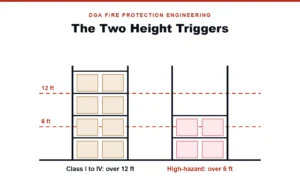
Storage height matters twice. The fire code uses 12 ft (Class I to IV) and, where the fire code official requires it, 6 ft (high-hazard commodities) as the line where Chapter 32 starts to apply, under the high-piled storage definitions in IFC Section 202 and the scope in Section 3201.1. NFPA 1 (2024) sets the Group A plastics line lower, at 5 ft.
NFPA 13 then uses storage height and ceiling height together to pick the sprinkler design: a system that protects Class III goods at 20 ft under a 30 ft roof may protect nothing at 30 ft under a 36 ft roof. The clearance from the top of storage to the sprinkler deflector, 18 in. for standard spray sprinklers and 36 in. for most ESFR and CMSA designs, is part of the same rule set.
Arrangement is the third input. Palletized or solid-piled goods burn differently from goods in open racks, which let fire climb the flue spaces. Solid shelves in racks, open-top containers, shrink-wrapped (encapsulated) loads and very narrow aisles each shift the design. NFPA 13 has separate rules for each arrangement, which is why the same commodity at the same height can need a different system in a different rack layout.
The Storage Height Ladder
How the Fire Code and NFPA 13 Divide the Work
The fire code decides whether a storage area is regulated and what the building must provide; the sprinkler standard decides how the sprinkler system is designed. IFC Chapter 32 (or NFPA 1 Chapter 34 in Maryland and Delaware) is enforced by the fire code official, usually a fire marshal or fire prevention bureau. NFPA 13 is a referenced standard that both the building code and the fire code adopt, and the sprinkler design is reviewed by whoever reviews the construction permit.
IFC Chapter 32 answers five questions. Section 3201.1 and the Section 202 definitions set the 12 ft and 6 ft height triggers. Section 3201.2 ties the storage area to the operational permit in Chapter 1 (Section 105.5 in the 2021 and 2024 IFC, 105.6 in the 2018 IFC), which applies above 500 sq ft.
Section 3201.3 lists the construction documents, which the industry calls the high-piled storage plan. Table 3206.2 sets the building features required for each size of high-piled storage area, and Sections 3206 through 3209 add the rules for aisles, flue spaces, hose connections, smoke and heat removal, and automated storage. The Trigger article on when IFC Chapter 32 applies, linked in the questions table above, walks through the triggers in detail.
Table 3206.2 is the heart of the chapter. Its rows are ranges of high-piled storage area, from 500 sq ft up to more than 500,000 sq ft, split between Class I to IV and high-hazard commodities, and its columns are the building features: an automatic sprinkler system, fire detection, fire department access doors, smoke and heat removal, and the maximum pile dimension, storage height and pile volume for solid-piled, shelf and palletized storage. In the smaller size ranges of areas not open to the public the table offers two options, one with sprinklers designed for the storage and one without sprinklers but with detection, access doors and smoke and heat removal; areas open to the public must take the sprinkler option. The table itself is copyrighted ICC text and is not reproduced here; the high-piled storage plan cites the cell that applies.
NFPA 13 (2022) takes over once the sprinkler system has to be designed. Chapter 20 holds the general storage rules and commodity classification. Chapters 21, 22 and 23 give the ceiling-level design criteria for control mode density/area (CMDA), CMSA and ESFR sprinklers. Chapter 24 covers alternative designs based on listings and tests, and Chapter 25 covers in-rack sprinklers.
Delaware adopts the 2025 edition, which renumbers some of these sections, so a design that will be filed in Delaware should cite the 2025 text.
FM Global Data Sheet 8-9, Storage of Class 1, 2, 3, 4 and Plastic Commodities, is the insurer's version of the same rules. Where an FM-insured owner is involved, the design often has to satisfy both NFPA 13 and the data sheet, and the data sheet is sometimes more demanding on clearance, in-rack requirements and water supply duration. The code official enforces the code; the insurer enforces the data sheet through the policy.
Does IFC Chapter 32 Apply?
Two Documents, Two Jobs
- Decides whether the storage area is regulated: 12 ft or 6 ft triggers, 500 sq ft permit threshold
- Requires the high-piled storage plan and the operational permit (Sections 3201.2, 3201.3)
- Sets building features by area size: sprinklers, detection, access doors, smoke and heat removal (Table 3206.2); hose connections by Section 3206
- Sets aisle widths, flue spaces, pile dimensions and housekeeping (Sections 3206 to 3209)
- Enforced by the fire marshal or fire code official, renewed with the permit
- Classifies the commodity: Class I to IV, Group A, B and C plastics (Chapter 20)
- Picks the ceiling design: CMDA or CMSA by commodity, storage height and ceiling height, ESFR by commodity and ceiling height (Chapters 21 to 23)
- Decides when in-rack sprinklers are required and how they are spaced (Chapter 25)
- Sets clearance to deflector, hose stream allowance and water supply duration
- Reviewed with the construction permit and the sprinkler shop drawings
What a High-Piled Storage Permit and Plan Cover
A high-piled storage permit is an operational permit issued by the fire code official that allows a building or part of a building over 500 sq ft to be used for high-piled storage. The permit is tied to the premises and the approved storage arrangement, not to the construction work, and it usually has to be renewed. In New York City the Fire Department of the City of New York (FDNY) issues the permit and inspects the premises each year before renewal; New Jersey has no separate fire permit for high-piled storage, so approval runs through the Uniform Construction Code permit and the local fire official enforces IFC Chapter 32 at inspection; in Maryland, NFPA 1 (2024) Section 1.13 (Table 1.13.8) lists a high-piled storage permit for areas over 500 sq ft, but the state amendments leave whether a permit is required to the local fire marshal's policy; Delaware deletes the NFPA 1 permit sections and approves high-piled storage through State Fire Marshal plan review; in Pennsylvania the requirement depends on whether the municipality has adopted the fire code.
The high-piled storage plan is the set of construction documents that IFC Section 3201.3 requires with the permit application. The plan shows the floor plan with the high-piled storage areas marked, the commodity classes stored in each area, the storage method (palletized, solid-piled, rack, shelf or bin box), the maximum storage height, the aisle widths and rack dimensions, the flue spaces, the sprinkler design basis including density and design area or the ESFR or CMSA listing, the fire detection and smoke removal provisions, the fire department access doors and hose connections, and the location of the water supply and fire pump if there is one. A fire protection engineer usually prepares the plan because the sprinkler design basis is the part most often wrong.
Cost and schedule follow the same three inputs. As of October 2026, a storage project whose existing sprinkler system already matches the commodity and height is mostly a documentation and review exercise measured in weeks. A project that needs in-rack sprinklers, a change from standard spray to ESFR, or a fire pump and tank because the municipal supply cannot carry the new demand is a construction project measured in months, and the water supply upgrade is usually the largest single line. The drivers are the commodity surprise found in the survey, the storage height the tenant insists on, the roof height and construction of the building, and the review queue at the fire marshal's office.
The permit and plan exist to freeze the three inputs: commodity, height and arrangement. A tenant that changes from cartoned goods to exposed plastics, raises the top load beam or installs solid shelving has changed the permit basis and in most jurisdictions needs an amended plan. The permit inspection is where fire marshals catch those changes, and the most common finding is storage that no longer matches the approved plan.
From Lease to Permit: The Sequence
Why Warehouses Outgrow Their Sprinklers (Commodity Creep)
Most high-piled storage problems are not design errors; they are buildings whose contents changed after the sprinklers were installed. A warehouse built in 2005 for cartoned Class III goods at 20 ft may now hold cartoned Group A plastics at 28 ft on taller racks for a new tenant. The sprinkler system did not change, but the fire it has to control did. Engineers call this commodity creep, and it is the single most common reason a fire marshal or an insurer rejects a storage occupancy.
Plastics are the usual driver. Under the mixed commodity rules in NFPA 13 (2022) Chapter 20, a Class III pallet load becomes Class IV once its Group A plastic content passes 5 percent, and Group A once nonexpanded plastic passes 15 percent by weight or expanded plastic passes 25 percent by volume (Sections 20.4.4 and 20.4.5). Plastic at 5 percent or less is ignored. Shrink-wrapped and plastic-encapsulated loads, plastic pallets, plastic totes and open-top bins each move a commodity up the scale. The Troubleshooting article on why open-top bins defeat rack sprinklers, linked in the questions table above, covers one of these cases.
Height and arrangement creep as well. Rack uprights get extended, a top beam level is added, a mezzanine is built, or wire decking is replaced with solid shelves. Each change can push the storage past the ceiling-only limits in NFPA 13 Chapters 21 to 23 and into Chapter 25 in-rack territory, or block the flue spaces the ceiling sprinklers rely on. When the water supply cannot support the new design, the fix becomes a fire pump or a tank, and the project cost changes by an order of magnitude.
The way to catch commodity creep is to compare the stored goods against the sprinkler design basis every time a tenant, a product line or a rack layout changes, not only at permit renewal. The Comparison article on ESFR and CMSA sprinklers, linked in the questions table above, explains why the two ceiling-only options have different ceilings for commodity creep.
Inside a Double-Row Rack: Flues, Clearance and In-Rack Heads
What Insurers Add on Top of the Code
The fire code sets the minimum a building must have; the property insurer sets what it will insure at a given rate. For storage occupancies the two often differ, because an insurer is protecting the inventory and the business interruption, while the code is protecting the people and the neighboring buildings. FM Global and the larger carriers write their own storage protection standards, and FM Global Data Sheet 8-9 is the one most owners in the region meet.
The insurer's version is usually stricter in four places. It may require in-rack sprinklers at lower storage heights than NFPA 13 allows for ceiling-only protection, especially for exposed plastics. It may require a longer water supply duration and a larger hose stream allowance. It may limit the use of ESFR sprinklers under certain roof constructions or with certain obstructions.
It will almost always require a loss prevention inspection in which the stored goods are compared against the design basis, which is where commodity creep is most often found.
An owner who meets the code but not the data sheet keeps the permit and loses the preferred rate, or receives a recommendation with a deadline. An owner who designs to the data sheet from the start usually meets the code with margin to spare. The decision belongs to the owner and the broker, and the high-piled storage plan should say which basis was used so the fire marshal and the insurer are reading the same document.
Who Needs to Act
The owner holds the permit and is responsible for the building features in Table 3206.2 and for keeping the sprinkler design basis on file. The tenant controls the commodity, the height and the arrangement day to day, and is the party that most often changes them without telling anyone. The broker or developer decides which buildings a storage tenant can realistically occupy, and a commodity and height check before the lease is signed is the cheapest fire protection decision in the whole sequence. The architect or fire protection engineer prepares the high-piled storage plan and the sprinkler design criteria, and the sprinkler contractor turns the criteria into shop drawings and an installed system that the fire marshal and the insurer both accept.
Code Editions by State
High-piled storage is regulated by a different document, a different edition and a different official in each of the six jurisdictions DGA works in. The table lists the fire code basis for Chapter 32 or Chapter 34, the sprinkler standard edition, the authority having jurisdiction (AHJ) and the name of the filing, as of October 2026. Local amendments are not shown.
| Jurisdiction | Fire code basis for high-piled storage | Sprinkler standard | AHJ | Filing or permit name |
|---|---|---|---|---|
| New York State (outside NYC) | 2025 Fire Code of New York State, Chapter 32 (based on the 2024 IFC) | NFPA 13 (2022) as referenced | Local code enforcement official or fire marshal; the Department of State sets the code | Building permit with the high-piled storage construction documents; operational permit where the local government has elected to require one |
| New York City | 2022 NYC Fire Code, Chapter 32 | NFPA 13 as amended by NYC Building Code Appendix Q | FDNY Bureau of Fire Prevention (permit); Department of Buildings (DOB) for sprinkler work | FDNY High-Piled Storage Permit (area over 500 sq ft), with design and installation documents reviewed by Fire Prevention and a Certificate of Fitness holder on site where hazardous materials are stored |
| New Jersey | Uniform Fire Code, N.J.A.C. 5:70, on a 2018 IFC basis, Chapter 32; Uniform Construction Code on the 2024 I-Codes for construction work | NFPA 13 (2022) under the UCC fire protection subcode | Local fire official (Uniform Fire Code); municipal construction official and fire protection subcode official (UCC) | No separate fire permit for high-piled storage (N.J.A.C. 5:70-2.7 lists none); UCC construction permit for sprinkler and rack work, with the fire official enforcing IFC Chapter 32 at inspection |
| Pennsylvania | Uniform Construction Code on the 2021 I-Codes; no statewide fire code, so IFC Chapter 32 (2021 or earlier) applies only where a municipality has adopted it; Philadelphia Fire Code | NFPA 13 (2019) as referenced by the 2021 IBC | Municipal or third-party code official; local fire marshal where a fire code is adopted; Philadelphia Department of Licenses and Inspections (L&I) | UCC building permit with the high-piled storage documents; local fire code operational permit where one exists |
| Maryland | State Fire Prevention Code, NFPA 1 (2024) Chapter 34 (General Storage); Building Performance Standards, 2021 IBC | NFPA 13 (2019) as referenced by the 2021 IBC for the county sprinkler permit; NFPA 1 (2024) references NFPA 13 (2022) | Office of the State Fire Marshal or the county fire marshal in jurisdictions with their own; county building official | Fire marshal plan review, and a high-piled storage permit for areas over 500 sq ft (NFPA 1 Section 1.13, Table 1.13.8) where the local fire marshal's policy requires one; county building permit |
| Delaware | State Fire Prevention Regulations, Regulation 701 (2026), NFPA 1 (2024) Chapter 34; IBC by county (New Castle and Sussex 2021, Kent and Wilmington 2018) | NFPA 13 (2025) | Office of the State Fire Marshal (Wilmington Fire Marshal inside the city); county building official | State Fire Marshal plan review and approval before the building permit; fire protection system permit |
Editions as listed in DGA's Fire Code Cheat Sheet for NY, NJ, PA, MD and DE (linked below). Confirm local amendments with the AHJ before filing.
Key Concepts
These are the terms the Storage and Commodities articles use. Each is defined once here so the spokes can use the term without re-explaining it.
- High-piled combustible storage: storage of combustible materials in closely packed piles or on racks, shelves or pallets above 12 ft, or, where the fire code official requires it, above 6 ft for high-hazard commodities, as defined in IFC Section 202. NFPA 1 (2024) uses 5 ft for Group A plastics.
- Commodity classification: the NFPA 13 system that sorts stored goods and their packaging into Class I through IV and Group A, B and C plastics by how much heat they release when burning.
- Group A plastics: the highest-hazard common commodity group, including polyethylene, polypropylene, polystyrene, nylon, PVC with more than 20 percent plasticizer and most rubber, which needs the most demanding sprinkler design.
- Encapsulation: a pallet load wrapped in plastic on the top and all sides, which traps heat and blocks sprinkler water and therefore raises the design requirement.
- Flue space: the open vertical gap between pallet loads in a rack, transverse between loads in a row and longitudinal between the two rows of a double-row rack, that lets ceiling sprinkler water reach a fire low in the rack.
- Clearance to deflector: the vertical distance from the top of storage to the sprinkler deflector, at least 18 in. for standard spray sprinklers and 36 in. for ESFR and CMSA sprinklers under NFPA 13.
- Ceiling-only protection: a sprinkler design that controls or suppresses a storage fire using sprinklers at the roof alone, which is available only up to the storage and ceiling heights listed in NFPA 13 Chapters 21 to 23.
- In-rack sprinklers: sprinklers installed inside the rack structure at one or more levels, governed by NFPA 13 Chapter 25, required when storage is too high or too hazardous for ceiling-only protection.
- ESFR (early suppression fast response) sprinkler: a large-orifice, fast-acting sprinkler designed to suppress rather than control a storage fire, which permits ceiling-only protection of many commodities under ceilings up to 45 ft.
- CMSA (control mode specific application) sprinkler: a large-drop type sprinkler listed for specific storage applications, designed to control a fire with fewer operating heads than standard spray.
- High-piled storage plan: the construction documents required by IFC Section 3201.3 that show the storage areas, commodity classes, heights, arrangement, aisles, flue spaces and the fire protection design basis.
- Commodity creep: the gradual change in stored goods, heights or arrangement after a sprinkler system is installed, which leaves the system designed for a smaller fire than the one it now faces.
Working With DGA on High-Piled Storage
DGA's engineers evaluate storage occupancies for owners, tenants and brokers before a lease or purchase, prepare high-piled storage plans and sprinkler design criteria for permits, and review existing sprinkler systems against the goods a tenant actually intends to store. The scope of work and the fee drivers are described on the high-piled storage and commodity classification service page, and the kinds of buildings DGA works in are described on the industrial and high-hazard sector page.
DGA prepares high-piled storage plans, commodity classifications and sprinkler design criteria for warehouses and distribution centers across New York, New Jersey, Pennsylvania, Maryland and Delaware. Project briefs get confirmation and preliminary code feedback within one business day. See where DGA works →
Two tools support the first conversation. The Sprinkler Water Supply Analysis tool compares a hydrant flow test against a storage sprinkler demand and shows whether the supply can carry an ESFR or in-rack design before anyone draws it. The Fire Code Cheat Sheet lists the adopted code and standard editions for every jurisdiction in the region so the design cites the right text from the start.
Key Takeaway: Warehouse fire protection is decided by three inputs: commodity class, storage height and storage arrangement. IFC Chapter 32 (NFPA 1 Chapter 34 in Maryland and Delaware) uses them to decide when a high-piled storage permit, a plan and building features are required, starting at 12 ft for ordinary goods, 6 ft for high-hazard goods where the fire code official requires it (5 ft for Group A plastics under NFPA 1) and 500 sq ft of area. NFPA 13 uses the same three inputs to design the sprinklers, and a building whose contents outgrow that design is the most common storage problem in the region.
Frequently Asked Questions
Does every warehouse need a high-piled storage permit?
No. The permit applies when combustible goods are stored above 12 ft (or, where the fire code official requires it, above 6 ft for high-hazard commodities such as Group A plastics; NFPA 1 uses 5 ft for Group A plastics) over more than 500 sq ft of floor area, under IFC Chapter 32 or NFPA 1 Chapter 34 as adopted. A warehouse that stores everything below those heights is still subject to NFPA 13 for its sprinklers but does not need the Chapter 32 permit.
Can a sprinklered warehouse store anything it wants?
No. A sprinkler system is designed for a specific commodity class, storage height and arrangement under NFPA 13. Storing a higher-hazard commodity, stacking higher or adding solid shelves can exceed the design, and the fire code official or the insurer can require the system to be upgraded or the storage reduced.
Is a high-piled storage plan the same as the sprinkler shop drawings?
No. The high-piled storage plan is the fire code document under IFC Section 3201.3 that shows the storage areas, commodities, heights, aisles and the fire protection design basis. Sprinkler shop drawings are the installation documents under NFPA 13 that show the piping, heads and hydraulic calculations. A project usually needs both, reviewed by different officials.
Do Maryland and Delaware use IFC Chapter 32?
No. Maryland and Delaware adopt NFPA 1 (2024), whose Chapter 34 carries the general storage and high-piled storage rules, with the sprinkler design under NFPA 13 (2025 in Delaware; in Maryland, 2019 through the 2021 IBC, while NFPA 1 references 2022). The thresholds and the logic are similar to IFC Chapter 32, but the section numbers and some details differ: NFPA 1 counts Group A plastics as high-piled above 5 ft, and its high-piled storage permit in Section 1.13 (Table 1.13.8) applies in Maryland only where the local fire marshal's policy requires one, while Delaware deletes the NFPA 1 permit sections and approves high-piled storage through State Fire Marshal plan review.
Who should prepare the high-piled storage plan?
Conditional: a fire protection engineer should prepare or review the plan whenever the sprinkler design basis is in question, which is most projects involving plastics, storage above 20 ft or an existing system. The architect or sprinkler contractor can prepare the plan for a new building whose design basis is already settled, with the engineer confirming the commodity classification.
This guide is general information, not a code determination for any project. Code editions, local amendments and reviewer practice change; confirm the adopted code and the authority having jurisdiction before relying on any threshold or section cited here.
Storing High, Storing Plastics or Signing a Warehouse Lease?
Send the address, the intended commodities, the planned storage height and any existing sprinkler drawings. DGA confirms the commodity class, checks the existing system against NFPA 13 and tells the owner whether the project is a permit filing or a retrofit. Project briefs get confirmation and preliminary code feedback within one business day.
From the project portfolio
ESFR sprinkler design for a 600,000 SF distribution center
- 600,000 SF
- 40 ft clear height
- K-25.2 ESFR
Result: Design approved on the first submission, with no changes to the steel package.
Read the project story Warehouse & Distribution · Cranbury area, NJRack storage sprinkler design and fire pump analysis for a fulfillment center
- 3-level pick modules
- In-rack sprinklers
- Diesel fire pump
Result: The pump and tank were sized right the first time, and the system passed acceptance testing on day one.
Read the project story Warehouse & Distribution · Meadowlands, NJFire alarm design for a last-mile delivery facility
- 24/7 operation
- Indoor van charging
- Addressable alarm
Result: Zero nuisance alarms in the first six months of operation.
Read the project storyOther topics
All Insights- Sprinkler Systems3 articles
- Fire Alarm1 article
- Water Supply39 articles
- Life Safety and Egress1 article
- Inspection and Testing2 articles
- Approvals by Jurisdiction62 articles
- Code Strategy2 articles
- Working with a Fire Protection Engineer1 article
Need an engineer on this?
DGA Fire Protection Engineering works on these questions every week for owners, architects and contractors in New York, New Jersey, Pennsylvania, Maryland and Delaware.