Fire Science · Feature
How Hot Is a House Fire? Temperatures by Stage
A fully developed room fire commonly averages above 1,800°F (1,000°C) in the hot gases filling the room. Flame centers can be hotter still. But a house fire does not sit at one temperature. It climbs through stages, and the air at the ceiling can be several hundred degrees hotter than the air at the floor. The most dangerous moment is the jump to flashover, and that jump can arrive within minutes.
This article gives the temperature ranges for each stage of a room fire, explains why they differ from place to place in the same room, and shows why modern homes reach the dangerous stage faster than older ones. We use US units first, with SI in parentheses.
TL;DR
- A fully developed room fire can average above 1,800°F (1,000°C) in its gases, and flame centers can approach 2,400 to 2,550°F (1,300 to 1,400°C), per FEMA’s technical guidance.
- Flashover, when a whole room ignites nearly at once, is tied to an upper gas layer around 1,100°F (600°C), per the U.S. Fire Administration.
- Heat is stratified: Ready.gov cites about 100°F at floor level and 600°F at eye level.
- In UL FSRI side-by-side tests, a modern furnished room reached flashover in about 3.5 minutes. The legacy room took about 29.5 minutes.
- The outdoor temperature changes little. Fuel, room size and air supply decide how hot a fire gets.
Table of Contents
- Temperatures by stage of a room fire
- Why the floor and the ceiling are so different
- Flames versus air: two different temperatures
- Why modern homes reach flashover faster
- What changes how hot a fire gets
- How heat compares with alarms and sprinklers
- What these temperatures do to people and materials
- Our perspective
- When the question becomes a design question
- FAQ
- Sources
Temperatures by stage of a room fire
Fire engineers describe a compartment fire (a fire inside an enclosed room) in four stages: incipient, growth, flashover and fully developed. The numbers below are drawn from federal and standards sources. They are ranges, not guarantees, because every room and fuel load is different.
| Stage | What is happening | Temperature picture | Source |
|---|---|---|---|
| Incipient | Ignition and a small flame. Hot gases rise in a plume. | Flame zone is very hot, but most of the room stays near ambient. | NIST (Quintiere) |
| Growth | Hot gases bank under the ceiling and heat other fuels. | Upper layer climbs toward the flashover range. | NFPA |
| Flashover | Exposed surfaces ignite nearly together. | Gases begin at 752°F (400°C) or more. Upper layer near 1,100°F (600°C) is a common marker. Room reaches about 1,832°F (1,000°C). | NIST FIRE FACTS, USFA |
| Fully developed | Every fuel surface burns. Heat output peaks. | Average gas temperatures from 1,292 to 2,192°F (700 to 1,200°C). | USFA |
Two more figures help frame the top of the range. Fully developed building fires can generally exceed 1,800°F (1,000°C) as an average across the room, and flame centers in relatively small fires may approach 2,400°F (1,300°C). Larger fires can conceivably reach 2,550°F (1,400°C). That is why you will see “2,500°F” quoted as a ceiling for a house fire. It is a peak for localized flame, not the temperature of the whole house.
Incipient: small flame, cool room
A small fire can be very hot at its core and still leave most of the room near normal temperature. NIST research on room fires describes the room as a hot upper layer, a lower region near ambient temperature, and a plume of flame acting as a localized heat source. Early on, the upper layer is thin and mild. The danger at this stage is mostly smoke, not heat.
Growth: the ceiling layer builds
As the fire grows, hot gases collect at the ceiling and begin to radiate heat downward. NFPA’s reporter guide explains that this lets all the fuels in a room approach their ignition temperatures at the same time. This is the stage where a fire stops being a single burning object and becomes a room problem. For a feel of how fast a fire can grow, our t-squared fire growth calculator lets you vary the growth rate and watch heat output climb.
Flashover: the turning point
Flashover is the transition in which surfaces exposed to thermal radiation, and fire gases above about 1,100°F (600°C), reach ignition temperature more or less at the same time. The fire then spreads rapidly through the whole space. A standard room fire test, ASTM E2257, marks flashover when the upper gas layer averages 1,100°F (600°C), or when radiant heat at the floor passes 20 kW/m², among other indicators.
NIST notes that flashover in an average family room typically happens at a heat release rate of about 1,000 kW. That is the power of ten thousand 100-watt light bulbs. Once it happens, no one inside can survive, and the room is no longer a place a person can escape through. If you want the mechanics, including how flashover differs from backdraft, read our explainer on flashover vs. backdraft.
Fully developed: peak heat
In the fully developed stage, every combustible surface in the room is burning. NFPA describes this as the point where temperatures peak and heat damage results. The USFA training material cited above puts average gas temperatures in this stage between 1,292 and 2,192°F (700 and 1,200°C). That is hot enough to do serious damage to structural materials, which is why fire-resistance testing uses long, severe heating exposures.
Why the floor and the ceiling are so different
Hot gases are lighter than the surrounding air, so they rise and pool at the ceiling. Ready.gov states that room temperatures in a fire can be 100°F (38°C) at floor level and rise to 600°F (316°C) at eye level. Breathing that hot air can scorch the lungs.
This stratification explains the standard advice to stay low and get out. It also explains why a fire in one room can be survivable near the floor of the next room while the ceiling is already dangerous. NIST’s zone model idea is the engineering version of the same fact: a hot upper layer sits on top of a cooler lower layer, and the boundary between them moves down as the fire grows.
Our compartment fire temperature calculator estimates the upper-layer temperature in a room from the fire size, room dimensions and openings. It is a good way to see how a larger fire or a smaller opening pushes temperatures up.
Flames versus air: two different temperatures
People often quote one number for “how hot a fire is.” There are two numbers to keep apart.
- Flame temperature. Temperatures in the flame zone approach the theoretical flame temperature of the fuel. This is the 2,000°F-plus range.
- Gas temperature in the room. This is lower, because air enters through openings at ambient temperature, and combustion products cool as they mix with colder gases and lose heat to walls and ceilings. This is what the room averages in the 1,000 to 1,800°F range.
NIST’s room-fire correlation makes this point directly: gas temperatures in a compartment depend on many factors, and they vary widely from one spot to another. Hot combustion products rising from a fire are commonly cited in the range of 1,472 to 2,192°F (800 to 1,200°C), and roughly 70 percent of the heat travels by convection, according to a fire dynamics course reference. Convection means the heat moves with the flowing hot gas. The rest travels mainly as radiation, which is why a person can be burned by a fire they are not touching.
Why modern homes reach flashover faster
The biggest change in house fires over the last few decades is not the peak temperature. It is the time it takes to get there.
UL’s Fire Safety Research Institute ran two side-by-side living room fires, one with modern furnishings and one with legacy furnishings. Both rooms measured 12 ft by 12 ft (3.7 m by 3.7 m) with an 8 ft (2.4 m) ceiling and a front opening. The modern room held a polyurethane foam sectional sofa, engineered wood tables and a flat-panel television. According to UL FSRI’s comparison, the modern room went to flashover in 3 minutes 30 seconds. The legacy room took 29 minutes 30 seconds.
In a separate UL FSRI comparison of synthetic and natural furnishings, the synthetic room reached flashover in 4 minutes 50 seconds. The natural room took more than 30 minutes.

The reason is fuel. Many modern furnishings use synthetic foams and fabrics that release heat quickly once they ignite. Legacy furnishings made of natural materials tend to burn more slowly. The result is a faster-growing fire, a faster-building ceiling layer and less time to react.
NFPA 921, the guide for fire and explosion investigations, notes that time to flashover from open flame can be as short as 1.5 minutes in a residential fire. The exact time depends on the fuel, the room and the air supply. The takeaway holds in all of them: minutes matter, and early warning matters most.
What changes how hot a fire gets
Four things do most of the work.
- Fuel type and amount. A room with more combustibles, and combustibles that burn fast, can release more heat. FEMA guidance notes that the effective heat of combustion for wood and plastics mixtures is on the order of 16 kJ/g, and that fully developed fires can produce radiant heat flux of roughly 150 to 200 kW/m².
- Room size and shape. A smaller room traps heat. A larger room dilutes it. The same fire gives a hotter upper layer in a small, tightly bounded space.
- Openings and air supply. A fire needs oxygen. A new opening, such as a door left open or a window that fails, can feed the fire and speed growth.
- Wind. NIST’s wind-driven fire research found that wind pushing through a single-story house can create temperatures above 500°F (260°C) between rooms. Conditions along the flow path were not survivable even for firefighters in protective gear.
Does the outdoor temperature matter?
Very little. A 40°F (4°C) day and a 90°F (32°C) day differ by tens of degrees at the start. A fire’s flame zone is set by its fuel and air, and its room temperature rises by hundreds or thousands of degrees. Outdoor air does matter in one indirect way: cold or hot air changes how air moves through openings, and wind can matter far more than the thermometer. For a given house, the fuel and the ventilation decide how hot the fire gets.
How heat compares with alarms and sprinklers
Smoke alarms and sprinklers work at the low end of this temperature scale, long before flashover.
A smoke alarm senses smoke particles in the air, not heat, so it can sound while the room is still close to normal temperature. A residential sprinkler head is a heat-activated device. It opens when the air around it reaches a set temperature that is far below flashover levels, and it applies water to a fire while it is still small. That is the reason sprinklers are so effective at keeping a fire in the growth stage. For how sprinkler systems are designed and where they are used, see our Sprinkler Systems hub.
The time gap is the point. Alarms warn you in the incipient stage. Sprinklers act on the early growth stage. Neither one is meant to cope with a fully developed fire, and the temperature table above shows why.
What these temperatures do to people and materials
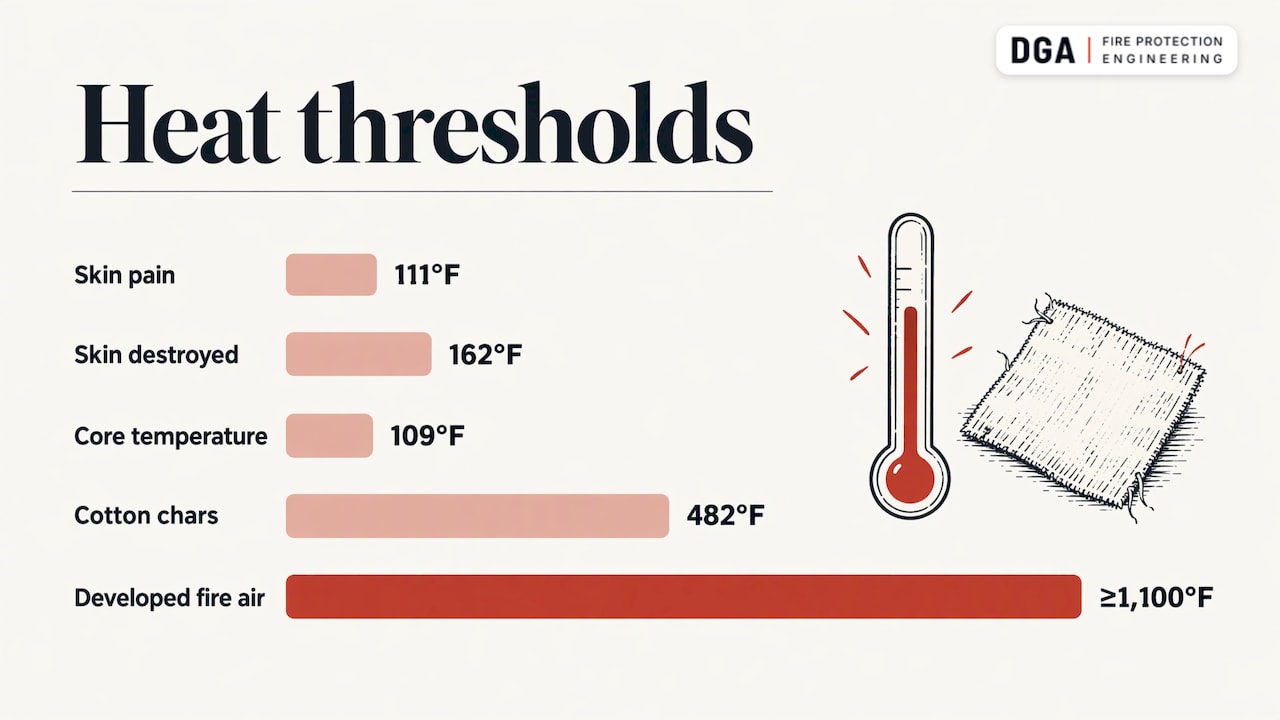
The human body has very little tolerance for heat. NIST’s FIRE FACTS lists these thresholds:
- Skin feels pain at about 111°F (44°C).
- Skin tissue is destroyed instantly at 162°F (72°C).
- A body core temperature of 109°F (43°C) may cause death.
- Natural cotton begins to char at 482°F (250°C).
Hot air is a hazard on its own. Michigan State University extension notes that a fully developed indoor fire can reach or exceed 1,100°F, and that even one breath of that air can be lethal. That is one reason smoke inhalation, not flame contact, is the most common cause of death in house fires.
Heat hazards from home equipment begin well below fire temperatures, too. A good example is how boiler overheating warning signs show up before a heating appliance becomes a danger to people in the house.
Building materials respond to heat on a similar scale. This is why engineers test floors, walls and structural members against standard time-temperature exposures, and why a building element that survives one hour of a severe fire is a meaningful achievement.
Our perspective
Most of the questions we get about house-fire temperature are really questions about time. The peak number is dramatic, but the number that decides outcomes is how many minutes pass between ignition and flashover.
In our work as fire protection engineers, we use the same tools described here: zone models, plume correlations and heat release rate curves from the SFPE Handbook. They turn a vague worry into a number an owner, architect or reviewer can discuss. A licensed PE stays on every project we take on, and that matters most when a fire scenario has to be defined, tested against a model and defended to an authority having jurisdiction.
We also think the public numbers deserve more context. A quoted figure of 2,500°F tells you very little unless you know whether it is a flame, a ceiling layer or a room average. That is why we publish free calculators built from the SFPE Handbook: so engineers, students and building owners can test the physics themselves.
DGA Fire Protection Engineering
When the question becomes a design question
If you are a developer, owner or design team that needs a fire scenario analyzed, our fire modeling and performance-based design service applies these same principles to a specific building. We are licensed in New York, New Jersey, Pennsylvania, Maryland and Delaware, and a licensed PE stays on each project from start to finish.

To talk through a project with an engineer, start at our contact page.
FAQ
What is the average temperature of a house fire?
There is no single average, because temperature depends on the stage. Federal guidance says a fully developed room fire can average above 1,800°F (1,000°C) in its gases. Earlier in the fire, the upper layer is much cooler, and the lower part of the room is cooler still.
What is the hottest a house fire can get?
Flame centers in larger fires can approach about 2,550°F (1,400°C), according to FEMA technical guidance. That figure describes flame, not the air in the whole house. Most of the room will be cooler than the hottest flame zone.
How fast can a room reach flashover?
It depends on the fuel and the room. In UL FSRI tests, a modern furnished living room reached flashover in about 3.5 minutes, while a legacy room took about 29.5 minutes. NFPA 921 notes times as short as 1.5 minutes from open flame in a residential fire.
Does cold or hot weather change how hot a house fire burns?
Not meaningfully. Fuel, room size and air supply set the temperature. Outdoor temperature matters far less than wind or a new opening that feeds the fire.
At what temperature is it no longer survivable?
The thresholds are low. NIST lists skin pain at about 111°F (44°C) and immediate tissue destruction at 162°F (72°C). A room at flashover is far beyond any survivable level, so the only safe response is to get out early and stay out.
To explore these numbers yourself, try the compartment fire temperature calculator or browse our other free fire dynamics calculators.
More in Fire Science
Sources
- FEMA 403, Protection in Buildings
- NIST, A simple correlation for predicting temperature in a room fire
- NIST, FIRE FACTS
- U.S. Fire Administration, Fire Dynamics and Modeling
- Ready.gov, Home Fires
- NFPA, All About Fire: A Guide for Reporters
- ASTM E2257 room fire test
- UL FSRI, modern and legacy home furnishings
- UL FSRI, synthetic and natural home furnishings
- NIST, Wind Driven Fires
- Fire Rescue 1, Flashover facts
- Michigan State University Extension, smoke inhalation
- PDH Online, Fire Dynamics Series
- Evo Plumbers, boiler overheating
Recommended
- Compartment Fire Temperature Calculator
- Flashover Calculator
- Fire Plume Temperature Calculator
- Fire Science Explained: How Fires Grow and Spread
This article is general information from DGA Fire Protection Engineering, not engineering advice for a specific building or project. Code requirements vary by jurisdiction and edition. Confirm with the authority having jurisdiction or a licensed fire protection engineer before acting on it.