Commissioning & integrated system testing
Modern buildings rely on multiple fire protection and life safety systems working together: sprinklers, alarms, smoke control, elevators, and access control. DGA Fire Protection Engineering provides fire protection system commissioning and integrated testing for new construction and major renovations across New York, New Jersey, Pennsylvania, Maryland, Delaware, Washington, Oregon, and Florida, verifying systems as a whole before the AHJ asks for proof. That includes witnessed acceptance testing of sprinkler, fire pump, standpipe, and fire alarm systems.
What’s Included
What commissioning and integrated system testing includes
DGA provides fire protection system commissioning and integrated testing for new construction and major renovations across New York, New Jersey, Pennsylvania, Maryland, Delaware, Washington, Oregon, and Florida. The firm’s work is led by licensed Professional Engineers, who verify that interconnected systems perform together, per NFPA 3 and NFPA 4.
Commissioning plans
Written plans defining scope, responsibilities, and acceptance criteria per NFPA 3.
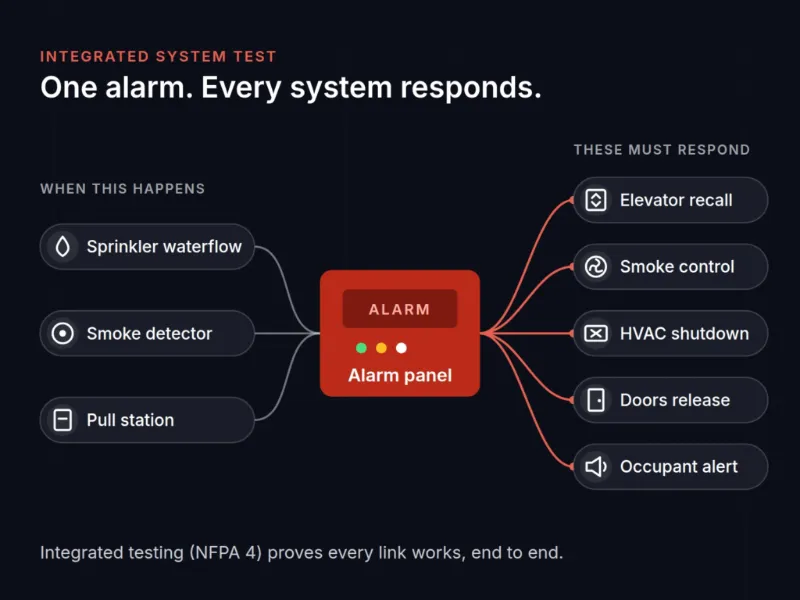
Integrated testing (NFPA 4)
End-to-end testing of interconnected fire protection and life safety systems: alarm initiates, smoke control responds, elevators recall, doors release.
Test documentation
Complete records of every test, result, and deficiency resolution for the AHJ and owner. These records become the baseline for ongoing inspection, testing, and maintenance under NFPA 25 and NFPA 72.
Deficiency tracking
Systematic punch-list management through final acceptance.
Owner training support
Documentation and walkthrough materials so building staff understand the systems they are inheriting.
Witnessed acceptance tests
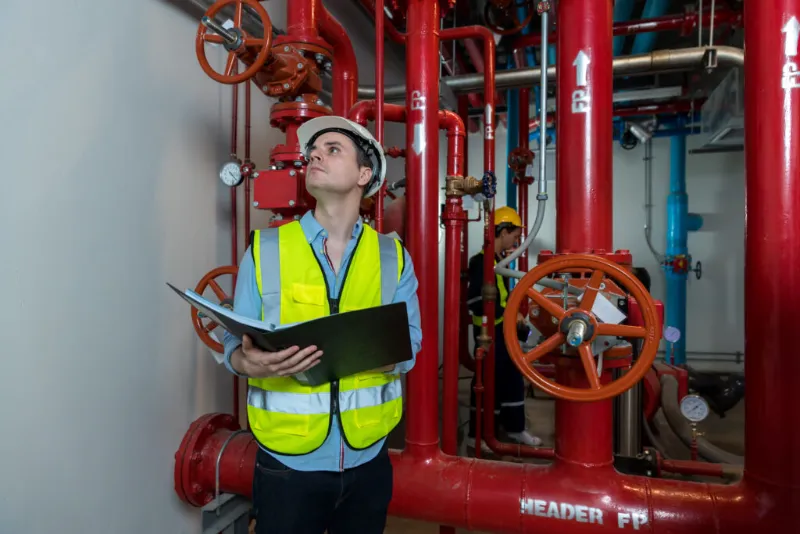
Sprinkler, fire pump, standpipe, and fire alarm acceptance tests observed and recorded against the design and the governing standard.
When It Applies
When commissioning and integrated system testing applies
Triggers
When you need it
- NFPA 3 & NFPA 4 Projects: High-rise and complex projects where the adopted codes call for fire commissioning and integrated system testing.
- Complex Facilities: Data centers, healthcare, assembly venues, and large commercial buildings with interconnected life safety systems.
- Major Renovations: Work that adds or changes equipment tied to existing suppression, detection, or building controls.
- Pre-Occupancy Reviews: Owners who want integration failures and sequence gaps caught before the AHJ final inspection.
What We Deliver
Commissioning & IST deliverables
- NFPA 3 Commissioning Plans: Owner’s project requirements (OPR), basis of design (BOD) review, and inspection checkpoints.
- NFPA 4 Integrated Test Plans: Scenario test scripts for power loss, alarm activation, and cross-system responses.
- Sequence of Operations Verification: Functional checks of elevator recall, door release, smoke dampers, stair pressurization, and generator transfer.
- Closeout Documentation: Test records, deficiency logs, and the integrated testing report for AHJ acceptance.
This work is common on data center, healthcare and life sciences, and commercial high-rise projects.
Process
The commissioning process
01
Plan
Commissioning scope, test matrix, and acceptance criteria defined up front.
02
Witness and test
Individual system tests observed, then integrated scenarios run end to end.
03
Document
Every result recorded, with deficiencies tracked to resolution.
04
Accept
Final documentation package prepared for the AHJ and owner turnover.
FAQ
Frequently asked questions
What is the difference between NFPA 3 and NFPA 4?
NFPA 3 covers commissioning of fire protection and life safety systems, which is the overall verification process. NFPA 4 covers integrated testing specifically: verifying that interconnected systems respond correctly together.
Is integrated testing required by code?
Often, yes. The International Fire Code requires integrated testing to NFPA 4 in high-rise buildings and where fire alarm is integrated with smoke control, at least every 10 years. Adopted editions and local amendments vary, so the firm confirms the requirement for each project.
Can the firm commission systems designed by someone else?
Yes. Third-party commissioning by an independent engineer is standard practice and often preferred.
Which states are you licensed in?
New York, New Jersey, Pennsylvania, Maryland, Delaware, Washington, Oregon, and Florida. Each project is sealed by a Professional Engineer licensed in the state where it is located.
From the Technical Library
Related Services
Related services
Also see FDNY Plan Examination & Approvals for the FDNY inspection that produces the fire alarm Letter of Approval.

Fire alarm system design
Fire alarm and detection system design for new and existing buildings.
Smoke control system design & testing
Smoke control design, analysis, and acceptance testing.