Fire Science · Feature
The fire Triangle explained: Heat, fuel and Oxygen
The fire triangle is a model that says a fire needs three things at once: heat, fuel and oxygen. Take away any one and the fire stops. Engineers add a fourth side, the chemical chain reaction, which turns the triangle into a tetrahedron (a four-sided shape). This article explains each side, how every common suppression method removes one of them, and where the simple model stops being enough.
TL;DR
- The fire triangle names three needs for fire: heat, fuel and oxygen. NFPA says fire burns until one or more of them is removed.
- The fire tetrahedron adds a fourth need, an uninhibited chemical chain reaction. It explains why clean agents and dry chemicals work.
- Water cools. Foam separates fuel from the flame. Carbon dioxide displaces oxygen. Clean agents and dry chemicals interrupt the chain reaction.
- Most building fire prevention work controls heat and fuel, because oxygen is nearly always present.
- The triangle explains why a fire exists. It does not predict how fast a fire grows. Fire dynamics tools do that.
Table of contents
- What the fire triangle says
- Heat: the energy that starts and feeds a fire
- Fuel: what burns and how
- Oxygen: why it is almost always there
- The fourth side: the chemical chain reaction
- How each suppression method removes one side
- The triangle through the four stages of a fire
- Where the triangle stops
- Using the triangle to assess a building
- Perspective
- When the building needs more than the model
- FAQ
- Sources
What the fire triangle says
NFPA’s guide for reporters describes the fire triangle as fuel, heat and air (oxygen). All three must be present. The fire keeps burning until one or more is removed.
The USGS puts it in terms of a reaction. Fire is the light and heat given off when oxygen and fuel combine, and both must be at or above ignition temperature. Without any one of the three legs, a fire cannot be sustained.
The triangle is a teaching tool, and a good one. It gives you three questions to ask about any fire, or any fire risk:
- What could ignite or heat something?
- What is there to burn?
- Is there enough oxygen?
The rest of this article answers those three questions in detail, then adds the fourth.
Heat: the energy that starts and feeds a fire
Heat is the energy that brings fuel up to the point where it gives off burnable vapor and ignites. OSHA’s fire protection guidance lists the usual sources: sparks, open flames, static electricity and heat-radiating equipment.
The University of Michigan’s process safety tutorial notes that about 98% of ignitions come from a short list of sources. That list includes open flames, hot surfaces, hot gases, sparks from mechanical or electrical equipment, static electricity and chemical reactions.
Heat does two jobs. First, an outside source usually starts the fire. The NPS lesson plan on the fire triangle explains that once a fire is burning, it makes its own heat. That is why a small ignition source can lead to a large fire.
Second, the fire’s heat moves to nearby fuel. The NWCG wildland fire behavior course material, published by NFPA, describes three paths: conduction (through direct contact), convection (hot gases and embers carried upward) and radiation (heat traveling as energy, like warmth from a stove). Each path dries and sometimes ignites surrounding fuel. The same three paths drive fire spread inside buildings.
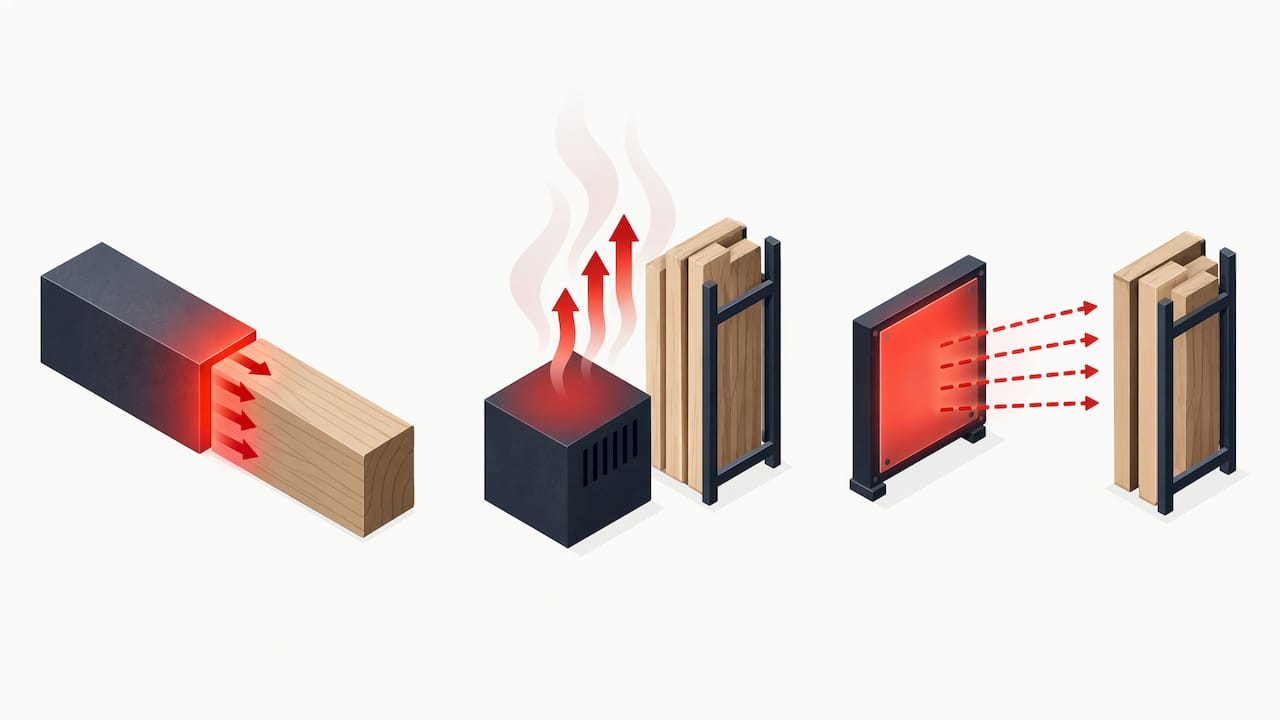
In a building, the question about heat is practical. Where could heat come from, and how close is it to something that burns? Electrical equipment, hot work such as welding, cooking appliances and heating equipment are the usual answers.
Fuel: what burns and how
Fuel is any material that can burn. OSHA’s guidance groups it into combustible solids such as wood and paper, flammable liquids such as gasoline, and flammable gases such as propane.
Here is a point that surprises many people. Solids and liquids do not burn directly. They must be heated until they give off vapor, and the vapor is what burns. A marine fire investigation guide makes this point in its chapter on the chemistry of fire. That is why a log needs a lot of heat to start, while a puddle of gasoline can ignite from a spark.
The same guide gives figures that show how different fuels are:
- Gasoline has a flash point of -45°F (-42.8°C). The flash point is the lowest temperature at which a liquid gives off enough vapor to ignite. Its ignition temperature is 536°F (280°C).
- Propane burns only within a range of concentration in air, from 2.15% (the lower flammable limit) to 9.6% (the upper flammable limit). Below the range the mixture is too lean. Above it, too rich.
Physical form matters too. The NPS notes that dead trees, leaves, needles and grasses burn sooner and hotter than live plants because they hold less water. In a warehouse, the same idea shows up as packaging, plastics and stacking arrangement: the same weight of material burns very differently depending on how it is configured.
Fuel storage is a plain example of the first question in practice. Standby power is one place where fuel control matters daily, and fuel problems in backup generators are a reminder that stored fuel needs attention as well as the equipment around it.
Oxygen: why it is almost always there
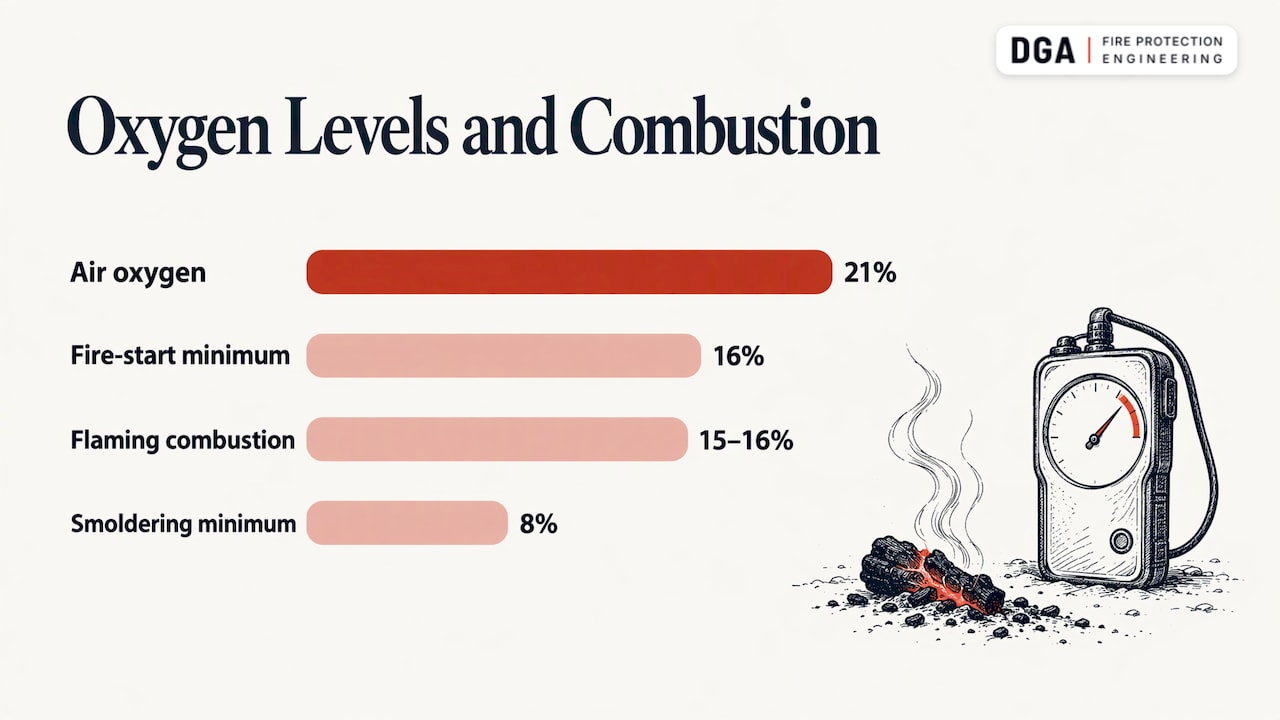
Air is about 79 percent nitrogen and 21 percent oxygen, according to OSHA. Fires can burn with much less oxygen than people need to breathe. The NPS says at least 16 percent oxygen must be in the air for a fire to start, compared with 21 percent in the air we breathe.
The marine fire guide adds a detail: flaming combustion needs about 15 to 16 percent oxygen, while smoldering (burning without flame) can continue with as little as 8 percent. This is one reason a fire can go quiet in a closed room and then flare when a door opens.
The Nevada fire service training chapter, based on IFSTA and FEMA material, makes the prevention point clearly. Except for a few specialized situations, oxygen is always present in enough quantity. So most fire prevention work is about controlling heat and fuel, and heat is the more common one to manage. The chapter even describes a ‘fire prevention angle’ that keeps heat and fuel in front and moves oxygen to the background.
There are exceptions. Some process areas, such as inerted tanks or oxygen-reduced storage rooms, deliberately lower oxygen. That is the oxygen side of the triangle being used as a design tool.
The fourth side: the chemical chain reaction
The three-sided model works for fire in its early, simple form. Flaming fire needs more. It needs a self-sustaining chemical reaction.
The USGS Wildland Fire Science School describes the chemical reaction as the middle element of the triangle. The fire service training chapter calls the fourth component an uninhibited chain reaction and places it as the base of the tetrahedron, with heat, fuel and oxygen as the three standing sides.
NFPA explains the chain reaction as the feedback of heat to the fuel, which produces the gaseous fuel that the flame burns. NFPA also notes that this fourth component more accurately describes suppression by clean agents, the halon replacements that break up the chain reaction.
In plain terms, a flame is a busy factory of short-lived chemical fragments. They keep the reaction going by passing energy from one step to the next. If something interrupts those steps, the flame dies even though heat, fuel and oxygen are all still present.
This is the answer to the common search for the ‘new fire triangle.’ It is not a new idea. It is the tetrahedron: the same three sides plus the chain reaction. OSU Extension’s fire science module defines it as fuel, heat, an oxidizing agent and an uninhibited chemical chain reaction, and lists the same four ways to extinguish: cool, exclude oxygen, remove fuel, break the reaction.
One caution on scope. Smoldering and glowing fires do not rely on a flame chain reaction in the same way. The tetrahedron is most accurate for flaming combustion. For everyday use, the triangle and tetrahedron work together.
How each suppression method removes one side
Every suppression method works by taking away one side of the tetrahedron. The CDC’s fire protection training unit says a fire cannot start or continue if one component is absent, and lists the approaches: eliminating fuel vapors, blocking oxygen, removing heat with water, or inhibiting chain reactions with special chemicals.
| Method | Side removed | How it works |
|---|---|---|
| Water | Heat | Absorbs heat from the fuel and flame, cooling the fuel below the point where it gives off enough vapor |
| Foam | Fuel (separation) | Forms a blanket that separates the fuel surface from the flame and from air, and slows vapor release |
| Carbon dioxide (CO2) | Oxygen | Displaces the air around the fire so there is not enough oxygen to sustain flame |
| Clean agents | Chain reaction | Interrupt the flame chemistry, mainly by removing heat and the reactive fragments, without leaving residue |
| Dry chemical | Chain reaction | Powder that interrupts the flame chemistry |
Water: removing heat
Water is the most common agent because it absorbs a great deal of heat. NIST fire research documentation describes the community view that water’s basic suppression effects are physical: oxygen dilution by steam and high heat absorption. The same NIST material notes that fine water mist can match halon 1301 in some tests.
The NPS teaching material gives a simple version for non-specialists: water on a fire removes heat and cuts off oxygen. That is why a sprinkler system, which applies water directly to the heat source, is so effective on ordinary fuels. Our Insights hub on special hazards and suppression covers where water is not the right agent.
Foam: separating the fuel
Foam is built for liquid fuels. It spreads over the surface and puts a barrier between the fuel and the flame. This is fuel separation. The liquid is still there, but the vapor cannot reach the flame and the flame cannot reach the liquid.
Carbon dioxide: displacing oxygen
CO2 is a gas that pushes air away from the fire. If the oxygen concentration falls below what flaming combustion needs, the flame goes out. Because the method works by lowering oxygen around people as well as fire, spaces protected this way need special safety measures, and personnel safety is part of the engineering.
Clean agents and dry chemicals: interrupting the reaction
Clean agents are gases that leave no residue. Dry chemical is a fine powder. Both are best understood through the tetrahedron, because they act on the chain reaction rather than on heat, fuel or oxygen alone. A fire protection engineer chooses between them based on what is being protected: data equipment, process hazards, kitchens or flammable liquids.
The free special hazard suppression calculators on our site cover this family of problems.
Removing fuel and the wildland version
Fuel can also be removed outright. In wildland fire, the NPS explains that crews dig a fireline to remove fuel, apply water to remove heat, and smother flames with water or dirt to cut off oxygen. In buildings, the equivalent is shutting off a gas supply or fuel pump.
The triangle through the four stages of a fire
NFPA describes four stages in the life of a fire, and the triangle applies to each:
- Ignition. Fuel, oxygen and heat come together in a sustained reaction. NFPA notes this is the stage when an extinguisher can control the fire.
- Growth. Convection and radiation ignite more surfaces, and the plume (the rising column of hot gas) reaches the ceiling.
- Fully developed. Temperatures peak and oxygen is consumed rapidly.
- Decay. Fuel is consumed and temperatures fall.
The source for all four is the NFPA reporter guide.
OSU Extension adds that fires decay to smoldering when they become fuel-controlled or ventilation-controlled. A fuel-controlled fire has plenty of air and is limited by what is left to burn. A ventilation-controlled fire has plenty of fuel and is limited by air.
That distinction is where the triangle starts to point toward fire engineering. Which side limits the fire at a given moment decides what the fire does next, and what a protection system must do about it.
Where the triangle stops
The triangle tells you what must be present. It does not tell you how much, how fast or how hot. A smart reader should know three limits.
It says nothing about rate. Two fires can have all three sides and grow at completely different speeds. Engineers describe growth with models such as the t-squared fire, where heat release rate rises with the square of time. Our fire dynamics calculators let you try these relationships with real inputs.
It treats the three sides as simple switches. A marine fire investigation guide, citing a classic text on the mechanics of fire, describes six elements of a fire’s life cycle: input heat, fuel, oxygen, proportioning, mixing and ignition continuity. The triangle covers only the first three. Proportioning and mixing explain why a gas leak is dangerous only inside its flammable range, as with the propane figures above. The source is the same marine fire investigation guide.
It does not capture the building. Smoke, ventilation and compartment size change how a fire behaves once it is under way. For a deeper look at those effects, see our feature on how fires grow and spread.
The oxygen story is also a reminder not to read safety conclusions from fire numbers. OSHA flags atmospheres below 19.5% or above 23.5% oxygen as immediately dangerous to life or health for reasons unrelated to fire. That is why OSHA’s fire protection guidance treats breathing safety separately from combustion.
Using the triangle to assess a building
Engineers use the triangle as a first-pass screen. For any space, ask what controls each side.
- Heat: What ignition sources are present? How are they separated from fuel?
- Fuel: What is stored or processed here? How is it arranged? Which liquids and gases can form vapor?
- Oxygen: Is the space normal air, or is oxygen intentionally changed?
- Chain reaction: If a fire occurs, what agent will interrupt it, and does that agent suit the hazard?
A commercial kitchen is a clear example. Cooking appliances supply the heat. Grease in the exhaust hood and duct is the fuel. Air is always there. The reasoning behind kitchen hood fire prevention follows the same triangle: control the grease, control the heat, and plan for the response.
A warehouse asks the same questions at a larger scale: what is stored, how high, and how will water reach it. A cold storage facility, an energy storage site and a historic building each answer them differently. If a specific requirement applies to your project, we cover those in our Insights library rather than here.
Perspective
We use the fire triangle as the first sketch of every fire problem, and we stop using it as soon as the problem gets specific.
The triangle is right that fire needs heat, fuel and oxygen. The decisions that matter in a building come after that. How much fuel, arranged how, with what heat source nearby, protected by which agent, reviewed by which authority? Those questions have engineering answers, and they change the design.
This is why a licensed Professional Engineer stays on each of our projects from first scope to final stamp. The person who understands the fire science is the same person who answers the code question and sizes the system. Designs are tailored to the local reviewer and authority having jurisdiction in New York, New Jersey, Pennsylvania, Maryland and Delaware, so they are built to get through permitting without rework.
The same thinking is behind the free calculators we publish. They are built from the SFPE Handbook so that engineers, students and plan reviewers can test the physics behind the model for themselves.
DGA Fire Protection Engineering
When the building needs more than the model
If you are planning a project where heat, fuel and oxygen interact in an unusual way, such as rack storage, cold storage, energy storage or a historic building, we can help. Our fire protection engineering design service covers sprinkler design and hydraulic analysis, fire alarm, smoke control and more, sealed by a licensed PE. Inquiries are handled by engineers, not a sales desk.

To talk through a project, contact an engineer at DGA.
FAQ
What are the three parts of the fire triangle?
They are heat, fuel and oxygen. NFPA says all three must be present, and a fire burns until one or more are removed. Remove any one and the fire cannot continue.
What is the difference between the fire triangle and the fire tetrahedron?
The tetrahedron adds a fourth element, the uninhibited chemical chain reaction. The extra side explains how clean agents and dry chemicals put out flames without removing heat, fuel or oxygen. The CDC fire protection unit presents the tetrahedron the same way.
How much oxygen does a fire need?
The air contains about 21 percent oxygen. The NPS states that at least 16 percent is needed for a fire to start. Smoldering can continue at lower levels, as low as 8 percent in one investigation guide.
Which side of the triangle does water remove?
Water mainly removes heat. It absorbs energy from the fuel and flame, and the resulting steam also dilutes oxygen near the fire. NIST describes both effects as the physical basis of water suppression.
Why do fire prevention programs focus on heat and fuel?
Oxygen is nearly always present in air, so it is rarely the side you can control. Prevention work therefore keeps ignition sources away from fuel. The fire service training chapter says this directly: most prevention deals with heat and fuel.
To go further, explore the special hazards and suppression hub or work through the physics in the fire dynamics calculators.
More in Fire Science
Sources
- NFPA: All About Fire, a guide for reporters
- USGS: Wildland Fire Science School, Part 1, Fire Basics
- OSHA: Fire Protection and Prevention
- University of Michigan SAFEChE: Fire Triangle
- NPS: Meeting the Fire Triangle, teachers
- NPS: Wildland Fire Facts, There Must Be All Three
- NWCG: Introduction to Wildland Fire Behavior (S-190), 2020
- Guide for Conducting Marine Fire Investigations, Chapter 1
- The Behavior of Fire and Fire Prevention (IFPP/FEMA)
- OSU Extension: Fire Science core curriculum, Module 1
- CDC: Fire Protection training unit
- NIST: Fire research, water suppression chapter
Recommended
- How Hot Is a House Fire? Temperatures by Stage
- Heat of Combustion Table (NIST, NUREG-1805)
- Flashover vs. Backdraft: How Two Different Fire Events Work
- Time to Ignition Calculator
This article is general information from DGA Fire Protection Engineering, not engineering advice for a specific building or project. Code requirements vary by jurisdiction and edition. Confirm with the authority having jurisdiction or a licensed fire protection engineer before acting on it.