Fire Science · Feature
Autoignition temperature: What it is and how to use it
Autoignition temperature (AIT) is the lowest temperature at which a combustible material ignites in air without a spark or flame, according to the NIST fire and explosion investigation glossary, which draws on NFPA 921. Heat alone does the work. No pilot flame, no arc, no ember. The number answers one question: can a hot surface or hot environment set this fuel off by itself?
That question is different from the one flash point answers, and mixing them up is the most common mistake in ignition-hazard screening. This article defines AIT, compares it with flash point, fire point and piloted ignition, explains why a published value is never one fixed number, and shows how engineers use it with care.
Table of contents
- TL;DR
- What autoignition temperature means
- AIT, flash point, fire point and piloted ignition
- Why one fuel has many AIT values
- Example values and where they come from
- Solids: why paper and wood have no single AIT
- Where AIT shows up in buildings and plants
- How engineers use AIT with care
- Our perspective
- When the question becomes a project
- FAQ
- Sources
TL;DR
- AIT is the lowest temperature at which a material ignites in air with no external spark or flame.
- Flash point asks whether a spark can ignite vapor. AIT asks whether heat alone can. The two can differ by hundreds of degrees.
- AIT is a test result, not a constant. Method, vessel, pressure, oxygen level and allowed delay all move it.
- ASTM E659 says its result should not be used alone to describe fire hazard under real fire conditions.
- Our time to ignition calculator lets you explore how heating conditions change ignition timing.
What the code requires today: NFPA 30 classifies flammable and combustible liquids by flash point, not by AIT. For how those classifications and hazardous-materials rules apply to a building, see our Hazardous Materials hub.
What autoignition temperature means
Fire needs fuel, oxygen and enough heat. In most fires, the heat comes from a flame or spark that raises a small region of the fuel-air mixture to ignition. Autoignition removes that local source. The whole mixture, or the hot surface it touches, supplies the energy.
NFPA 921, as quoted in a University of Washington vehicle-fire reference, defines autoignition as the start of combustion by heat but without spark or flame. The same source notes that the property varies substantially with conditions. It also explains that when someone says “minimum autoignition temperature,” they usually mean the value measured by an ASTM-specified procedure.
The mechanism is simple to picture. As a liquid or vapor gets hotter, its molecules move faster and react with oxygen more readily. At some point the reactions release heat faster than the surroundings carry it away. The reaction accelerates and a flame appears. A flammable liquid that leaks onto a surface hotter than its AIT can ignite on contact, provided oxygen is present and the vapor concentration is in the right range.
AIT, flash point, fire point and piloted ignition
Four terms describe how fuels ignite. Each assumes a different heat source and answers a different question.
- Flash point applies to liquids. It is the lowest temperature at which the liquid gives off enough vapor to form an ignitable mixture with air near its surface, as the University of Washington characteristics page puts it. A flame is present. The flash can be brief.
- Fire point is the lowest temperature at which vapor is produced fast enough to keep burning after ignition. The same university source says it is generally somewhat higher than the flash point.
- Piloted ignition is ignition caused by a small flame, spark or hot particle placed in the flammable mixture. Flash point is a piloted-ignition measurement for liquids.
- Autoignition needs no pilot at all.
NFPA 497, in a public-input document, defines AIT as the minimum temperature needed to start self-sustained combustion of a solid, liquid or gas dispersed in air, independent of the heating element and without a specific ignition source. It defines flash point separately.
| Property | Heat source present | Question it answers | Typical relationship |
|---|---|---|---|
| Flash point | Small flame or spark | Is there enough vapor to ignite near the surface? | Lowest of the three for a given liquid |
| Fire point | Small flame or spark | Will the flame keep burning after ignition? | Somewhat above flash point |
| Piloted ignition | Small flame, spark or hot particle | Will a pilot ignite this material under these conditions? | Depends on heating and material form |
| Autoignition temperature | None | Will heat alone ignite it? | Often far above flash point |
Take gasoline as an illustration. Its flash point is well below freezing, so at ordinary temperatures it gives off ignitable vapor and a spark is enough. Its AIT is far higher, so a warm surface alone will not ignite it. A heavy lubricating oil is the reverse in practice: it takes a lot of heat before it makes ignitable vapor, yet once it is hot, its autoignition behavior can matter on a hot pipe or exhaust.
A fuel can therefore be easy to ignite with a spark and hard to ignite with a hot surface, or the other way around. Which number matters depends on the hazard in front of you. Sparks from switches and static point to flash point and flammable limits. Heaters, steam lines, hot process equipment and exhaust manifolds point to AIT.
Why one fuel has many AIT values
Search a handbook, a safety data sheet and a lab report for the same fuel and you will often find three different numbers. That is not an error. AIT depends on how it was measured.
The standard test is ASTM E659. It covers the hot-flame and cool-flame autoignition temperatures of a liquid chemical in air at atmospheric pressure in a uniformly heated vessel. A small sample is injected into a heated flask of air. The lab watches for a flame and records the delay before it appears. A cool flame is a faint, low-temperature reaction. A hot flame is full combustion.
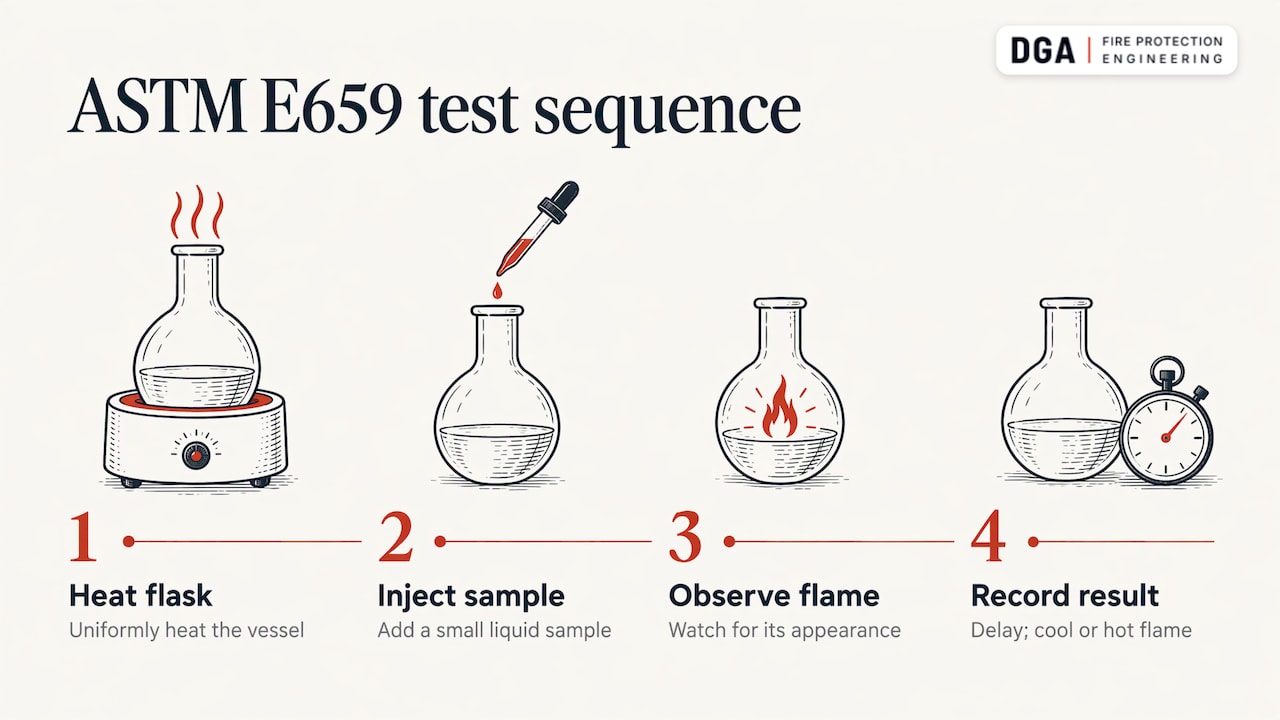
ASTM states that the result depends on the chemical and physical properties of the material and on the method and apparatus. Several variables shift it.
Vessel size and material
In a larger vessel, the reacting gas loses less heat to the walls relative to its volume, so ignition can occur at a lower temperature. The vessel surface can also speed up or slow down the reactions. ASTM lists vessel volume and vessel material among the factors that change the result, so a value from one apparatus does not necessarily represent the true minimum self-ignition temperature.
Pressure
Higher pressure packs more molecules into the same space, so reactions accelerate. ASTM says the measured temperatures can be expected to vary with test pressure. A value measured at atmospheric pressure says little about a high-pressure process line. The Caltech Explosion Dynamics Laboratory also describes minimum AIT as a strong function of fuel type, pressure and fuel concentration.
Oxygen concentration
More oxygen means faster reactions and a lower AIT. Less oxygen does the opposite. ASTM lists oxygen concentration as a variable. Standard tests use air, so enriched atmospheres, such as those around medical gas or some process equipment, need values measured for those conditions.
Delay time
Autoignition is not instant. In the standard test, ignition can come after a delay. Caltech’s Jet A glossary says that delay runs from 5 to 600 seconds. A fuel held just below its reported AIT for long enough can still ignite if the test window was short. A hot surface that is touched briefly behaves differently from one the fuel sits on for hours.
Fuel structure
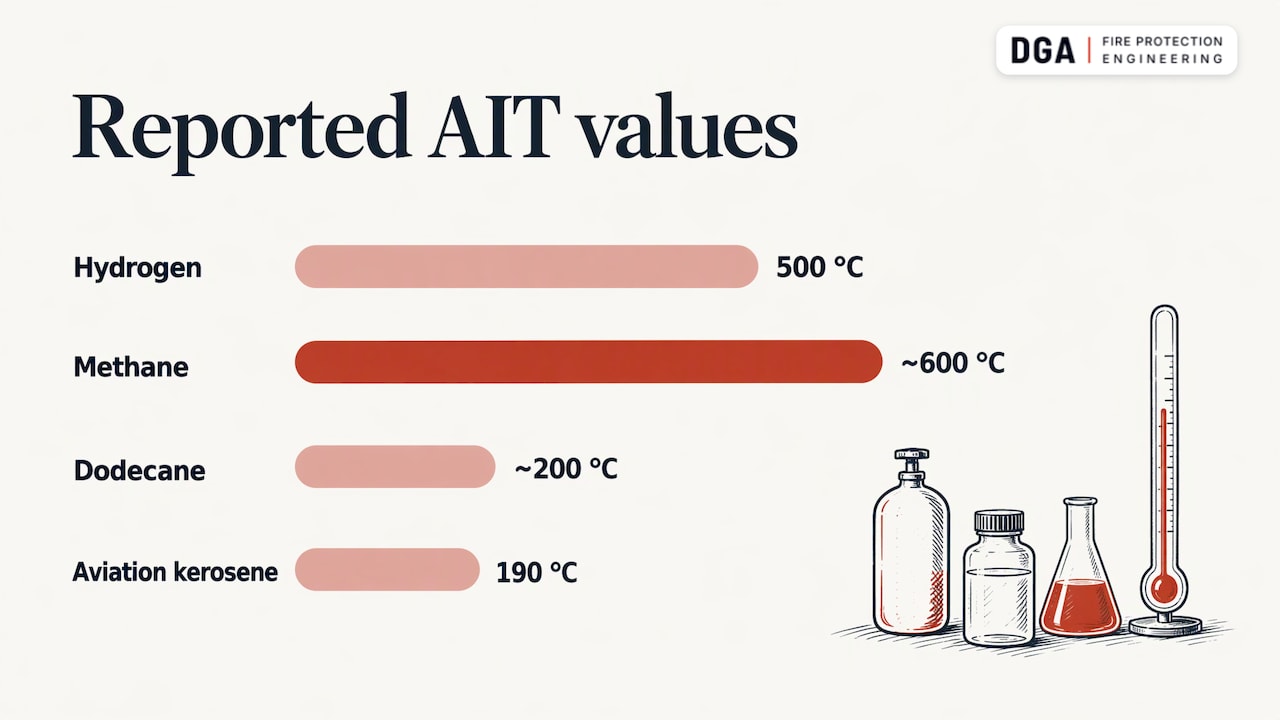
Caltech notes that minimum AIT depends on atomic composition and molecular structure. For common hydrocarbon fuels it falls from about 1,350 °F (600 °C) for methane to about 472 °F (200 °C) for dodecane. Longer-chain molecules break apart and react more readily, so they often autoignite at lower temperatures than small ones, even though they are harder to ignite with a flame because they make less vapor.
Example values and where they come from
A few reference points help you build intuition. Treat each as an estimate tied to a method.
| Fuel | Reported AIT | Source |
|---|---|---|
| Hydrogen in air | 932 °F (500 °C) | Drexel University chemical safety summary |
| Methane | about 1,350 °F (600 °C) | Caltech Explosion Dynamics Laboratory (link above) |
| Dodecane | about 472 °F (200 °C) | Caltech Explosion Dynamics Laboratory (link above) |
| Aviation kerosene (minimum used in hazard analysis) | 450 °F (190 °C) | Caltech Explosion Dynamics Laboratory (link above) |
Hydrogen shows why AIT alone is not a safety verdict. Drexel gives hydrogen an AIT of 932 °F (500 °C) and explosive mixtures with air at concentrations of 4 to 76 percent. That very wide range, not the AIT, is what makes small leaks so important to control. Drexel also notes that a burning hydrogen leak may need a flame detector to be seen.
Caltech makes another point worth remembering. The minimum AIT from the standard test is much higher than the flash point of the fuel but much lower than typical hot-surface ignition temperatures, which can reach about 2,000 °F (900 °C) for common hydrocarbon fuels, citing a 1997 paper in Combustion Science and Technology. A flowing fuel contacting a small hot surface behaves differently from fuel sitting in a heated flask. The flask test is a conservative lower bound, not a prediction of any one surface.
Solids: why paper and wood have no single AIT
People often ask for the autoignition temperature of paper or wood. The honest answer is that these materials do not fit the standard test well. ASTM E659 states it is not designed for solids or for liquids that are solid at the test temperature, such as wood, paper, cotton, plastics and high-boiling chemicals. Those materials break down thermally in the flask, and the decomposition products may be what ignite. The method is also not designed for materials capable of exothermic decomposition.
So a number for paper is only meaningful with the form, moisture, heating rate and exposure time attached. A thin sheet, a stack of cartons and a bale of fiber behave differently. For solids, engineers usually turn to ignition-time and heat-flux data rather than a single temperature. That is where fire dynamics tools such as the time to ignition calculator help: they ask how long a given heat exposure takes to bring a surface to ignition.
Where AIT shows up in buildings and plants
AIT matters wherever fuel can meet a hot surface with no flame in sight. Common situations include:
- Heated process equipment and steam lines. A flammable liquid leaking onto a surface above its AIT can ignite in air. Surface temperature limits for equipment are set with this in mind.
- Hydraulic fluids. The U.S. Mine Safety and Health Administration’s test procedure ASTP5002 uses the E659 syringe-injection method for fire-resistant hydraulic fluids under 30 CFR 35.20, with a pass criterion of a lowest ignition temperature of at least 600 °F.
- Cooking operations. Grease and hot appliances sit close together in commercial kitchens. A thorough overview of commercial kitchen hood fires covers prevention and response for these hazards.
- Fuel and exhaust systems. Fuel lines routed near hot exhaust components are checked against fuel AIT and against real hot-surface behavior.
- Hydrogen and battery spaces. Gas that escapes into a warm enclosure raises questions about both ignition sources and surface temperatures.
In each case the engineering question is the same: what is the hottest surface the fuel can reach, and how does that compare with an AIT measured under conditions that resemble the real one?
How engineers use AIT with care
ASTM is direct about limits. The standard says the test should not be used to describe or appraise fire hazard or risk under actual fire conditions. It adds that results may be used as elements of a fire risk assessment that accounts for the factors pertinent to a particular end use.
In practice, that means a few habits:
- Record the method. A value without its test method, vessel and pressure is a rumor. Prefer ASTM E659 values for liquids and note the edition.
- Add margin. Keep surface temperatures well below the lowest credible AIT, not just below the average of reported values.
- Match conditions. If the process runs above atmospheric pressure, in enriched oxygen, or with long contact times, ask for data at those conditions.
- Separate the hazards. Use flash point and flammable limits for spark and flame sources. Use AIT for hot surfaces and heated spaces. Do not substitute one for the other.
- Look at the whole scenario. Leak rate, ventilation, vapor concentration and detection all affect whether a hot surface becomes an ignition source.
If you want to see how heat exposure translates into ignition time for a surface, try the time to ignition calculator. For a classification question, use the Hazardous Materials hub linked above.
Our perspective
Most ignition mistakes we see discussed in the field come from treating a number as a verdict. A single AIT on a data sheet looks authoritative. It is really the answer to a narrow laboratory question: at what temperature did this sample ignite in this flask, in air, at this pressure, within this delay?
The better habit is to ask what the real exposure looks like. What is the surface temperature under load, how long can fuel stay on it, and what do pressure and oxygen do to the margin? A licensed Professional Engineer should be able to walk through that reasoning, not just quote a table.
That is how we approach it. A licensed PE stays on each project from start to finish, and code questions get same-day answers from engineers, not a sales desk. When a design depends on ignition behavior, our fire modeling and performance-based design work gives the reasoning a quantitative footing that a plan reviewer can follow.
DGA Fire Protection Engineering
When the question becomes a project
If ignition behavior is shaping a design, a review or a dispute, our engineers can help. We provide fire modeling and performance-based design for buildings in New York, New Jersey, Pennsylvania, Maryland and Delaware, with a licensed PE involved from first scope to final stamp.
For questions about how a hazard fits into the wider code picture, our fire code consulting services are the place to start. You can also talk to an engineer about your project.
FAQ
What is the difference between flash point and autoignition temperature?
Flash point is the lowest temperature at which a liquid gives off enough vapor to ignite when a flame or spark is present. Autoignition temperature is the lowest temperature at which the material ignites with no flame or spark at all. The AIT is often much higher than the flash point, and each answers a different hazard question.
What is the autoignition temperature of hydrogen?
Drexel University’s chemical safety summary gives hydrogen in air an autoignition temperature of 932 °F (500 °C). Other references report slightly different values, because the result depends on test method and conditions. Hydrogen’s very wide flammable range in air, 4 to 76 percent, is often the bigger design concern.
Does paper ignite at 451 °F?
There is no single autoignition temperature for paper. It is not a pure compound, and ASTM E659 says the method is not designed for solids like wood and paper, because they degrade thermally in the test flask. Ignition depends on the form of the paper, moisture, how it is heated and for how long.
Why do different sources list different AIT values for the same fuel?
AIT depends on the apparatus, vessel volume and material, pressure, oxygen concentration and how long the test waits for ignition. ASTM states that a value from one method does not necessarily represent the true minimum self-ignition temperature. Always note the method behind a number.
Can I use AIT alone to judge whether a space is safe?
No. ASTM E659 says the test should not be used on its own to describe or appraise fire hazard or risk under actual fire conditions. Engineers use AIT as one input to a risk assessment that also considers leaks, ventilation, surface temperatures and detection.
More in Fire Science
Sources
- Autoignition Temperature, NIST Fire and Explosion Investigation glossary
- Fuels: Flammability Characteristics, Detailed Definitions, University of Washington
- Fuels: Flammability Characteristics, University of Washington
- NFPA 497 public input document
- ASTM E659 Standard Test Method for Autoignition Temperature
- Explosion Dynamics Laboratory, flammability, Caltech
- Explosion Dynamics Laboratory, Jet A glossary, Caltech
- Chemical Safety Summary: Hydrogen, Drexel University
- MSHA Standard Test Procedure ASTP5002
Recommended
- Time to Ignition Calculator
- Heat of Combustion Table (NIST, NUREG-1805)
- Compartment Fire Temperature Calculator (MQH)
- Fire Plume Temperature Calculator (NFPA 92)
This article is general information from DGA Fire Protection Engineering, not engineering advice for a specific building or project. Code requirements vary by jurisdiction and edition. Confirm with the authority having jurisdiction or a licensed fire protection engineer before acting on it.