Features & Perspectives
Twin Parks fire: What happened and what changed
On January 9, 2022, a fire in a Bronx apartment killed 17 people, including eight children, at the 19-story Twin Parks North West building. The flames stayed mostly in one apartment. The deaths came from smoke that traveled through stairwells because doors that should have closed stayed open. This article explains the fire science behind that, then lists what New York City and New York State did afterward. Facts are current as of November 2026.
We write this for the people who design, review, own and operate buildings. We keep to what official sources and published investigations established. We do not speculate beyond them, and we leave out victims’ names and graphic detail.
TL;DR
- Fire marshals found that an electric space heater ignited a mattress in a duplex apartment. The fire itself stayed small. Smoke reached upper floors through open stair doors.
- The apartment door and stairwell doors are meant to self-close. These did not, so the stairwell worked like a chimney.
- The 1972 building was not sprinklered apart from compactor and laundry rooms. Compartmentation was the main protection.
- The city tightened self-closing door enforcement and defined the term in law. The state set safety standards for space heaters.
- Federal proposals and retrofit sprinkler legislation were announced or proposed. Keep them separate from what was enacted.
Table of contents
- What the code requires today
- What happened on January 9, 2022
- What the official findings say about cause
- Why smoke goes up a stairwell
- The building: compartmentation instead of sprinklers
- What New York City changed
- What residents faced afterward
- What engineers take from Twin Parks
- Our perspective
- If you own or manage a building like this
- FAQ
- Sources
What the code requires today
New York City’s housing maintenance code requires self-closing apartment entry doors in multiple dwellings, and the City Council added a definition of the term after this fire. For how requirements work in the city, see our Life Safety and Egress hub.
What happened on January 9, 2022
The fire started in the morning in a duplex apartment on the building’s second and third floors. A New York Times investigation, built on fire department and city records, found that an electric space heater ignited a mattress on the lower level of the unit. Smoke reached the upper level. The family fled and left the apartment door open. The door was supposed to close behind them.
The Times also found that both third-floor stairwell doors stayed open. One door had also malfunctioned as firefighters used that stair as their attack route. Doors on the 15th and 19th floors did not work as intended either. The Times counted 14 of the 17 victims on floors 15, 18 and 19. Every death was from smoke inhalation, not burns.
A fire department that arrives within minutes can still face a building where smoke is already above the fire floor. A University of Maryland fire protection engineering case study notes a four-minute response and records that firefighters and EMTs saved 15 of 32 critically injured victims. The same study notes that an e-bike in the apartment was not the cause but complicated the response.
The Times reported a second factor. Residents had learned to discount alarms because of a history of false alarms. We mention this because it shapes how engineers think about alarm credibility. It does not assign blame to the people who lived there.
What the official findings say about cause
Fire marshals from the Fire Department of New York (FDNY) determined the cause: a space heater that ran for a prolonged period and ignited a mattress. Reporting at the time noted that the Consumer Product Safety Commission was looking at whether the heater itself had malfunctioned. We stop at the official finding and do not go further.
The cause explains how the fire started. It does not explain 17 deaths. Space heater fires happen in homes every winter, and most do not become mass-casualty events. What made this one different was what happened to the smoke.
Why smoke goes up a stairwell
A fire produces hot gas that rises. In a tall building, that rising gas combines with a second effect called the stack effect. Stack effect is the pressure difference that develops in a tall vertical space when the air inside is at a different temperature than the air outside. In winter, warm indoor air tends to rise inside shafts and stairwells, drawing air in low and pushing it out high.
A stairwell is a shaft. When a fire floor connects to it through an open door, smoke gets a direct path up. The smoke does not need to be hot at the top. It only needs to be pushed along by the fire’s heat and the building’s pressure patterns.
The Times commissioned a three-dimensional smoke simulation from a Worcester Polytechnic Institute fire protection engineering team. They used NIST’s Fire Dynamics Simulator and ventilation calculations based on the 1964 New York State building code. The model showed smoke moving along the third-floor hallway ceiling and up the stairwells into upper hallways within 20 minutes of ignition.
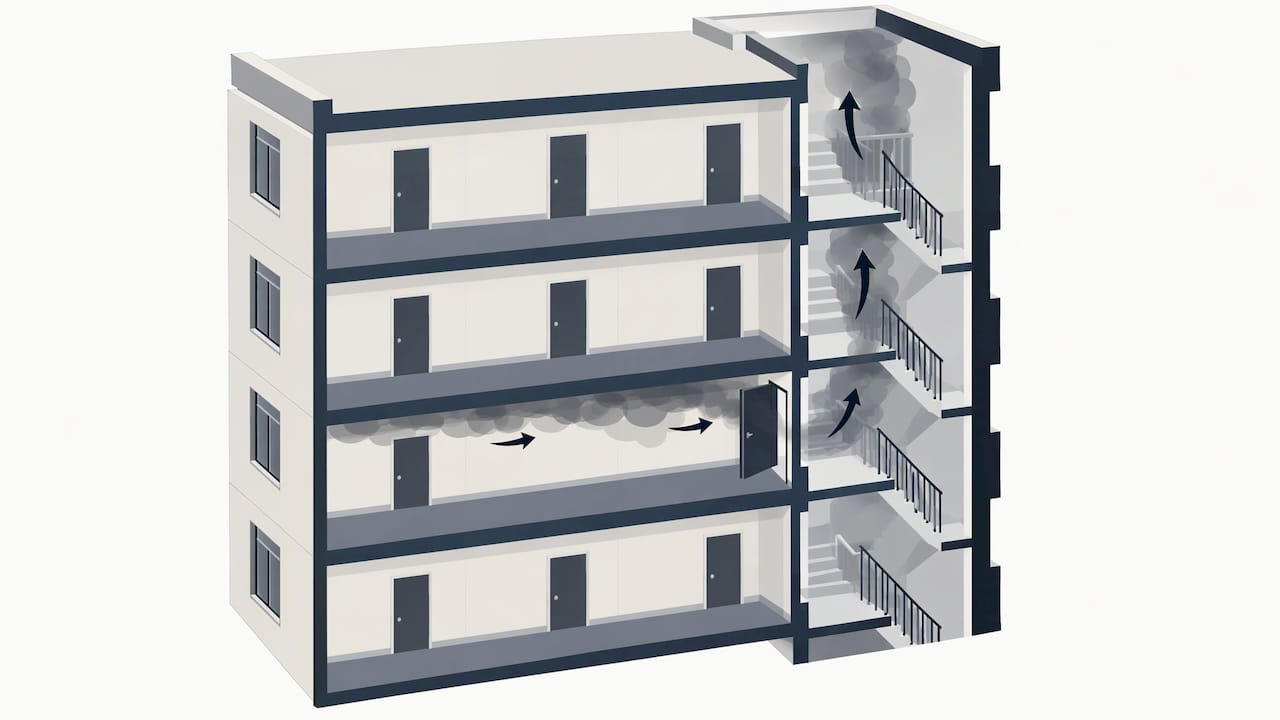
The lesson for engineers is plain. In a building like this, the stairwell door is a smoke control device, whether or not anyone calls it one.
How to test the idea yourself
You can get a feel for timing with a free tool. Our smoke layer descent calculator shows how quickly a smoke layer builds in a space. It applies to a single compartment, not a stairwell, but it shows why minutes matter.
The building: compartmentation instead of sprinklers
The building dated to 1972. According to the AP, it had sprinklers only in the compactor and laundry rooms. In an unsprinklered high-rise, a fire is not controlled by water at the point of origin. Protection depends on compartmentation: walls, floors and doors that hold fire and smoke in one area.
In that design, a self-closing door is the primary smoke barrier. Think of a self-closing door as a valve. It only works if it is closed. The AP reported that the apartment door was required by city law to be spring-loaded and self-closing. The owner said the mechanism had been checked when the lock was repaired. It was open when residents fled, and a second open stairwell door on the 15th floor let smoke sweep the building.
The University of Maryland case study draws four lessons for professionals:
- Compartmentation integrity matters most in unsprinklered 1970s high-rises.
- Stairwell chimney effects can carry smoke far from the fire floor.
- Retrofit sprinkler legislation is a policy question as well as a technical one.
- Hospitals and responders need plans for events with more than 100 patients.
The study also frames the fire as a test of government responsibility and code development. It asks whether officials will deliver substantive remedies such as retrofit sprinkler legislation, and whether fire service leaders can persuade them to invest in safety.
A door that closes by itself depends on a spring, a closer and a latch. Any of them can wear out, get disabled or be adjusted incorrectly. Doors need periodic checks for exactly this reason.
What New York City changed
We separate what was enacted from what was proposed. Everything in this section comes from city and state sources or press reports of them.
Executive action, March 2022
The mayor’s office announced an executive order directing Housing Preservation and Development (HPD) inspectors to check for the FDNY Fire Safety Notice on every apartment door during routine inspections. It also gave FDNY access to HPD’s fire-safety violation records. The release said the administration would work with the Council on retrofit sprinkler legislation and on higher penalties for falsely reported door corrections. Read the mayor’s office announcement.
City council package, may and June 2022
On May 19, 2022, the Council voted on a legislative package on fire safety. It would:
- define a self-closing door as one that returns to the closed position and latches when released;
- shorten the landlord’s correction period for violations from 21 days to 14;
- require HPD follow-up within 20 business days;
- set civil penalties for violations and for false certification of correction.
Per the Bronx Times, the mayor signed five related bills on June 1, 2022. They defined “self-closing door” in the housing maintenance code, shortened the correction time, prohibited the sale of electric space heaters without certain safety features, required FDNY space heater safety education, and waived permit fees for fire-damage alterations to one- to three-family homes.
Local Law 71: inspections of doors
The City Council’s legislative record shows Int. 0208-2022, enacted as Local Law 71. It required HPD to develop a process by July 1, 2023 to inspect self-closing doors in selected class A multiple dwellings, which are the city’s standard apartment buildings. HPD must select 300 buildings each year. The law also gave FDNY access to fire-safety violation records dating to January 1, 2017.

State law on space heaters
According to the Bronx Times, the governor signed the state’s Safety Standards for Space Heaters law on December 8, 2022. It requires thermostats, automatic shut-offs and certification. This addresses the ignition source rather than the smoke path. Both matter.
Proposed at the federal level
In January 2022, a congressional task force announced federal bills. These would have required automatic shutoff and mandatory standards for space heaters, and self-closing doors with monthly certified inspections in federally funded or regulated multifamily housing. The Norwood News review on the second anniversary describes the proposed Twin Parks North West Fire Safety Act (H.R. 6529) as a bill that would have required self-closing apartment and stairwell doors in federally assisted rental units. It describes this as a proposal. The same review notes that federal law does not require retrofitting sprinklers in older buildings unless they are substantially renovated.
What residents faced afterward
The human cost continued after the fire. City Limits reported that more than 100 families were left homeless, some with no clear timeline to return. In March 2022, the Bronx Times reported that the city released assistance to more than 150 households and designated a Melrose development as a relocation option, with moving and furniture credits for families who relocated or returned.
We include this because fire protection is judged by outcomes for people. Designs that keep a building usable after a fire protect residents beyond the night of the event.
What engineers take from Twin Parks
For designers, reviewers and operators, we see five practical points.
- Treat doors as life safety components. A door that closes only when someone remembers to close it is not a barrier. Closers, latches and hinges need maintenance.
- Check the stair as a system. Stair doors, pressure differences and the attack stair used by firefighters all interact. A single open door at the fire floor can change conditions many floors up.
- Do not assume alarms are trusted. Frequent false alarms train occupants to ignore them. Alarm design, voice messaging and clear instructions all affect what people do. Our fire alarm integration article covers how the connections work.
- Know the building’s age. Older high-rises can rely on compartmentation more than on sprinklers. Reviews of legacy buildings should start by listing which barriers carry the load. See our high-rise and multifamily pages.
- Remember tenant behavior. Residents flee, and they cannot be expected to close doors in a crisis. Passive closing has to work without human help.
This fire fits a long pattern. Many code changes follow fires where a basic safeguard failed. Our notable fires page collects others, including the One Meridian Plaza fire, a high-rise fire that also drove changes in practice.
Our perspective
We read Twin Parks as a failure of a passive system, not a failure of one family. Compartmentation is easy to forget because when it works, nothing happens. When it fails, smoke moves faster than anyone can respond.
The engineering question we ask on every existing building is simple: which element is carrying the life safety load, and how do we know it works? For some buildings the answer is a sprinkler system. For others it is a set of doors, shafts and walls drawn in 1972. Either answer needs to be written down and reviewed.
A licensed Professional Engineer stays on each of our projects from start to finish, and code questions get same-day answers. Our designs are built for the local reviewer and the authority having jurisdiction in New York, New Jersey, Pennsylvania, Maryland and Delaware. For buildings like the one in this article, that means life safety and egress analysis, smoke control design and reports on legacy systems that name the barriers a building depends on.
DGA Fire Protection Engineering
If you own or manage a building like this
If you own or operate an older multifamily or high-rise building and want an engineer to look at how its life safety features work together, our life safety and egress consulting and smoke control design teams can help. A licensed PE stays on each engagement from first scope to final stamp.

For an existing-building question, you can talk to an engineer.
FAQ
How many people died in the Twin Parks fire?
Seventeen people died, including eight children, according to the New York Times investigation. All deaths were from smoke inhalation. The fire was the deadliest in New York City in decades.
What caused the Twin Parks fire?
FDNY fire marshals determined that an electric space heater ignited a mattress in a duplex apartment. The heater had run for a prolonged period. We do not speculate beyond that official finding.
Why did smoke spread to the upper floors?
The apartment door and stairwell doors did not close, according to the Times and AP reporting. Open doors let smoke enter the stairwell, which acts like a chimney in a tall building. A university simulation showed smoke in upper hallways within 20 minutes.
Did the building have sprinklers?
The AP reported that the 1972 building had sprinklers only in the compactor and laundry rooms. Most apartments and corridors were not sprinklered. Protection relied heavily on compartmentation.
What changed in New York after the fire?
The city defined self-closing doors in law, shortened correction times, started HPD door inspections under Local Law 71 and restricted the sale of uncertified space heaters. The state set safety standards for space heaters in December 2022. Federal bills were proposed, and retrofit sprinkler legislation was discussed.
For more on how life safety requirements work, visit our Life Safety and Egress hub or the Approvals by Jurisdiction hub.
Sources
- The Chain of Failures That Left 17 Dead in a Bronx Apartment Building (The New York Times, July 2022)
- How fleeting choices, circumstances doomed 17 in Bronx fire (AP News)
- Twin Parks fire case study (University of Maryland Fire Protection Engineering)
- Council Votes on Legislative Package to Strengthen Fire Safety (NYC Council, May 2022)
- Int 0208-2022, Local Law 71 (NYC Council legislative record)
- Mayor Adams Signs Executive Order Strengthening Fire Safety Enforcement (NYC Mayor’s Office, March 2022)
- One year after the deadly Twin Parks fire (Bronx Times, January 2023)
- Federal legislative proposals on fire safety and housing quality (Bronx Task Force on Fire Safety, January 2022)
- A Look Back on Legislative Actions on the 2nd Anniversary of the Twin Parks Fire (Norwood News, January 2024)
- What’s Ahead for Tenants Displaced by Deadly Bronx Fire? (City Limits)
- Mayor’s Fund releases assistance, relocation housing available (Bronx Times, March 2022)
Recommended
- One Meridian Plaza Fire: What Happened and What Changed
- The Station Nightclub Fire: What Happened and What Changed
- Notable Fires That Changed the Fire Codes
- What Caused the Triangle Shirtwaist Fire, and Why It Killed 146
This article is general information from DGA Fire Protection Engineering, not engineering advice for a specific building or project. Code requirements vary by jurisdiction and edition. Confirm with the authority having jurisdiction or a licensed fire protection engineer before acting on it.